



Neoclassical Inlaid Credenza
A neoclassical inlaid credenza brings architectural precision and finely figured timber into a room, offering both display surface and concealed storage.

Neoclassical Inlaid Credenza
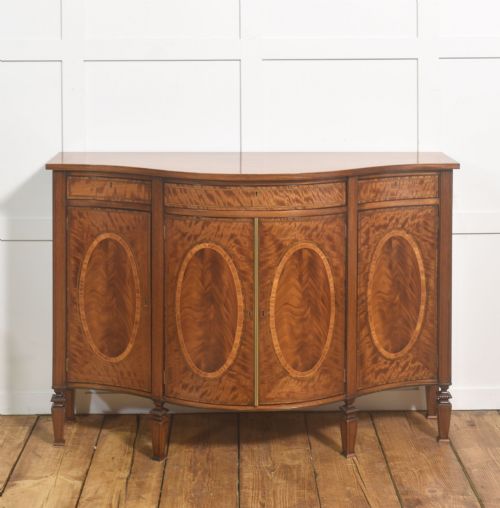
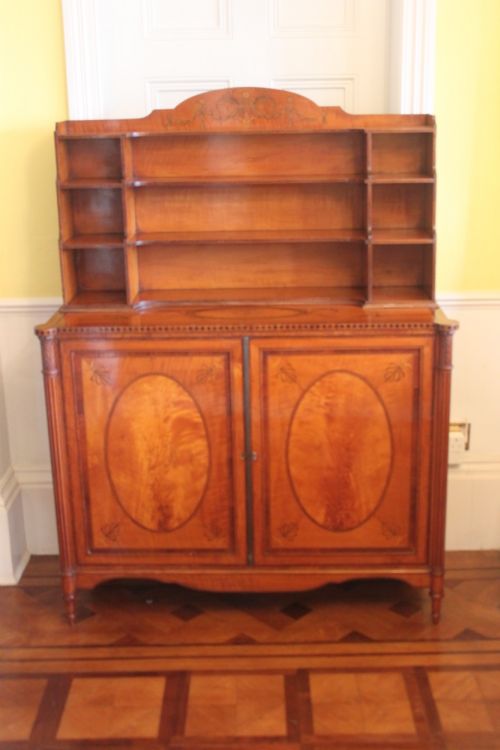
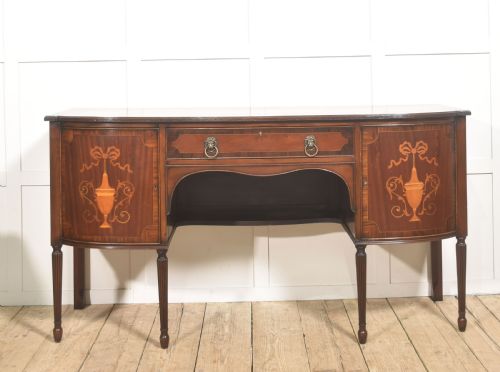
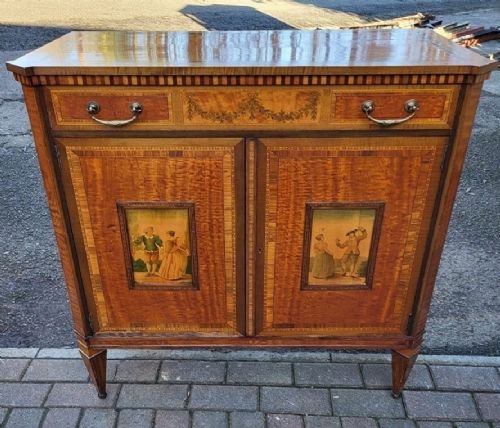
A neoclassical inlaid credenza combines classical symmetry with disciplined surface ornament, appearing in forms such as side cabinets, sideboards, commodes, and display pieces. These items surface frequently in Sheraton Revival interpretations alongside authentic George III and 18th-century pieces originating from Britain and Italy.
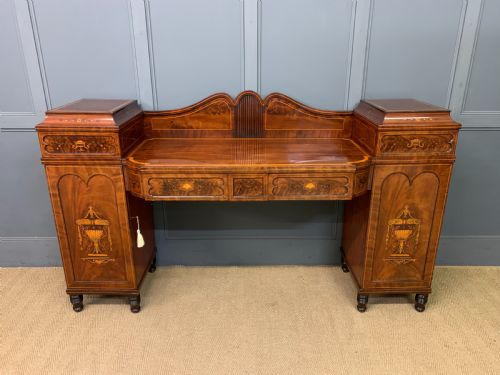
The layout typically follows a breakfront or demi-lune profile, providing a substantial footprint designed to anchor a principal reception room or dining space. Makers of the revival periods during the 19th and early 20th centuries borrowed heavily from Adam and Sheraton vocabularies to produce these balanced case pieces.
How they were made
Cabinetmakers built the carcass using stable secondary timbers before applying fine veneers of mahogany, satinwood, walnut, and rosewood. Contrasting woods like boxwood and darker species were sliced thin for linear stringing and pictorial marquetry.
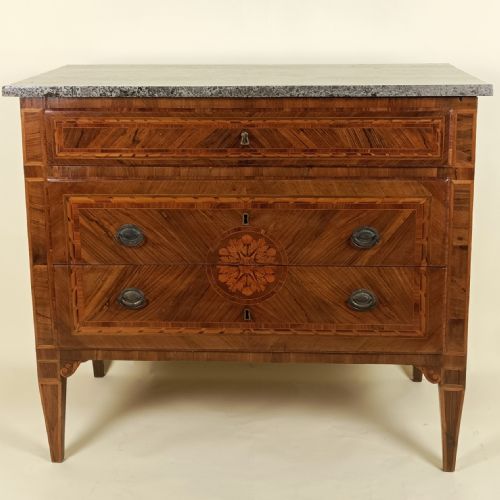
Surfaces were frequently finished with hand-cut brass mounts, handles, and occasional gallery rails. Marble tops appear on several continental European commodes and side cabinets, adding weight and a cool tactile contrast to the polished timber below.
Listings feature satinwood, mahogany, and walnut woods paired with brass and marble across various 18th-century and revival periods.
What varies in quality
The distinction between ordinary and exceptional pieces lies in the precision of the marquetry and the choice of veneer. Finer examples display tightly grained satinwood and mahogany selected for natural chatoyancy rather than uniform plainness.
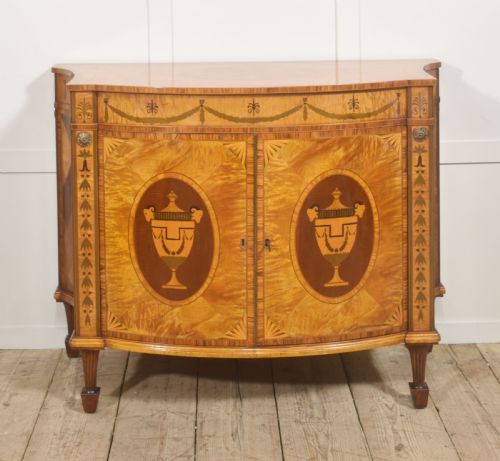
Detailing on the inlay work separates standard production from exhibition pieces, where individual floral urns, neoclassical swags, and classical urns show sharp contrast and zero filler. The crispness of carved mouldings and the seamless integration of doors within the breakfront curve determine the makerial ambition.
James Hicks·Maple and Co·Pietro Ferrario·Edwards and Roberts
The Neoclassical Inlaid Credenza Glossary
- Marquetry
- The art of forming decorative patterns by fitting together thin slices of wood veneer on a ground. This technique allows for complex pictorial scenes and geometric borders.
- Satinwood
- A lustrous, yellowish timber native to Ceylon and the West Indies, prized for its golden sheen. It serves as the primary ground for many classical revival pieces.
- Demi-lune
- A half-moon shape characteristic of side cabinets and commodes designed to stand flush against a wall. The curved front requires specialised bending techniques for the woodwork.
- Breakfront
- A cabinet design where the central section projects forward from the flanking wings. This architectural arrangement creates depth and shadow across the frontal elevation.
- Stringing
- Thin lines of contrasting wood inlaid into grooves on the furniture surface. It provides linear definition to drawers, tabletops, and cabinet doors.
Neoclassical Inlaid Credenza: Frequently Asked Questions
How do I spot a revival piece?
Revival pieces often utilise machine-cut veneers and lighter secondary woods inside the carcass compared to their 18th-century predecessors.
Examination of the internal construction and secondary timber reveals the true period of manufacture.
Where were credenzas placed?
These large case pieces historically stood against the principal walls of dining rooms and grand reception spaces.
Their flat tops served to display silver and porcelain while the cupboards stored dining linen or serving wares.
How should I care for satinwood?
Keep inlaid satinwood away from direct sunlight to prevent the golden timber from darkening and the natural resins from fading.
Dust with a dry cloth and avoid silicone-based polishes that can penetrate old veneer joints.
What defines the neoclassical style?
Neoclassical design draws upon the architectural ruins of Pompeii and Herculaneum, favouring straight lines, symmetry, and classical motifs like urns and swags.
It marks a direct reaction against the swirling asymmetry of the preceding Rococo period.