


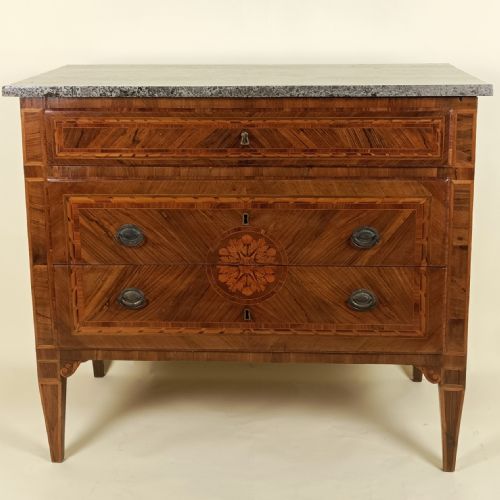
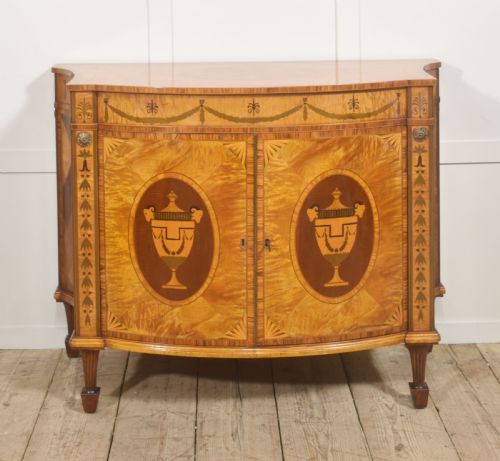


Neoclassical Inlaid Commode
A neoclassical inlaid commode brings architectural restraint and intricate timber work to a room, offering both display surface and structured storage.
Neoclassical Inlaid Commode
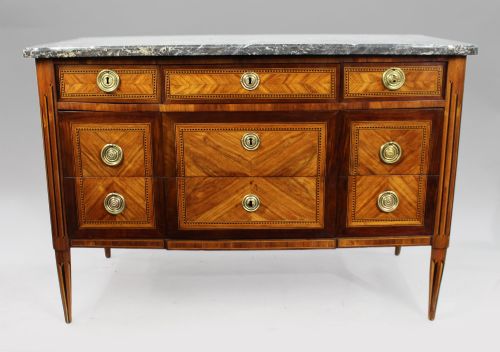
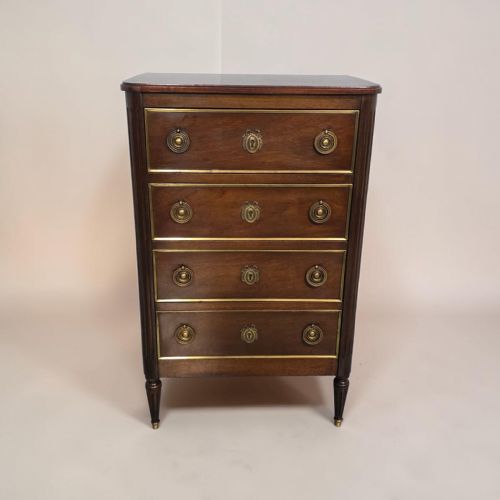
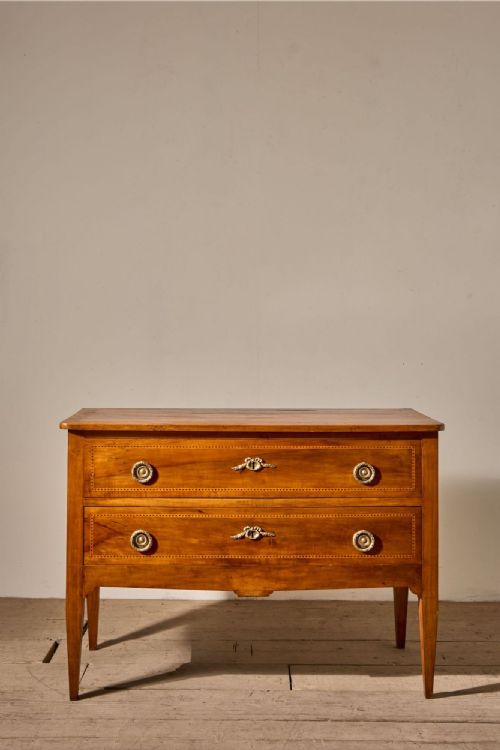
A neoclassical inlaid commode stands as a formal chest of drawers or side cabinet defined by symmetry, straight lines, and classical proportions. When searching for a neoclassical inlaid commode, a buyer meets examples ranging from eighteenth-century French and Italian originals to later nineteenth-century revivals.
The forms span straight-fronted chests, serpentine shapes, breakfront profiles, and demi-lune side cabinets. These pieces originate from workshops across England, France, Italy, Austria, Sweden, and the Netherlands.
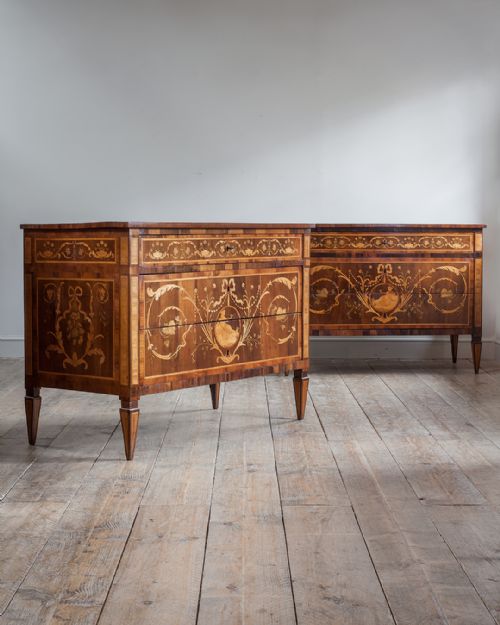
The scale and silhouette reflect the broader design shift away from heavy curves toward disciplined, classical geometry. Walnut, mahogany, satinwood, and fruitwood provide the primary timber surfaces for these geometric and floral marquetry schemes.
Materials and Construction Techniques
Cabinet makers utilised dense structural timbers such as walnut, mahogany, and oak for the carcase and drawer framing. Upon these foundations, they applied contrasting veneers of satinwood, harewood, kingwood, birch, and fruitwood to create detailed inlaid patterns.
Marquetry and parquetry techniques required precise cutting of diverse woods, including boxwood, to form pictorial or geometric motifs across the drawer fronts and top surfaces. Mounts and galleries cast in brass or ormolu frequently border the marble tops and frame the corners.
Many continental and British examples feature imported marble tops, predominantly white or grey, fitted directly onto the timber carcase. Parcel gilding occasionally highlights carved mouldings and fluted pillar details.
Some chests hide delicate secret drawers behind their decorative friezes, built specifically for storing quiet letters.
Distinctions in Quality and Execution
Quality rests in the crispness of the timber inlay and the fidelity of the classical proportions. Superior examples display tightly fitted marquetry with minimal filler, using natural tonal shifts in the veneers rather than painted lines to create depth.
The sophistication of the secondary details, such as fire-gilt ormolu mounts, heavy moulded marble tops, and secondary timber choices like oak or walnut for drawer linings, separates standard cabinet work from exhibition pieces.
James Hicks·Pietro Ferrario
The Neoclassical Inlaid Commode Glossary
- Marquetry
- Decorative veneer work arranged in pictorial or floral patterns across a surface. Different coloured timbers are cut and fitted together precisely before being glued to the carcase.
- Parquetry
- Geometric wood inlay forming repeating patterns such as cubes or lozenges. This technique creates structured surface texture on drawer fronts and top panels.
- Demi-lune
- A half-moon shape used for cabinets and commodes designed to sit flush against a wall. The curved front often carries elaborate radial veneer work.
- Ormolu
- Gilt bronze mounted onto furniture as decorative handles, feet, or corner mounts. The technique involves applying a mercury and gold amalgam to brass or bronze.
- Serpentine
- A front contour that curves outward in the centre and inward toward the ends. This undulating profile requires skilled carpentry to shape both the timber carcase and the drawers.
Neoclassical Inlaid Commode: Frequently Asked Questions
Where did neoclassical commodes originate?
Neoclassical commodes emerged across eighteenth-century European furniture centres, with distinct regional styles developing in France, Italy, England, and the Netherlands. Makers in these areas interpreted classical design rules through local timbers and traditional joinery.
Italian and French workshops frequently employed elaborate floral marquetry and marble tops, while English makers favoured satinwood and mahogany with restrained geometric stringing.
How do I style a neoclassical commode at home?
A neoclassical commode functions effectively as a focal point in a hallway, dining room, or drawing room. Its flat top and drawer capacity provide practical utility alongside strong decorative presence.
Pair the piece with simple, contemporary walls to let the wood grain and marquetry stand out. Avoid overcrowding the marble or timber top with heavy objects.
What is the difference between an 18th-century piece and a revival piece?
Eighteenth-century commodes carry the original construction methods, wear patterns, and regional timber selections of their period. They represent the active era of neoclassical design development.
Revival pieces, such as those from the later nineteenth or early twentieth century, adopt the same classical vocabulary but utilise later nineteenth- or twentieth-century workshop standards and secondary woods.
How do I care for an inlaid wood surface?
Inlaid timber requires stable indoor humidity and protection from direct sunlight to prevent the delicate veneers from lifting or fading. Keep the surface clean with a dry, soft cloth.
Avoid using silicone-based polishes or harsh chemical sprays on antique veneer. Traditional wax applied sparingly helps preserve the sheen of the wood.