



Neoclassical Gilt Candelabra
Neoclassical gilt candelabra bring architectural balance and warm metallic light to a room, drawing on classical antiquity.
Neoclassical Gilt Candelabra
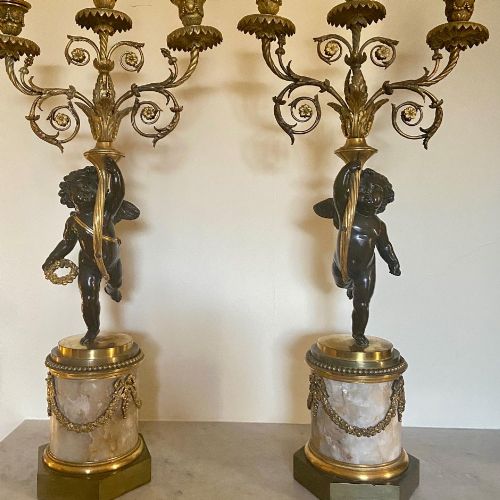
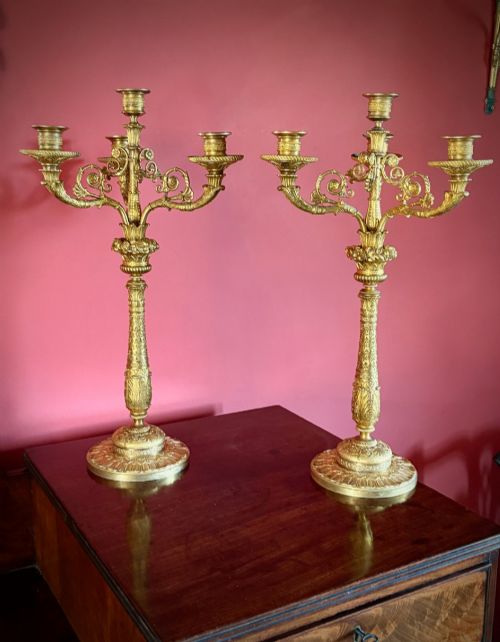
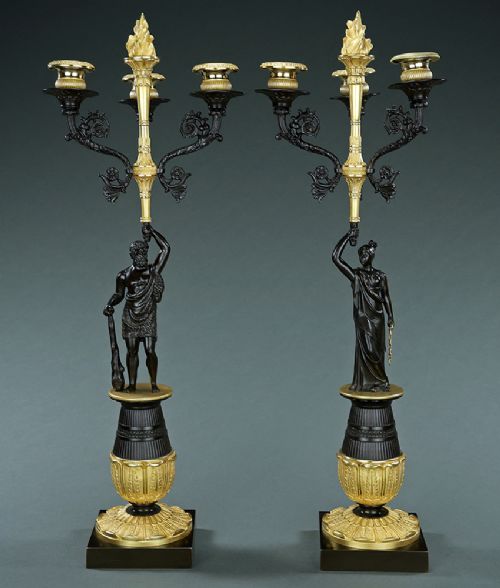
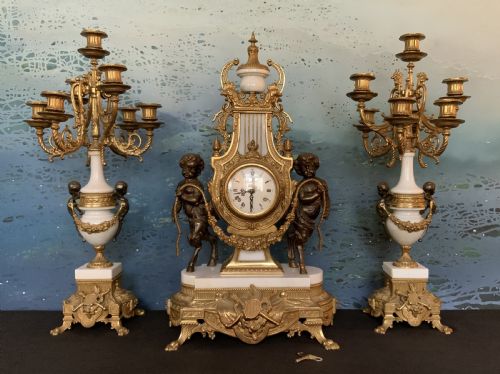
When you search for neoclassical gilt candelabra, you encounter monumental lighting pieces that draw heavily on the vocabulary of ancient Greece and Rome. The listings here present various iterations, from pairs designed for mantelpieces to parts of larger clock garniture sets.
You are most likely to meet French examples following the Empire and Louis XVI styles, alongside Regency and Swedish interpretations. These objects often take the form of multi-branched candle holders incorporating figural elements, urns, or scrolling foliage.
Many items span the nineteenth century, though earlier eighteenth-century influences and later revivals also appear among the selection. They frequently incorporate side branches for multiple candles, sometimes adapted later for electricity while retaining their original stature.
Assessing quality
Quality in these items rests upon the crispness of the bronze casting and the depth of the gilt or ormolu surface. Superior examples exhibit finely chiselled details on figures, drapery, and acanthus leaves, whereas lesser pieces show softer contours and simpler finishing.
The integration of materials also defines the hierarchy, particularly how cleanly the bronze meets the marble or slate base. Signed works or those following known models by prominent makers command greater attention through their superior proportions and heavier metal gauge.
Listings feature materials including gilt bronze, patinated bronze, white marble, brass, slate, and enamel across various nineteenth-century styles.
Francois Redmond·Rabiat·Claude Clodion·AD Mougin Paris
The Neoclassical Gilt Candelabra Glossary
- Ormolu
- Gilded bronze achieved through a mercury amalgamation technique historically used on fine mounts. This finish yields a deep, warm golden tone distinct from modern electroplating.
- Garniture
- A set of matching decorative objects, typically comprising a central mantel clock flanked by a pair of candelabra or vases. These sets dominated nineteenth-century interior display.
- Patinated bronze
- Bronze treated with chemical solutions to darken the surface, creating contrasts against bright gilt bronze details. It highlights sculptural depth in figures and foliate mounts.
- Louis XVI style
- A neoclassical aesthetic characterised by straight lines, symmetry, and classical motifs such as ribbons, urns, and fluting. It experienced major revivals during the nineteenth century.
- Candelabrum
- A multi-branched lighting device designed to hold several candles simultaneously. Larger versions often formed part of grand table settings or mantel displays.
Neoclassical Gilt Candelabra: Frequently Asked Questions
What periods do these candelabra date from?
The pieces span from the eighteenth century through the nineteenth century, with strong representation from the Empire, Regency, and later revival periods.
Later nineteenth-century interpretations sit alongside earlier models, reflecting enduring tastes for classical revival design.
Are these candelabra wired for electricity?
While many retain their original configuration for wax candles, certain examples have been adapted as lamps or electric candelabra over time.
Buyers find both traditional candle-holding formats and electrified versions designed for modern domestic lighting.
What is a clock garniture set?
A clock garniture is a matched decorative ensemble consisting of a central mantel clock accompanied by flanking candelabra or urns.
These three-piece sets were designed to sit harmoniously together on a fireplace mantel or sideboard.
How do I care for gilt bronze and marble?
Gilt bronze surfaces require gentle dusting with a soft brush, avoiding aggressive cleaning products that can strip the historic gilding.
Marble bases benefit from occasional wiping with a damp cloth, keeping moisture away from any exposed metal joins.