

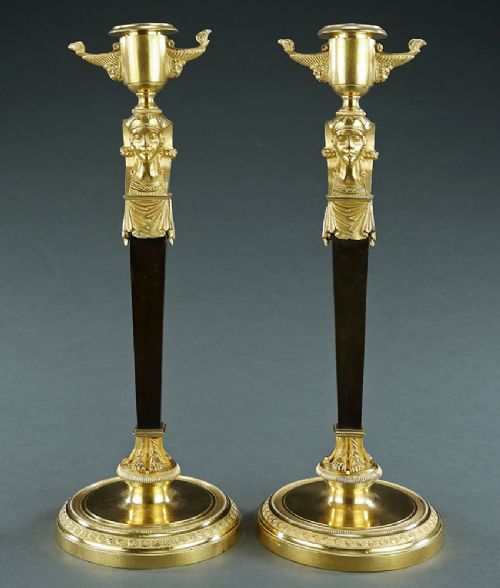


French Empire Style Candelabra
French empire style candelabra bring architectural bronze and gleaming ormolu into a room, offering striking classical proportion.
French Empire Style Candelabra
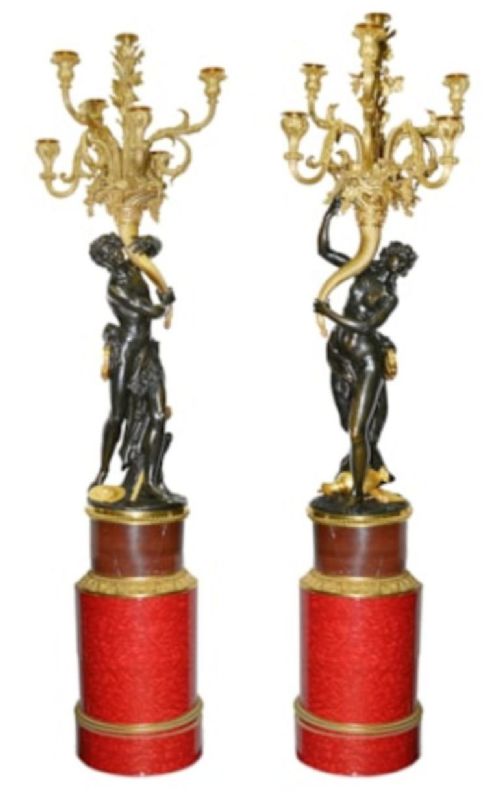
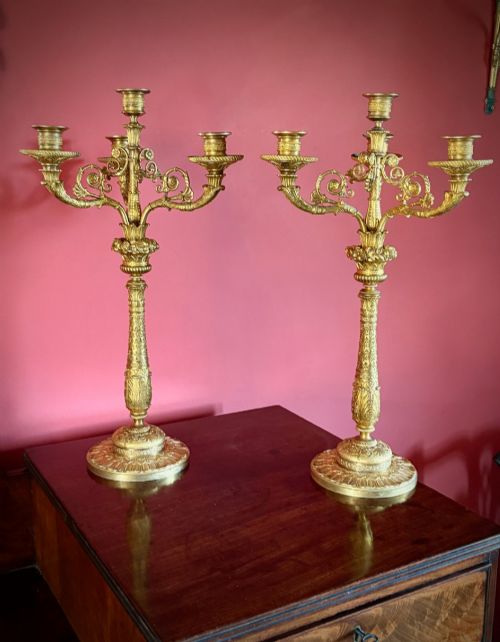
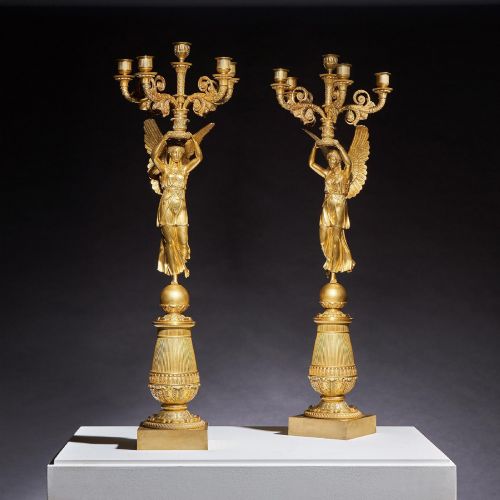
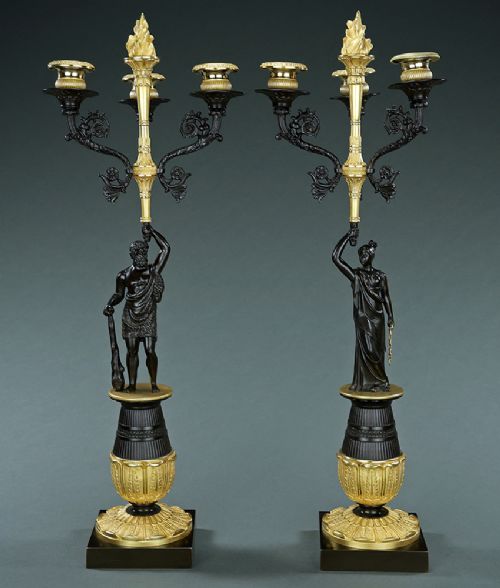
French empire style candelabra combine classical mythology with heavy metalwork, drawing heavily on ancient Roman, Greek, and Egyptian motifs. Buyers searching this phrase most frequently encounter matched pairs dating from the nineteenth century, often featuring multi-branched arms designed for formal dining tables or mantelpieces.
The selection here encompasses works ranging from substantial four-arm bronze and ormolu designs to slender marble-based pieces decorated with winged figures or classical maidens. Alongside standard candelabra, the inventory includes related items such as clock garnitures and converted table lamps sharing the same neoclassical vocabulary.
Materials and Construction
These pieces rely on a combination of patinated bronze and fire-gilded ormolu, cast in sections and secured with internal threaded rods and nuts. The contrast between dark, rich bronze figures and bright, polished ormolu details defines the visual weight of the style.
Many examples incorporate bases and columns carved from white, siena, or black marble, sometimes paired with onyx. Subsidiary elements like drip pans and nozzles are frequently cast separately and assembled by hand.
Listings feature pieces incorporating white, siena, and black marble bases alongside patinated bronze figures.
Assessing Quality
Heavier casting and tighter mechanical joints between the arms, stems, and bases separate finer workshop productions from lighter, later commercial outputs. The integrity of the original marble and the completeness of matching branch components also determine the standing of an individual pair.
Pierre Philippe Thomire·Thomas Hope·Clodion
The French Empire Style Candelabra Glossary
- Ormolu
- Finely ground high-carat gold applied to a bronze base using a mercury amalgamation technique, yielding a warm, durable metallic finish. This surface treatment is characteristic of high-end nineteenth-century French metalwork.
- Patinated bronze
- Bronze treated with chemical solutions to produce a controlled dark brown or greenish surface tone. It provides a subdued visual counterpoint to bright gilt elements.
- Clock garniture
- A matching set consisting of a mantel clock accompanied by two side pieces, such as candelabra or urns. These groups were designed to create a balanced decorative arrangement on a fireplace mantel.
- Retour d'Egypte
- A design style inspired by Napoleon's campaign in Egypt, incorporating motifs like sphinxes, pharaohs, and winged scarabs. It forms an early sub-current within the broader empire aesthetic.
- Chasing
- The manual post-casting process of refining metal surfaces with chisels and punches to sharpen details and textures. High-level chasing distinguishes master bronziers from standard foundry production.
French Empire Style Candelabra: Frequently Asked Questions
How do I clean ormolu candelabra?
Dust these pieces gently with a soft, dry brush to prevent dirt accumulation in recessed chased areas. Avoid commercial metal polishes, which can strip the thin historic gold layer from the bronze.
Moisture can damage underlying base metals and stone components. Wipe surfaces only with a barely damp cloth when necessary and dry them immediately.
Were these always wired for electricity?
Original nineteenth-century examples were designed exclusively for beeswax candles and feature removable nozzles and drip pans. Many surviving pairs were converted to table lamps during the twentieth century by running cords through the central stem.
Some conversions preserve the original candle sockets alongside wiring, while others replace them entirely. Check whether any structural alterations were made during electrification.
How do I date a pair?
Examine the casting method, the quality of the ormolu, and the assembly screws or nuts holding the structure together. Hand-cut threads and heavy, finely chased bronze usually point to the first half of the nineteenth century.
Later nineteenth-century reproductions often feature machine-standardised threads and simpler surface finishing. Accompanying marble types and stylistic markers like Napoleonic symbols also help narrow the production window.
What is a clock garniture set?
A clock garniture is a matched decorative ensemble designed to sit together across a mantelpiece or sideboard. The central clock is flanked by two matching side objects, most commonly candelabra or urns.
These sets were produced in workshops across Paris to unify interior decoration schemes. All three pieces share identical materials, patination, and decorative motifs.