






Navy Blue Border Carpet
A navy blue border carpet grounds a room with deep indigo framing, anchoring traditional Persian and Caucasian room-size floors.
Navy Blue Border Carpet
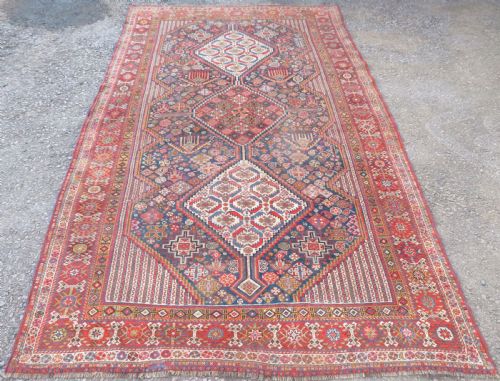
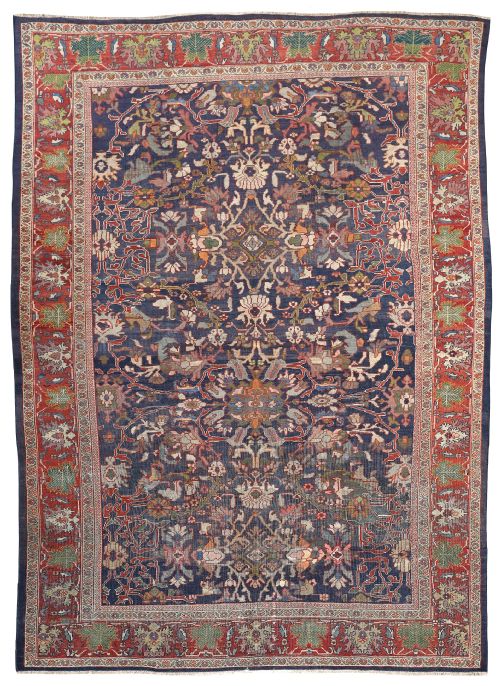
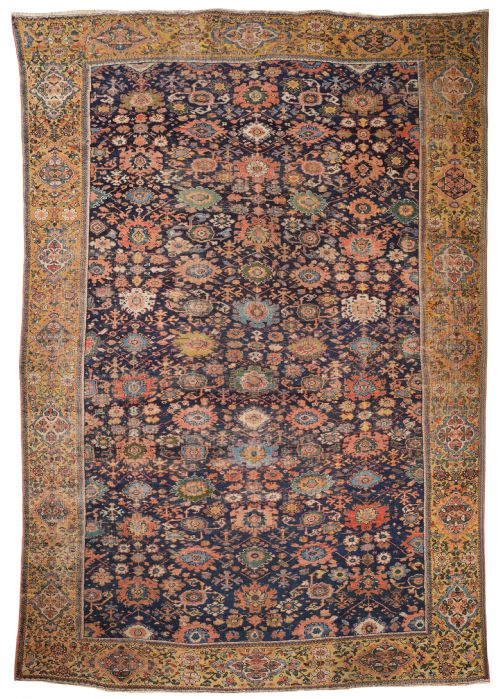
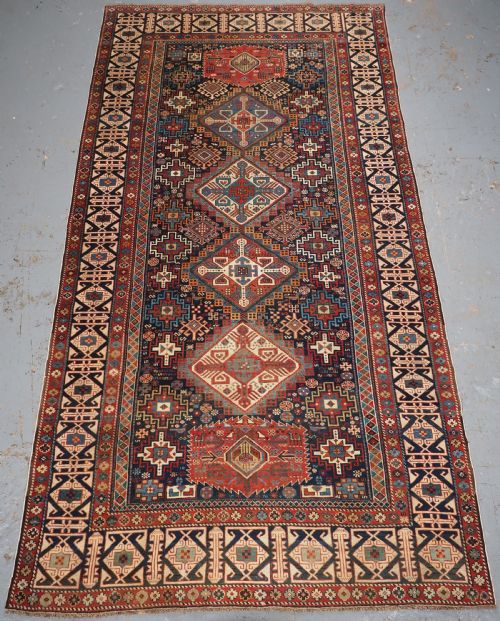
A navy blue border carpet brings together large room-size dimensions, runner formats, and square room-size formats framed by dark indigo framing. When searching for a navy blue border carpet, buyers examine hand-knotted room-size carpets and long gallery carpets originating from Persian weaving centres and Caucasian workshops. These floor coverings date from the mid-nineteenth century through to the early decades of the twentieth century.
The material composition relies on wool, hand-spun wool, and cotton foundations that sustain heavy foot traffic while retaining structural integrity. Heriz, Serapi, Sultanabad, and Kirman workshops dominate the available selection, alongside regional tribal pieces from Khamseh, Bakhtiar, and Kurdish weavers. The resulting inventory provides decorators with room-sized formats and narrower gallery runners defined by strong indigo or navy margins.
Quality and Execution
The fineness of the knotting and the complexity of the border drawing dictate the primary tier of execution within these Persian and Caucasian carpets. Superior examples display precise geometric or floral medallions where the navy blue border maintains consistent saturation and sharp contouring.
Secondary factors involve the regularity of the weave across large formats and the preservation of original selvedges and end finishes. Pieces with high wool quality retain a supple handle and distinct abrash variation, whereas lower tiers show stiffness or uneven wear to the pile.
Listings span 1850 to 1920, featuring wool, cotton, and hand-spun wool across Persian and Caucasian regional workshops.
The Navy Blue Border Carpet Glossary
- Abrash
- Natural tonal variation within a single colour field, caused by differences in dye batches or hand-spun wool. This subtle streaking adds visual depth to the indigo border.
- Warp
- The vertical threads stretched lengthwise on the loom that form the structural foundation of the carpet. Cotton warps provide the rigid framework for heavier room-size weaves.
- Weft
- The horizontal threads passed across the warps after each row of knots to bind the structure. They secure the pile in place and determine the rigidity of the rug.
- Selvedge
- The bound edge finishing along the lengthwise sides of the carpet that prevents fraying. Original selvedges indicate a well-preserved textile.
- Medallion
- A large central ornamental design motif placed in the middle of the carpet field. It often dictates the stylistic relationship between the core design and the surrounding border.
Navy Blue Border Carpet: Frequently Asked Questions
How do I place a room-size carpet?
Position the carpet so that the major furniture groupings sit comfortably on the field, allowing the navy blue border to frame the seating area clearly.
Keep sufficient bare floor perimeter exposed to highlight the contrast between the dark border and your room's flooring.
What distinguishes Heriz from Serapi carpets?
Serapi carpets typically display slightly earlier nineteenth-century weaving traits with bolder, more open geometric medallions and calmer fields.
Heriz carpets tend to feature finer knot density and tighter, more intricate corner spandrels within the dark border framework.
How should I clean my antique carpet?
Vacuum gently using suction attachment only, avoiding the rotating brush bars that can pull at hand-spun wool pile and weaken cotton foundations.
Arrange for professional textile cleaning by specialists familiar with antique natural-dyed Persian rugs every few years.
Can I use a gallery runner in a hallway?
Long gallery carpets and runners fit well in corridors and high-traffic transitional spaces, provided you install an appropriate non-slip underlay beneath.
The sturdy wool construction handles daily walking while the dark framing conceals transitional wear effectively.