

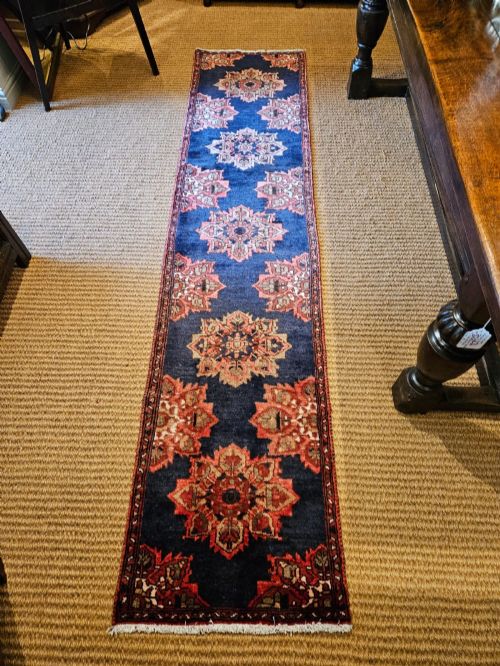
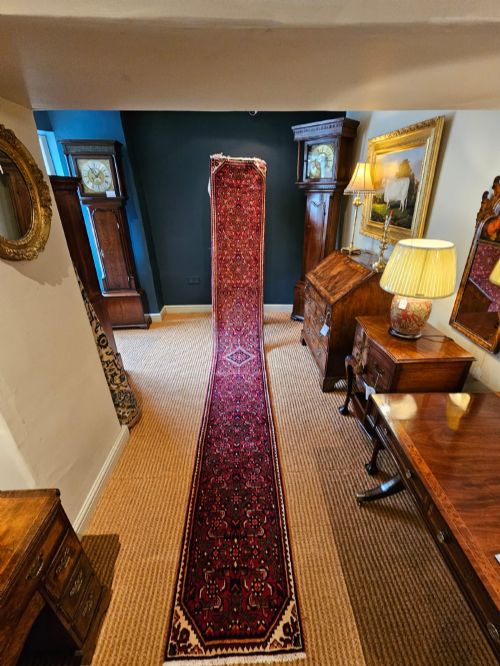
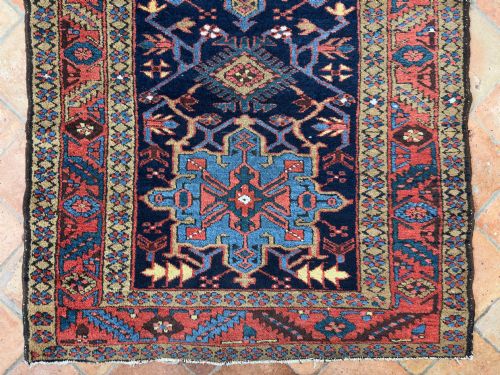


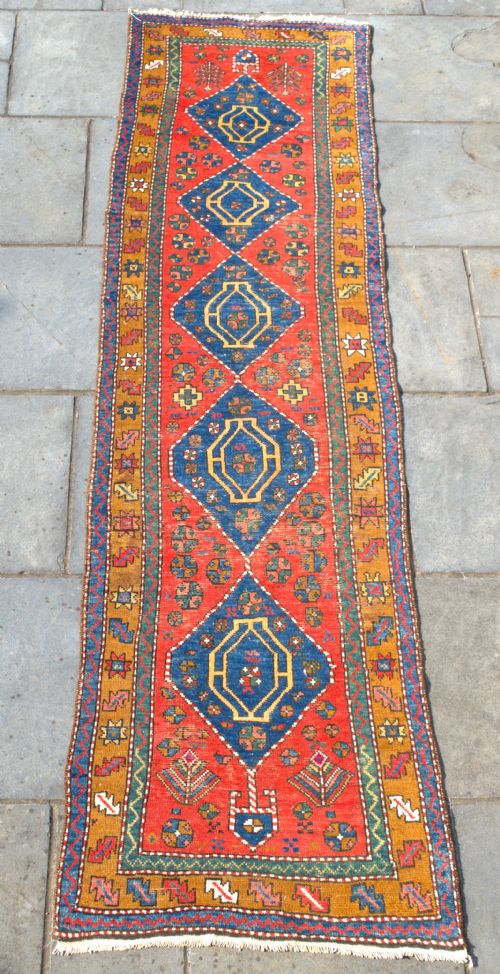

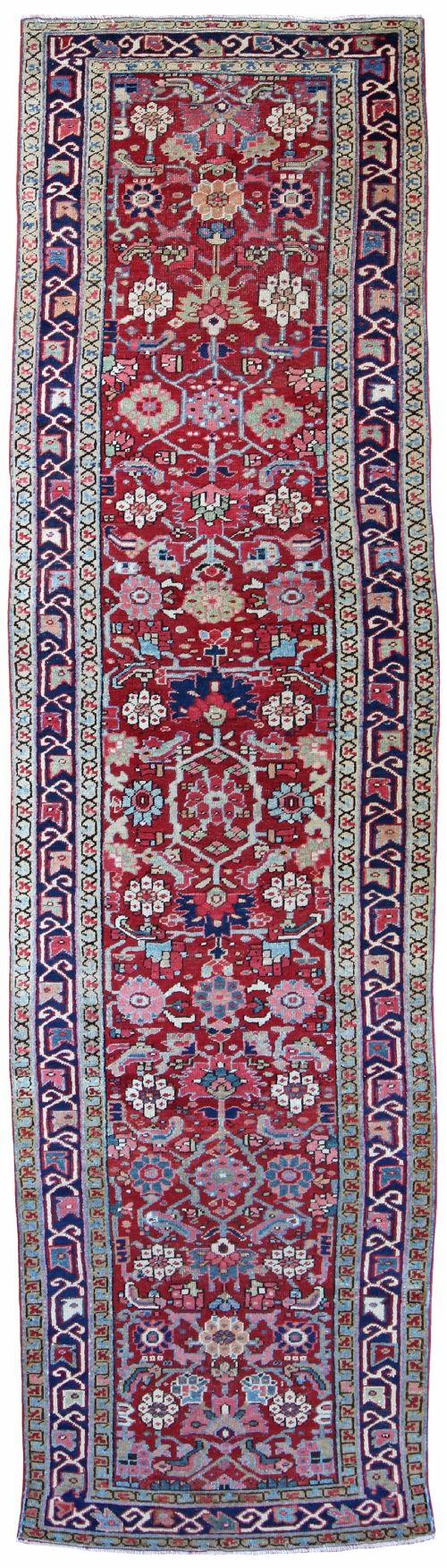


Narrow Persian Floor Rug
These narrow persian floor rug examples bring disciplined pattern and narrow proportion to long corridors, shaped from wool and cotton.
Narrow Persian Floor Rug
A narrow persian floor rug provides linear coverage for hallways and passages, appearing primarily as antique runners from the nineteenth and early twentieth centuries. These pieces span specific regional styles including Heriz, Bidjar, Karaja, Hamadan, and Kurdish traditions from North West Persia.
The format focuses on elongated proportions designed for floors rather than open rooms. Listings show lengths stretching well beyond four metres alongside narrower widths suited to traditional hallway spaces.
Makers and weavers working in these Persian regions employed durable floor coverings that balance utility with traditional geometric and floral motifs. The pieces surviving now reflect decades of domestic use in red, blue, and mellow colour palettes.
How they were made
Construction relies upon traditional hand-knotting techniques using natural materials recorded as wool and cotton. Wool forms the pile and foundation structure, offering resilience for high-traffic hallway placement.
Weavers utilised foundational cotton warps and wefts to stabilize the elongated format of each runner. This material combination maintains structural integrity across spans exceeding fourteen feet while holding dyed wool piles securely.
Narrow Persian Floor Rug Retail Price Guide 2026
Typical asking prices for narrow persian floor rug among the pieces listed under this phrase on Sellingantiques today, from the lower quarter to the upper quarter. They describe what is for sale here now, not the wider market.
Current listings span periods from the 1870s through the 1930s, constructed entirely from wool and cotton materials.
What varies in quality
Quality rests upon the crispness of the regional design execution and the retention of pile across the elongated field. Finer examples maintain structural balance along extreme lengths without distortion.
The selection of dyestuffs and the density of the wool pile determine how well the pattern reads over large expanses. Variations in weave tightness distinguish standard domestic utility pieces from finer woven workshop productions.
The Narrow Persian Floor Rug Glossary
- Runner
- A long, narrow carpet format designed specifically for corridors, hallways, and staircases. This layout appears frequently across nineteenth and early twentieth century Persian floor coverings.
- Pile
- The upright yarn loops or cut ends that form the soft surface of a carpet. In these pieces, wool pile provides both warmth and durability underfoot.
- Warp
- The vertical threads stretched tightly on the loom before knotting begins. Cotton warps form the rigid skeleton supporting the entire runner structure.
- Weft
- The horizontal threads passed back and forth between warp threads to lock the knots in place. This technique secures the structural width of the carpet.
Narrow Persian Floor Rug: Frequently Asked Questions
Where do narrow Persian runners work best?
These elongated floor coverings fit naturally into corridors, long hallways, and narrow landing spaces where standard square carpets fail to reach.
The narrow proportions allow the pattern to guide the eye down architectural passages while protecting high-traffic wooden floorboards.
How do I care for an antique wool runner?
Regular gentle vacuuming without a rotating brush roll keeps surface dust from settling deep into the wool pile.
Professional cleaning tailored to antique textiles preserves the natural lanolin in the wool and protects the cotton foundations.
What periods do these runners date from?
The pieces available here primarily date from the late nineteenth century through the early decades of the twentieth century.
Production periods span across the 1870s up to the 1930s, reflecting traditional regional weaving practices.
What materials are used in their construction?
The physical evidence recorded in these listings shows construction entirely in wool and cotton.
Wool provides the dense surface pile, while cotton supplies the stable foundation threads running the length and width.