

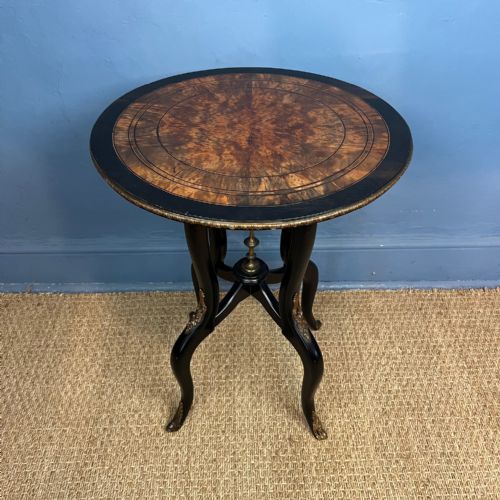
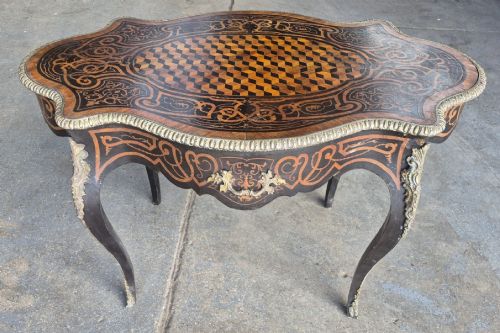
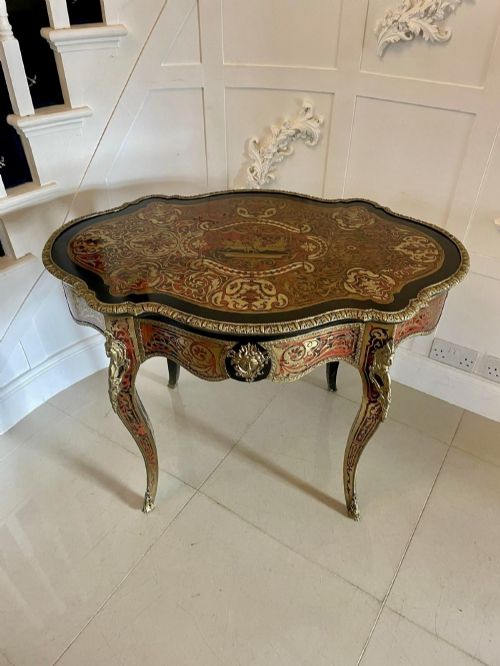
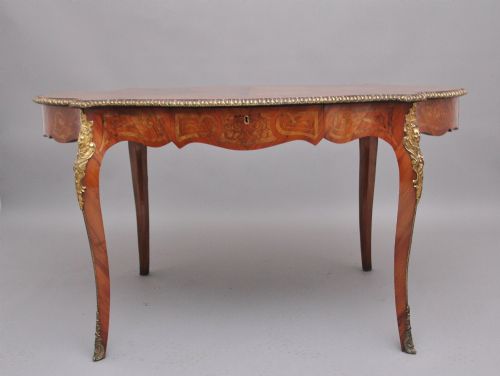
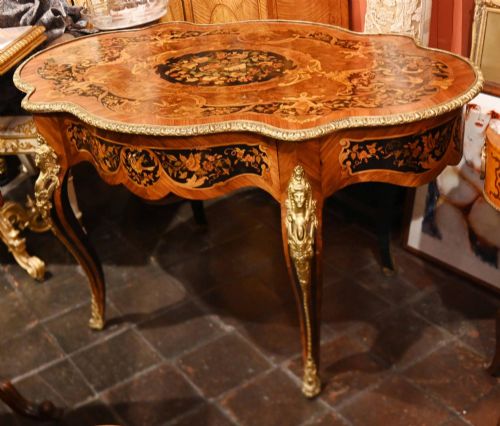

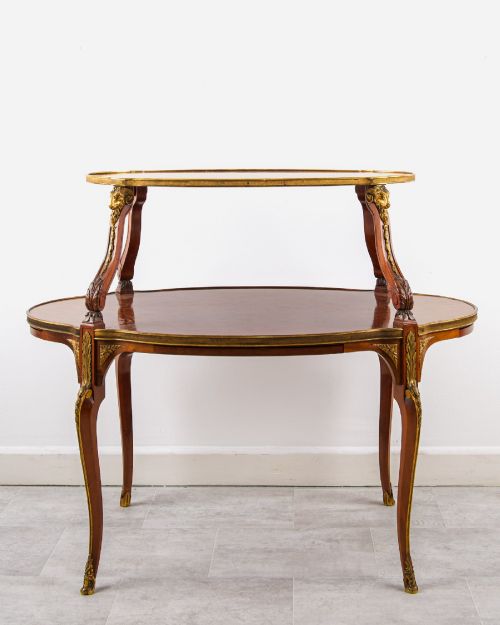


Napoleon III Centre Table
A napoleon iii centre table brings French Second Empire opulence into a room with striking brass inlay and polished woods.
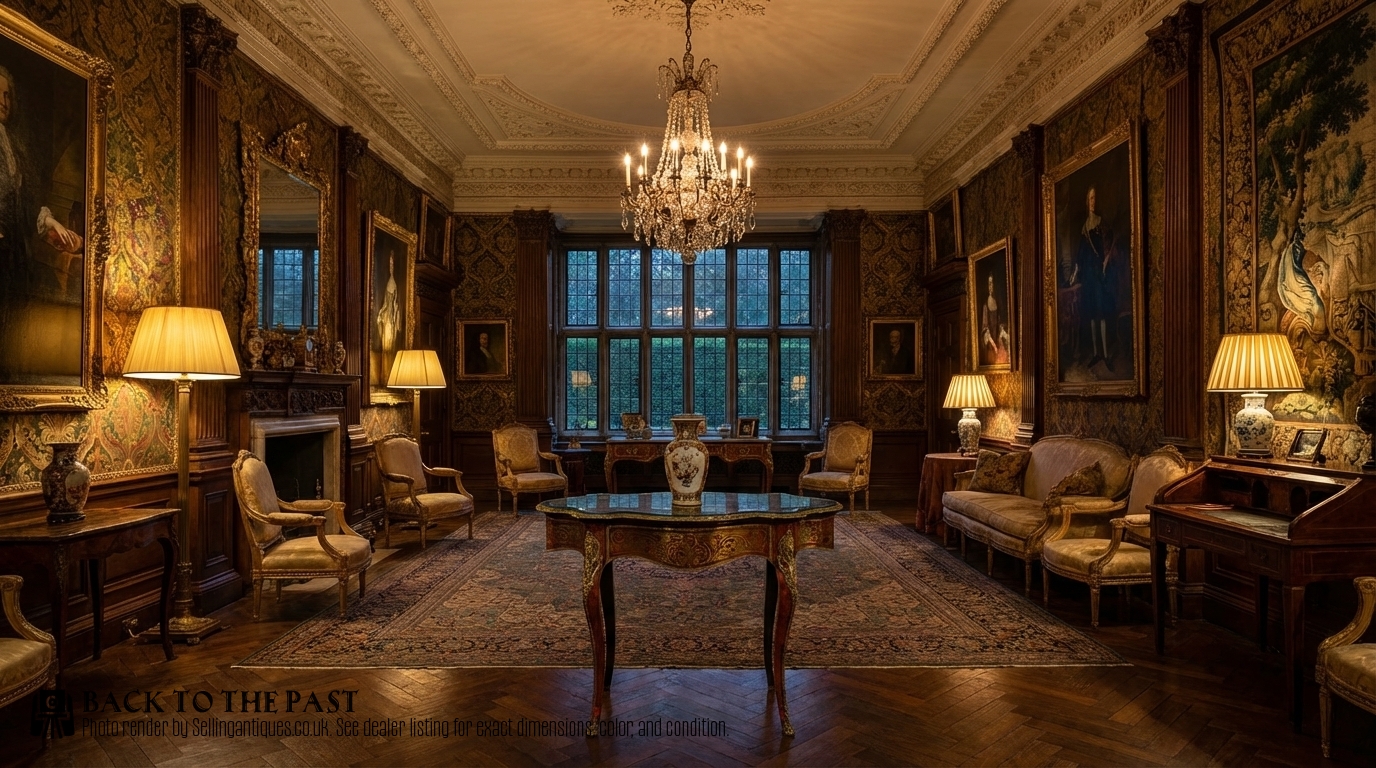
Napoleon III Centre Table
A napoleon iii centre table sits freestanding in a room, designed to be admired from every angle rather than pushed against a wall. The pieces collected here span the nineteenth century, capturing the decorative revivals popular during the French Second Empire.
Most examples you encounter on this page take the form of centre tables, writing desks, or smaller occasional tables. Walnut, rosewood, and ebonised wood provide the dark foundations for intricate surface decoration.
Cabinetmakers of this period drew heavily on earlier Louis styles, incorporating curved rococo lines and disciplined neoclassical geometry. The resulting tables served as centrepieces for formal nineteenth-century interiors.
Materials and Construction
The construction relies on dense timbers like rosewood, walnut, and mahogany, often forming the base for elaborate marquetry and parquetry patterns. Ebonised wood is frequently paired with inlaid brass to create high-contrast surfaces.
Inlaid floral motifs and geometric designs cover the tops and aprons, secured with traditional adhesives and joinery of the period. Sevres style porcelain plaques occasionally inset into the timber add a touch of painted colour.
Napoleon III Centre Table Retail Price Guide 2026
Typical asking prices for napoleon iii centre table among the pieces listed under this phrase on Sellingantiques today, from the lower quarter to the upper quarter. They describe what is for sale here now, not the wider market.
Materials recorded across the inventory include ormolu, ebonised wood, brass, walnut, tortoiseshell, rosewood, porcelain, and gilt bronze.
Assessing Craftsmanship
The refinement of the ormolu mounts dictates much of the visual weight and finish, distinguishing sharply cast bronze from softer, simpler metalwork. Crisp chasing on the gilt bronze shows the hand of a skilled artisan rather than mass production.
Marquetry execution varies from straightforward geometric repeats to complex, finely shaded floral scenes rendered in multiple exotic woods. The precision of the brass inlay in Boulle pieces reveals whether the metal and tortoiseshell fit together without gaps.
Subtle differences in timber selection and the depth of the French polish affect how light plays across the surface of the table. Tables bearing signatures from established Parisian workshops generally display greater attention to internal framing and finishing.
Maison Millet·A. Beurdeley·Zwiener Jansen Sucesseur
The Napoleon III Centre Table Glossary
- Boulle
- A method of marquetry using brass and tortoiseshell inlaid together, named after the cabinetmaker André-Charles Boulle. The technique allows pieces to be cut in opposing positive and negative patterns.
- Ormolu
- Gilded bronze applied to furniture as mounts, feet, and decorative trims. This metallic ornamentation gives definition to the structural corners and aprons of nineteenth-century tables.
- Marquetry
- The art of applying small pieces of veneer to a structure to form decorative patterns and pictures. Craftsmen selected woods of varying natural tones to achieve shading without paint.
- Bureau Plat
- A freestanding writing table fitted with a flat top, often lined with leather. These tables frequently double as centre tables due to their finished backs and drawers.
- Guéridon
- A small round table supported by a central column or several legs. Nineteenth-century examples often feature marble tops bordered by gilt-bronze galleries.
Napoleon III Centre Table: Frequently Asked Questions
What is a napoleon iii centre table?
A napoleon iii centre table is a freestanding nineteenth-century French table built to stand in the middle of a room. These pieces showcase elaborate surface decoration including marquetry, brass inlay, and ormolu mounts.
They reflect the revivalist tastes of the Second Empire, drawing inspiration from earlier royal French periods. Their versatile forms served as writing desks, display surfaces, and focal points in formal interiors.
Where should I place a centre table?
These tables belong in the middle of a principal room where their detailed decoration can be seen from all sides. They function well in drawing rooms, large studies, or entrance halls as decorative and practical surfaces.
Because they are finished on all sides, they do not require placement against a wall. Keep them away from direct sunlight and heat sources to protect the polished wood veneers and tortoiseshell.
How do I care for ebonised wood?
Dust ebonised and polished wood surfaces regularly with a soft, dry cloth to prevent dust accumulation. Avoid using modern aerosol polishes, which can build up a hazy film over the dark finish.
Maintain a stable room humidity to prevent the underlying timber from expanding and cracking. Gentle cleaning with appropriate furniture wax preserves the deep sheen of the ebonised finish.
How do I distinguish Boulle work?
Boulle work is identified by the distinctive combination of tortoiseshell and cut brass inlaid into a dark wooden surface. The technique creates a luminous, reflective pattern across the top and sides of the table.
First-century makers cut these materials together to form matching positive and negative sheets. Inspect the joints between the metal and shell to appreciate the precision of the hand-cut design.