
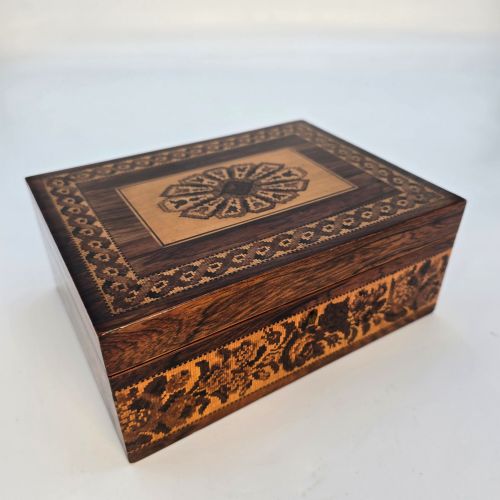


Mosaic Wood Box
These mosaic wood box examples are intricate works of craftsmanship that bring tactile history and meticulous geometric pattern into a modern room.
What a mosaic wood box is
When you search for a mosaic wood box, you encounter nineteenth-century English and Anglo-Indian receptacles designed for stationery, trinkets, or games. These pieces display elaborate surface decoration built from tiny wood blocks or micro-mosaics.
The most frequent examples on this page belong to the Victorian period, specifically originating from Tunbridge Wells. They take the form of ladies boxes, small trinket boxes, and cribbage boxes.
Earlier archive examples extend to Anglo-Indian stationery and writing boxes featuring sandalwood and Sadeli mosaic. Every version serves as a functional desktop or vanity accessory.
Materials and construction
These items rely on dense cabinet timbers like rosewood, walnut, and sandalwood for their foundational structure. Woods such as boxwood, ebony, holly, and sycamore provide the contrasting tones necessary for the geometric patterns.
Craftsmen assembled miniature wooden rods in precise geometric arrangements, slicing them into thin mosaic veneers. These delicate picture panels and borders were then applied directly to the exterior surfaces of the boxes.
The object forms recorded under this search encompass functional desk accessories, including stationery boxes, ladies trinket chests, and dedicated cribbage boards.
Assessing quality
Quality rests upon the microscopic precision of the timber tesserae and the complexity of the pictorial or geometric motif. Finer boxes display hundreds of individually shaped wooden blocks creating sharp architectural or floral perspectives without visible gaps.
The choice of primary timber also dictates the tier of the piece, with richly grained rosewood and fragrant sandalwood supporting the most elaborate exterior decoration. Simpler borders contrast with panoramic lid scenes that require extraordinary patience from the maker.
The Mosaic Wood Box Glossary
- Tunbridge Ware
- A specialised form of nineteenth-century decorative woodwork originating from Kent, characterised by mosaic veneers depicting landscapes, flora, and geometric tessellations. It relies on contrasting natural timber colours rather than pigments.
- Sadeli mosaic
- An intricate micro-mosaic technique utilising tiny pieces of horn, bone, ivory, and stained woods arranged in geometric bands. This craft is predominantly associated with nineteenth-century Anglo-Indian luxury goods.
- Tessera
- An individual small block of wood, ivory, or bone used to construct the mosaic surface of the box. Artisans grouped thousands of these tiny elements together to form a cohesive picture.
- Cribbage box
- A specialised Victorian games box fitted with internal compartments for playing cards and cribbage pegs. The lids often incorporate scoring tracks marked directly into the timber surface.
Frequently Asked Questions
What were these boxes used for?
Victorian households utilised these decorative containers to store personal letters, postage stamps, sewing implements, and small trinkets on desks and dressing tables. Games variations housed playing cards and counters for evening entertainment.
Their sturdy timber construction protected delicate contents from dust and light while adding ornamental elegance to a parlour or study.
How do I care for a wooden mosaic box?
Keep the box away from direct sunlight and radiators to prevent the dry heat from shrinking the timber or loosening the microscopic mosaic tesserae. Dust gently with a dry, soft cloth and avoid liquid polishes entirely.
Maintaining a stable indoor humidity protects the historical glues and delicate wooden veneers from warping or cracking over time.
How do I identify a Tunbridge Ware box?
Look for characteristic geometric or floral mosaic borders built from countless tiny blocks of naturally coloured woods like holly, sycamore, and ebony. Many pieces feature a distinctive label on the underside from prominent manufacturing establishments.
Advanced specimens display miniature pictorial panels of castles, butterflies, or local Kent views inset directly into the lid.
What is Anglo-Indian Sadeli mosaic?
Sadeli mosaic is a meticulous craft developed in nineteenth-century India, featuring intricate geometric patterns assembled from minute prisms of wood, bone, and horn. These complex strips were bound together and sliced into thin veneers for decorative boxes.
This technique contrasts with English Tunbridge Ware through its use of alternate materials and mesmerizing, kaleidoscopic repeat patterns.