
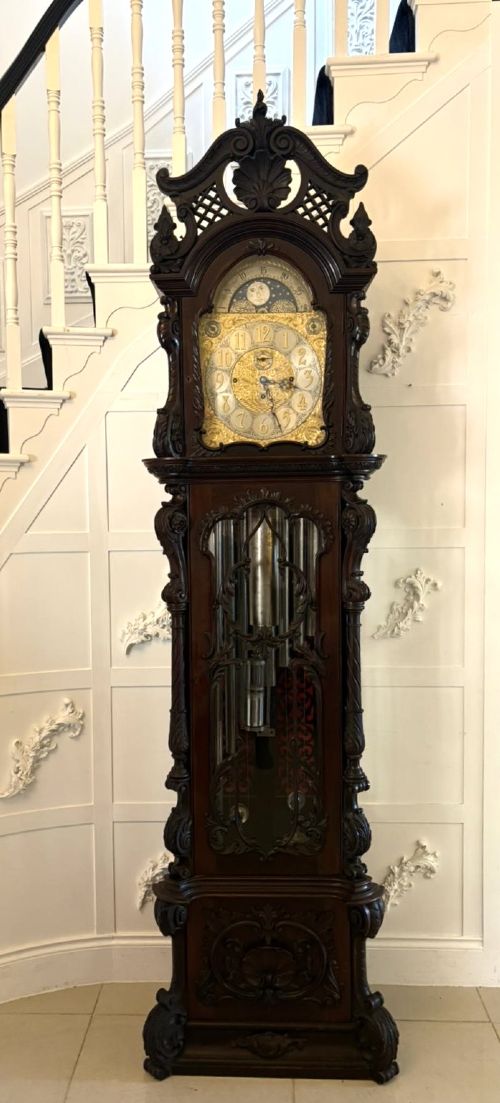
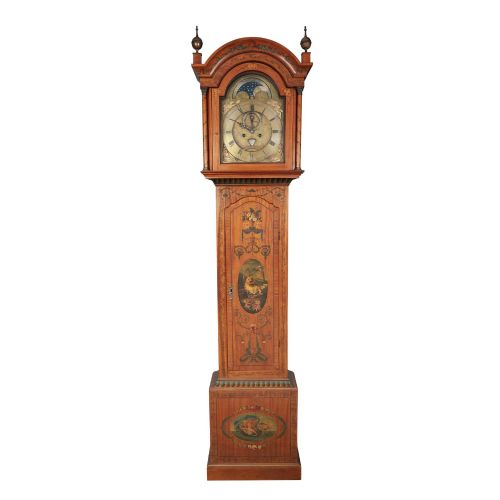
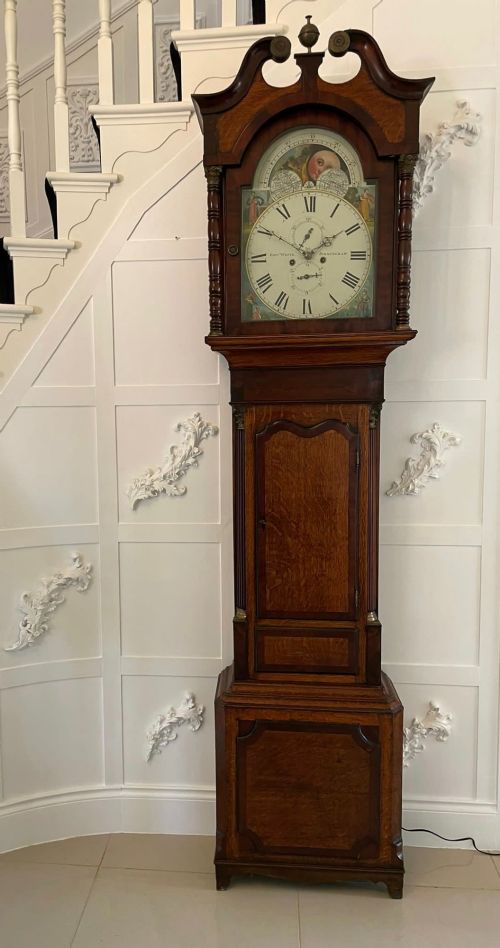
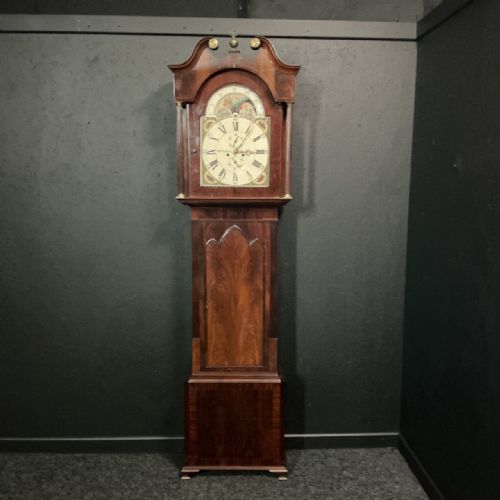


Moon Phase Tall Clock
A moon phase tall clock brings centuries of mechanical tracking into your hallway, showing the lunar cycle alongside the passing hours.
Moon Phase Tall Clock
When you search for a moon phase tall clock, you encounter floor-standing timepieces that combine standard hour tracking with a rotating painted disc representing the age and phase of the moon. These mechanisms sit inside tall wooden cases designed to protect the pendulum and weights.
The versions most common on this page date from the Georgian and Victorian eras, stretching from the mid-eighteenth century through the nineteenth century. Makers constructed these longcase clocks in oak, mahogany, and satinwood, often housing brass dials and painted iron movements.
Regional British makers from Birmingham, Manchester, Liverpool, and Scotland signed their dials on these tall clocks, showing how local craftsmanship adapted London styles. You find both eight-day movements that require weekly winding and simpler rolling moon mechanisms.
How they were made
Cabinetmakers built the tall cases using solid timbers such as mahogany and oak, occasionally incorporating satinwood stringing and inlay. These woods provided the structural rigidity needed to house heavy mechanical movements and long pendulums.
Dial faces combined brass chapters with painted iron plates, where artists rendered lunar scenes by hand using oil paints. Steel components drove the intricate gear trains, while glass protected the dial face from dust and damage.
Listings feature mahogany, oak, brass, and painted iron, spanning the Georgian and Victorian periods.
What varies in quality
The refinement of the cabinetwork separates standard examples from exceptional pieces, particularly in the selection of figured mahogany grain and the precision of inlaid details. Dials painted with detailed lunar landscapes and signed by recognised regional makers command greater attention than utilitarian alternatives.
The complexity of the internal movement dictates the tier of the clock, ranging from basic penny moon indicators to rolling moon mechanisms that track the lunar month accurately over twenty-nine and a half days. Original signed brass backplates and clean gear trains preserve the integrity of the piece.
Edward White Birmingham·Edward Shepley·Will Lassell·Thos Russell Lancaster·Furnival Oldham·Thomas Dean·Stanyer Nantwich·R Lawson·John Wood·Henry Smith·William Mercer·David Griffith·John Wyat
The Moon Phase Tall Clock Glossary
- Moon phase
- A mechanical display on the dial showing the visible shape of the moon as it waxes and wanes. This disk rotates twice every fifty-nine days to match the lunar cycle.
- Longcase clock
- A tall pendulum clock housed in a wooden case designed to rest directly on the floor. These instruments are frequently referred to as grandfather clocks.
- Penny moon
- A simple form of lunar display featuring a single painted moon disk visible through a semicircular aperture in the dial arch. It offers a clear visual indicator without complex gear ratios.
- Rolling moon
- A mechanism utilising two identical painted moons on a rotating disc that moves behind the dial arch. This setup tracks the lunar month more comprehensively than a single aperture indicator.
- Quarter chiming
- A movement capability that sounds the time on bells or tubes at each quarter hour interval. Such systems require larger case designs to accommodate additional weight trains.
Moon Phase Tall Clock: Frequently Asked Questions
How does the moon mechanism work?
The moon mechanism relies on a rotating disk behind an arched aperture on the dial face, driven by the clock's internal gear train. Two painted moons on the disk appear sequentially to show the lunar phase.
This display steps forward once every twenty-four hours, completing a full revolution every twenty-nine and a half days to mirror the lunar month.
Where were these clocks made?
These clocks originated in workshops across Britain, with regional centres in cities like Liverpool, Manchester, Birmingham, and various Scottish towns. Local makers sourced timber and built movements to order.
Makers often signed directly on the painted iron or brass dial faces, recording their workshop locations alongside their names.
How do I care for a tall clock?
Caring for a tall clock involves keeping it on a stable floor surface away from direct sunlight and damp conditions to protect the wood and movement. Winding requires pulling the weights upward at regular intervals depending on the movement type.
Professional servicing every few years ensures the brass gears and steel pivots remain clean and properly lubricated.