




Miniature Grandfather Clock
A miniature grandfather clock brings the presence of a full-size timepiece into a fraction of the floor space.
Miniature Grandfather Clock
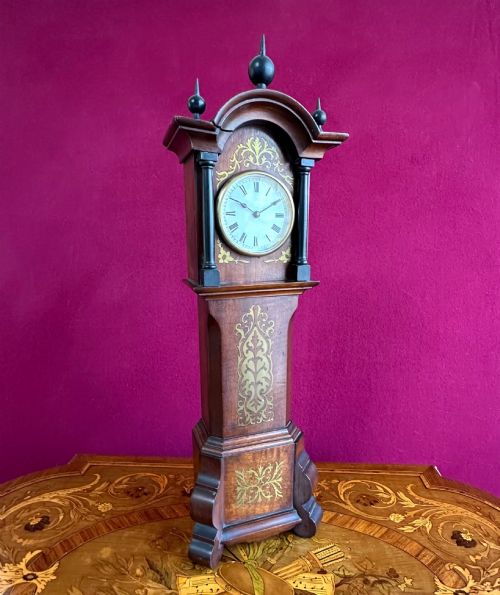
A miniature grandfather clock takes the familiar longcase silhouette and scales it down for mantels and tabletops. Buyers searching for a miniature grandfather clock frequently encounter pieces described interchangeably as grandmother clocks or miniature longcase clocks.
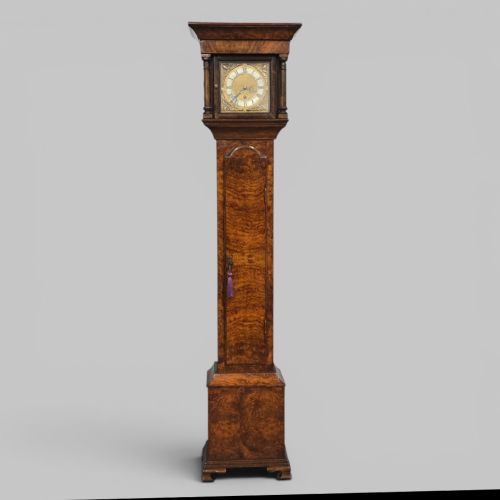
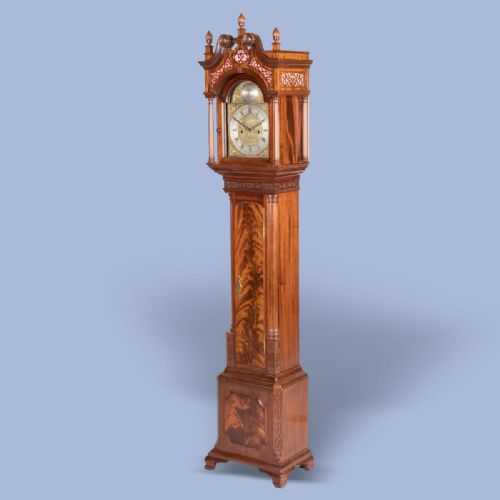
The pieces appearing here span the late nineteenth century through the 1920s, drawing on revival styles such as Queen Anne, Chippendale, and the seventeenth century. Oak, mahogany, and burr walnut form the primary case materials, often paired with brass dials and glass doors.
Makers such as Dent of London, JJ Elliot, and Winterhalder & Hoffmeier produced notable examples, alongside regional firms like Cottell Brothers Swindon. These horological items function as both desk clocks and mantel clocks while retaining the proportions of taller longcase ancestors.
Materials and construction
Mechanically, makers fitted spring-driven or weight-driven movements, some incorporating Westminster chimes, quarter-striking ting-tang mechanisms, and enamel dials. Ormolu mounts and gilded brass details appear on select ornate revival models.
Miniature Grandfather Clock Retail Price Guide 2026
Typical asking prices for miniature grandfather clock among the pieces listed under this phrase on Sellingantiques today, from the lower quarter to the upper quarter. They describe what is for sale here now, not the wider market.
Some miniature longcases tick with such quiet restraint they require a completely silent room to reveal their industrious little hearts.
Assessing craftsmanship
Quality rests in the precision of the cabinetwork, visible in the careful matching of burr walnut veneers, the crispness of mahogany string inlay, and the correct proportions of the hood, trunk, and base. Finer examples maintain architectural integrity that mirrors full-sized longcase furniture rather than appearing merely chunky or compressed.
The sophistication of the movement distinguishes standard pieces from superior items. Signed movements by established makers like Dent or Winterhalder & Hoffmeier, complex chime capabilities, and high-grade gilded brass or enamel dials elevate the standing of a piece.
Dent of London·JJ Elliot·Winterhalder & Hoffmeier·Cottell Brothers Swindon
The Miniature Grandfather Clock Glossary
- Grandmother clock
- A taller version of the miniature grandfather clock, typically standing between five and six feet high rather than sitting on a desk or mantel.
- Longcase clock
- The formal term for a grandfather clock, featuring a tall wooden case that houses the weight-driven or spring-driven pendulum movement.
- Regulator
- A precision timepiece designed to keep highly accurate time, often featuring a simplified dial layout for ease of reading.
- Ting-tang
- A two-hammer striking mechanism that sounds on two gongs to indicate the quarters of the hour.
- String inlay
- A narrow line of contrasting wood veneer embedded flush into the surface of the cabinet woodwork for decoration.
Miniature Grandfather Clock: Frequently Asked Questions
How do I set up a miniature grandfather clock?
Place the clock on a stable mantel, desk, or shelf where it remains level and free from vibrations. Secure the pendulum if the movement uses one, and carefully advance the hands to the correct time.
Allow the movement to settle into beat before making any fine adjustments to the regulation. Consult any specific winding instructions that correspond to spring-driven or weight-driven mechanisms.
What is the difference between a grandmother clock and a miniature grandfather clock?
A miniature grandfather clock sits comfortably on a tabletop, desk, or mantel, functioning as a scaled-down decorative object. A grandmother clock usually stands independently on the floor at a medium height between a full-size longcase and a desk clock.
Both share the classic proportions and hood-and-trunk silhouette associated with traditional longcase timepieces. Makers and sellers often use the terms interchangeably in historical and modern descriptions.
Are these clocks weight-driven or spring-driven?
Examples include both weight-driven and spring-driven movements depending on the specific scale and maker. Mantel-sized variants typically rely on spring-driven mechanisms to fit within compact wooden cases.
Taller diminutive versions or specific regulator models may utilise miniature weights hung inside the trunk. Examining the interior through the glass door reveals the powering method.
What wood types were used for the cases?
Mahogany, oak, and walnut appear frequently across these pieces, with burr walnut utilised for decorative grain patterns. Craftsmen also applied string inlay and polish to highlight the natural tones of the timber.
Edwardian and Victorian cabinetmakers favoured these hardwoods for durability and aesthetic warmth. Oak cases frequently align with Jacobean or seventeenth-century revival styles.