




Military Campaign Lap Desk
These military campaign lap desk pieces are travel writing boxes designed for officers on the move, offering timber construction and folding writing surfaces.
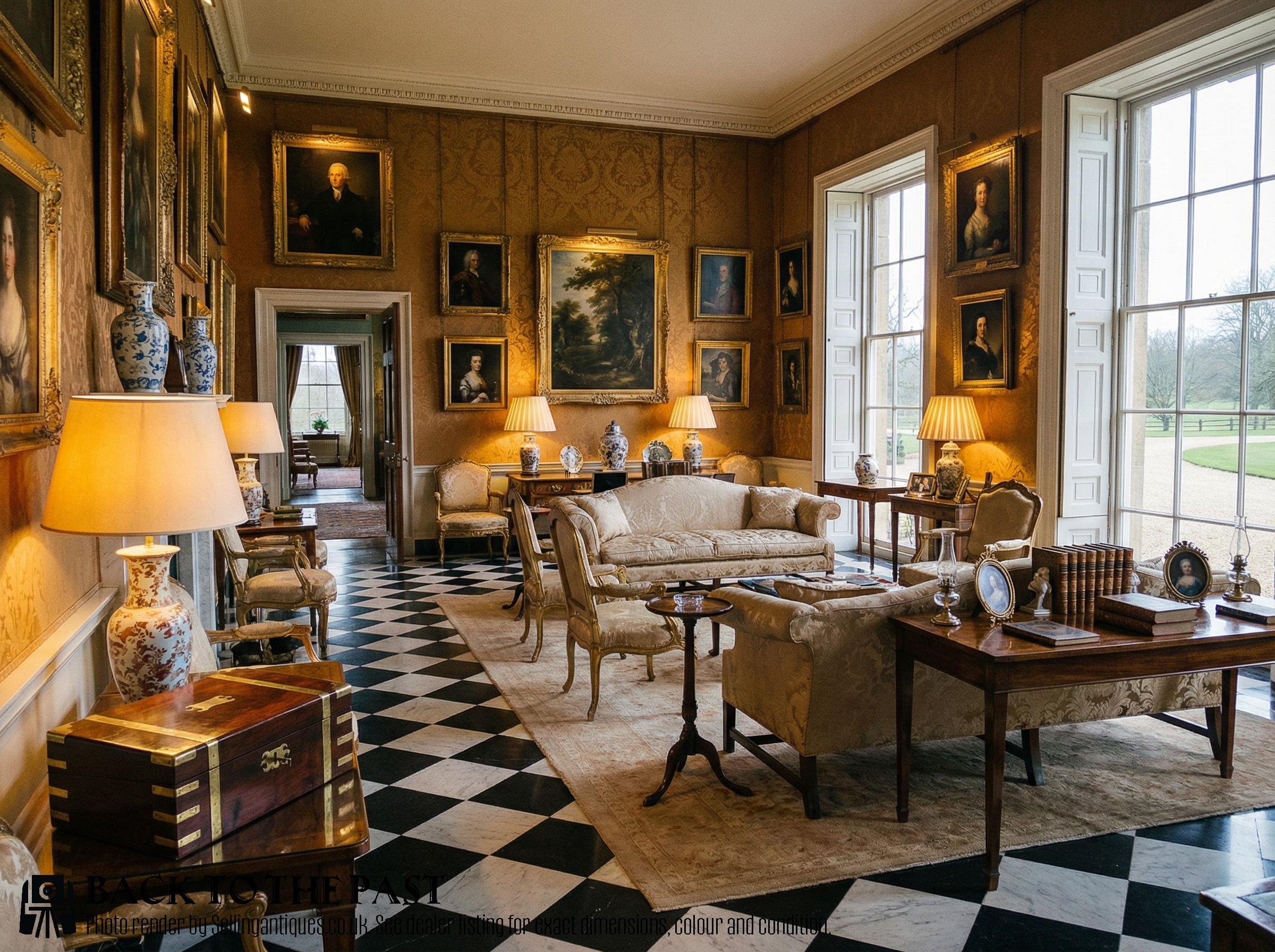
Military Campaign Lap Desk
A military campaign lap desk is a portable writing box built for use on the move during the 19th century, Georgian, Regency, and Victorian periods. These pieces take the form of writing slopes, boxes, and correspondence cases that fold open to create a desk surface.
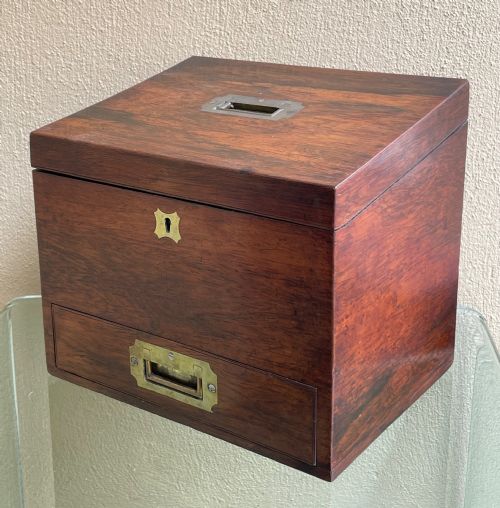
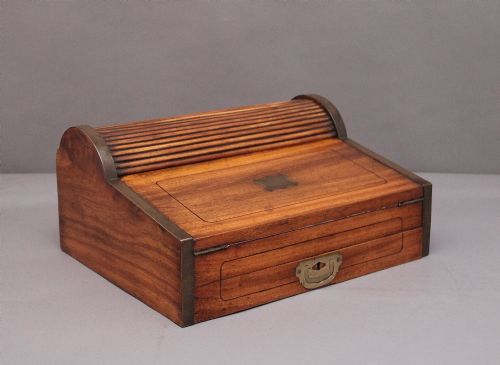
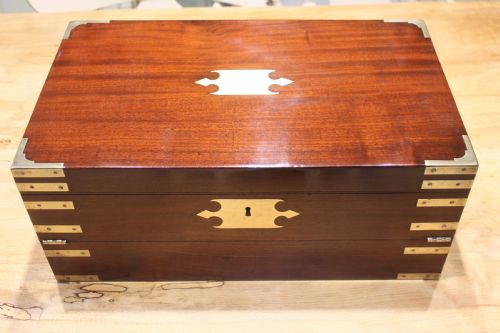
Mahogany and camphor wood dominate the selection, often reinforced with brass mounts and bound corners to withstand transport. Buyers regularly encounter standard folding slopes alongside more complex metamorphic and roll-top designs.
Origins stretch from standard British military styles to Anglo-Indian workshops producing specialised camphorwood boxes. The primary function remains the safe storage of writing materials and documents during travel.
Materials and construction methods
Cabinetmakers constructed these desks from dense timbers such as mahogany, rosewood, walnut, burr walnut, and camphor wood to resist splitting in transit. These woods were chosen for their durability and finished to highlight natural grain patterns.
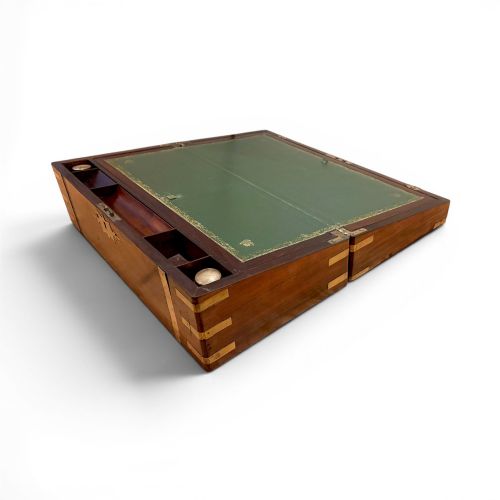
Brass corners, straps, and flush-fitting handles were countersunk into the timber to protect the edges and prevent snagging during packing. Internal compartments frequently incorporate leather writing surfaces and secret drawers concealed behind false panels.
Some officers required candle sconces and hidden sovereign sections built directly into their writing slopes to manage late-night paperwork and coin safely.
Judging construction and execution
Quality rests in the precision of the joinery and the integration of brass hardware, where flush fitting indicates careful hand-fitting by the maker. The choice of timber also dictates grade, with figured burr walnut and select camphor wood representing more ambitious commissions.
Finer examples distinguish themselves through complex interior engineering, such as metamorphic mechanisms, candle sconces, and secret sovereign sections. Simpler boxes rely on straightforward folding slopes without auxiliary fittings.
The Military Campaign Lap Desk Glossary
- Campaign lap desk
- A portable box designed to fold open into a writing surface for travel use. These objects date across the Georgian, Regency, and Victorian eras.
- Metamorphic
- A descriptive term for furniture that transforms its function through folding, sliding, or expanding parts. In these desks, it allows compartments to shift during opening.
- Secret drawers
- Hidden storage compartments concealed behind removable panels or triggered by secret release catches. They were built into writing slopes to secure valuables and private papers.
- Brass mounts
- Metal brackets and corner pieces screwed to the exterior of a box to reinforce joints. Flush mounting prevents the brass from catching on other luggage.
Military Campaign Lap Desk: Frequently Asked Questions
What is a military campaign lap desk?
A military campaign lap desk is a portable wooden box designed for officers on active service to write letters and store documents while travelling. They fold open to provide a slanted writing surface and internal compartments for ink and paper.
These pieces date predominantly from the 19th century, incorporating sturdy timbers like mahogany and camphor wood with protective brass mounts to survive rough transport.
How were these writing boxes used?
Owners placed the folded box on a table or their lap, opened the hinged lid to reveal a leather-lined writing slope, and utilised the interior wells for inkwells and pens. Secret drawers and compartments held postage, wax, and correspondence.
Officers on campaign relied on these desks to maintain official records and personal letters away from permanent quarters.
How do I date a campaign desk?
Dating relies on timber choices, brass hardware styles, and construction techniques associated with the Georgian, Regency, and Victorian periods. Regency and George III examples often feature cleaner Regency lines, while later Victorian pieces may incorporate elaborate brass banding.
Cabinetmaking methods, such as hand-cut dovetails and specific lock mechanisms, also help narrow the decade of production.
What is the difference between camphor and mahogany boxes?
Mahogany boxes were standard for British military officers, offering a heavy, dark red-brown hardwood surface suited to formal use. Camphor wood boxes often point toward Anglo-Indian origins or colonial service where the aromatic timber repelled insects.
Both woods were utilised for their stability during travel, but camphor wood possesses a distinct pale grain and natural scent.