



Mid Victorian Wine Glasses
Mid victorian wine glasses are tactile objects of lead crystal and coloured glass made to sit on a formal table, bringing weight and colour to your glassware collection.
Mid Victorian Wine Glasses
Mid victorian wine glasses are drinking vessels produced during the nineteenth century, most often seen on this page in pairings and sets dating around eighteen fifty and eighteen sixty. You will frequently encounter green wine glasses, alongside ruby overlay, cranberry glass, and crystal forms.
The selection ranges from tall green stems and cut crystal wine glasses to larger rummers intended for robust pours. Alongside standard wine glasses, related serving pieces such as decanters, carafes, and claret jugs appear in matching materials like amethyst and cranberry over crystal.
How they were made
Makers shaped these pieces from heavy lead crystal and coloured glass, employing techniques such as wheel cutting and hand painting to decorate the surface. Several items feature elaborate overlay methods, where layers of contrasting glass are cut away to reveal the clear metal beneath.
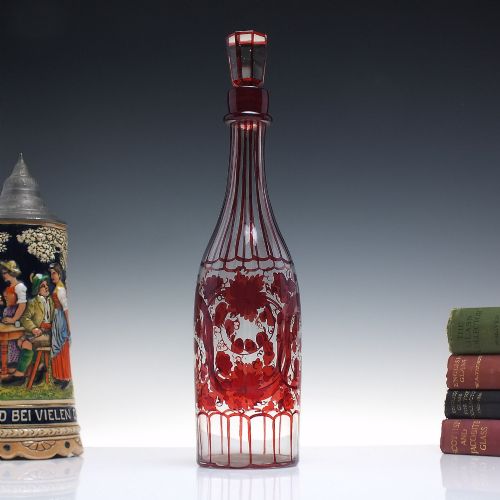
Engraving was also common, as seen on large red crystal jugs ornamented with fruiting vines. French pieces incorporate delicate glass latticinio decoration, while English workshops relied on deep cutting and hand enamelling.
Mid Victorian Wine Glasses Retail Price Guide 2026
Typical asking prices for mid victorian wine glasses among the pieces listed under this phrase on Sellingantiques today, from the lower quarter to the upper quarter. They describe what is for sale here now, not the wider market.
Current listings demonstrate a strong presence of mid nineteenth century English and French glassware, dominated by lead crystal, coloured glass, and cut crystal decanters.
What varies in quality
Quality rests upon the crispness of the cut and the depth of the metal, where sharper facets catch the light more brilliantly. Heavy lead crystal provides a satisfying heft in the hand that lighter, ordinary glass simply lacks.
The richness and consistency of the coloured glass also define the upper tier, especially in cranberry, emerald green, and amethyst examples. Finer pieces display precise engraving and clean joins between bowl, stem, and foot.
Baccarat
The Mid Victorian Wine Glasses Glossary
- Lead crystal
- A heavy, brilliant glass containing metallic oxide to increase refractive index and weight. It allows for deep, sharp wheel cutting.
- Cranberry glass
- A rich pinkish-red glass created by adding gold chloride to the molten batch. It is frequently used in overlay and flash techniques.
- Latticinio
- A decorative glassware technique using opaque white glass threads twisted within clear glass. This creates intricate internal webbed patterns.
- Rummer
- A large, sturdy glass with a short stem used in the nineteenth century for ale, wine, or punch. They possess considerable weight and capacity.
- Overlay
- A vessel made with two or more distinct layers of glass. The outer layer is partially cut away to expose the contrasting colour underneath.
Mid Victorian Wine Glasses: Frequently Asked Questions
How do I identify mid victorian green wine glasses?
Look for the characteristic deep emerald hue typical of the mid nineteenth century alongside hand-blown pontil marks on the base. The weight of the lead crystal and the traditional stem formation help distinguish them.
They often appear in matched pairs or small sets dating around eighteen fifty. Comparing the cutting style with documented pieces from the same decade confirms the era.
What is cranberry over crystal glass?
This material consists of a clear crystal core encased in a thin outer layer of rich cranberry red glass. Artisans cut through the outer red layer to reveal the clear crystal underneath.
This creates a strong contrast and allows light to pass through the decorative facets. It requires skilled hand cutting to achieve precise patterns.
How should I display coloured glass?
Position coloured glasses near natural light so the emerald green, ruby, and amethyst tones glow properly. Open shelving or a glass-fronted cabinet works best for catching the illumination.
Keep them away from direct, harsh sunlight for prolonged periods to protect the glass chemistry. Grouping them with matching decanters creates a cohesive period display.