


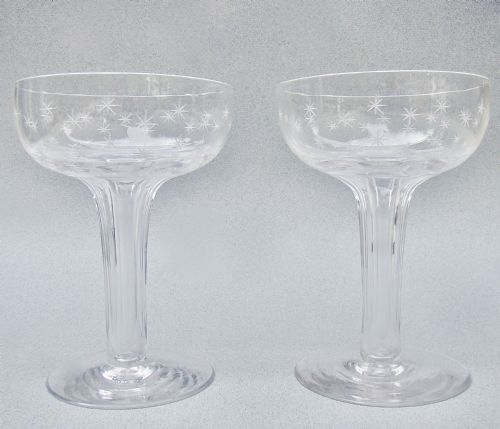


Antique Crystal Stemware Pair
These antique crystal stemware pair selections bring matched drinking vessels to the table, spanning Georgian engravements to Art Deco forms.
Antique Crystal Stemware Pair
When searching for an antique crystal stemware pair, buyers encounter matched drinking vessels spanning wine glasses, champagne coupes, hock glasses, and flutes. The selections on this page range from Georgian ale glasses and Jacobite sympathy wine glasses to Victorian star-etched champagne bowls.
The offerings also include Edwardian cut lead crystal wine glasses alongside later continental pieces from the 1900s to the 1930s. Forms extend beyond standard drinking vessels to incorporate cut glass vases and specialised champagne coupes with coloured overlays.
Origins represented in these pairings bridge English production with continental output from Germany and Bohemia. Buyers find vessels designed for specific historical dining habits, whether for beer, hock, or sparkling wines.
What varies in quality
The distinction between tiers rests upon the precision of the wheel cut and the depth of the facet work on the stem and bowl. Crispness in engraved details, such as the rendering of foliage or heraldic motifs, separates standard utility vessels from masterworks.
Material clarity and the successful execution of layered cased glass, where coloured layers contrast sharply with the underlying crystal, define the upper bracket of manufacture. The matching consistency of the pair, in both height and wall thickness, dictates overall desirability.
Antique Crystal Stemware Pair Retail Price Guide 2026
Typical asking prices for crystal stemware pair among the pieces listed under this phrase on Sellingantiques today, from the lower quarter to the upper quarter. They describe what is for sale here now, not the wider market.
Early Jacobite sympathy glasses carried hidden toasts to exiled monarchs, safely disguised beneath seemingly innocent floral engravings.
Baccarat·Stevens & Williams·Theresienthal·Moser
The Antique Crystal Stemware Pair Glossary
- Lead Crystal
- Glass containing a high proportion of lead oxide, which increases brilliance, weight, and the refractive index. This composition allows for deeper and sharper cutting without fracturing.
- Cased Glass
- Glass composed of two or more distinct layers of different colours, often clear crystal cased in red or green. Artisans cut through the outer coloured layer to expose the clear material underneath.
- Facet Cut
- A style of surface decoration featuring flat, polished geometric planes cut into the body of the glass. It catches light from multiple angles and adds tactile grip to the stem or bowl.
- Hock Glass
- A traditional tall-stemmed wine glass originally intended for German white wine. These vessels frequently feature coloured bowls or elaborate enamel decoration upon the body.
Antique Crystal Stemware Pair: Frequently Asked Questions
How do I spot Georgian glass?
Georgian stemware often displays darker metal with darker inclusions or slight surface wear consistent with age, alongside distinct tool marks from pontil rods on the base.
The cutting on eighteenth-century pieces tends to be shallower and softer than the sharp, deep brilliance found on later Victorian lead crystal.
What is cased glass?
Cased glass involves fusing a layer of coloured glass over a clear crystal base during the blowing process. This technique creates a rich exterior colour that can be selectively carved away.
Cut-to-clear examples reveal the underlying crystal through patterns of flutes, panels, or detailed floral engravings.
How were champagne coupes used?
Champagne coupes were specifically designed with wide, shallow bowls to allow the bubbles to dissipate more rapidly during formal nineteenth-century dining. Guests held the long stems to prevent warming the sparkling wine with their hands.
Over time, these broad bowls transitioned into decorative vessels often embellished with star-etching or engraved foliage.
Are these glasses safe for daily use?
Historic crystal requires careful hand washing in warm water without abrasive detergents to preserve the surface polish and delicate engravings. Dishwashers cause permanent clouding and thermal shock.
Because lead crystal is softer than modern glass, storage should prevent rim-to-rim contact to avoid chips on the fragile edges.
What defines Edwardian stemware?
Edwardian pieces generally exhibit lighter forms and refined cut lead crystal patterns that reflect the polished elegance of early twentieth-century dining tables. The glass metal is typically brighter and clearer than earlier Georgian iterations.
Decoration often leans toward symmetrical floral panels and restrained pillar cutting rather than dense overall coverage.