

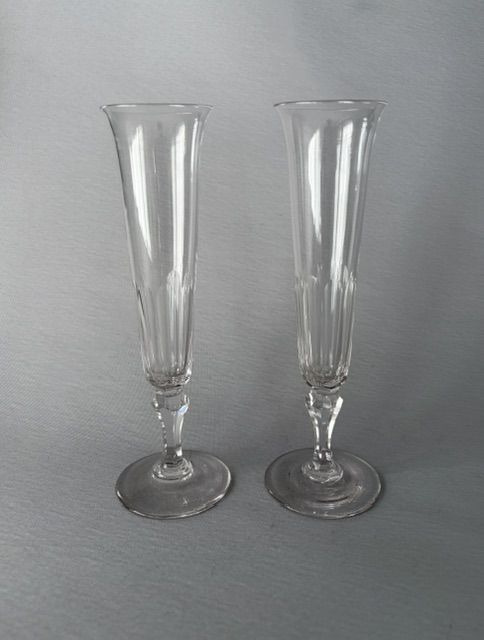




Vintage Cut Glass Drinkware
These vintage cut glass drinkware pieces bring weight and brilliance to the table, and collectors prize them for their crisp wheel-cut facets and ringing clarity.
Vintage Cut Glass Drinkware
Vintage cut glass drinkware encompasses utilitarian vessels and formal suites spanning from the Georgian and Regency eras through the Victorian, Edwardian, and Art Deco periods. Buyers seeking these items encounter a broad range of forms, including wine glasses, cordial glasses, whiskey tumblers, champagne flutes, and complete decanter sets.
The objects on this page originate from English, Irish, French, and Czech workshops, displaying decorative traditions that shift from heavy early Anglo-Irish cutting to delicate acid etching and geometric Vienna Secession styling.
How they were made
Artisans formed these pieces using lead crystal, clear glass, and crystal glass, shaping the molten material by hand before applying decorative surface treatments. Skilled cutters utilised rotating wheels to carve deep facets, flutes, and patterns into the hardened surface.
Secondary ornamentation frequently involved delicate acid etching and fine engraving, which complemented the bolder structural cuts on pieces such as Edwardian cordial glasses and Art Deco suites.
Vintage Cut Glass Drinkware Retail Price Guide 2026
Typical asking prices for vintage cut glass drinkware among the pieces listed under this phrase on Sellingantiques today, from the lower quarter to the upper quarter. They describe what is for sale here now, not the wider market.
Listings here span from the 1860s Victorian era through Edwardian suites up to 1930s French and Czech Art Deco designs.
What varies in quality
The distinction between standard examples and superior pieces rests upon the crispness of the wheelwork and the purity of the metal. Finer specimens display sharp, precisely defined facets that catch the light cleanly, whereas lesser items show softer edges and minor optical distortions within the glass body.
Weight and balance also differentiate the range, as heavier lead crystal components offer a resonant ring and a substantial hand-feel that lighter moulded alternatives simply lack.
Moser·Otto Prutscher
The Vintage Cut Glass Drinkware Glossary
- Lead crystal
- A high-clarity glass containing metallic oxide that increases the refractive index and weight of the object. This material allows cutters to achieve deep, sharp facets that scatter light brilliantly.
- Acid etching
- A decorative technique using acid to eat away exposed portions of the glass surface to create frosted designs. It often appears alongside wheel-cut patterns on early twentieth-century tableware.
- Anglo-Irish cut glass
- A distinct style originating in Ireland and England during the Georgian and Regency periods, characterised by heavy metal and deep, geometric brilliant cutting.
- Faceting
- The process of grinding flat planes into the exterior of glassware to create reflective surfaces. Precision in spacing and depth defines the skill of the cutter.
- Pontil mark
- A rough scar on the base of hand-blown glassware where the pontil rod was attached during manufacture. Its presence confirms traditional hand-blown production methods.
Vintage Cut Glass Drinkware: Frequently Asked Questions
Are these glasses safe for daily use?
Most vintage drinking vessels are entirely suitable for occasional or regular dining, provided they are handled with reasonable care. The sturdy lead crystal and heavy glass used in many tumblers and wine glasses were built for practical hospitality.
For exceptionally delicate cordial glasses or pieces with fine engraved decoration, reserve them for special toasts to preserve their condition.
How can I tell Georgian glass from Victorian pieces?
Georgian and Regency items often display heavier metal, deeper Anglo-Irish cutting, and distinct pontil marks on the base. Victorian and Edwardian examples frequently introduce lighter proportions alongside varied etching techniques.
Examining the silhouette and the weight provides immediate clues regarding the specific manufacturing era of the tableware.
What defines Art Deco drinkware?
Art Deco drinking vessels from the interwar years favour stylised geometry, clean lines, and streamlined forms influenced by movements like the Vienna Secession. French and Czech makers produced large suites featuring structured engraving that broke away from ornate Victorian styling.
These sets often include matching decanters designed to showcase the sharp, modern aesthetic of the 1930s.