
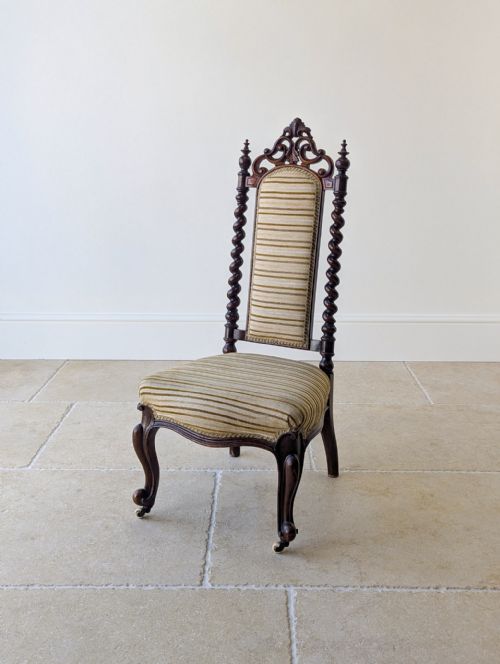
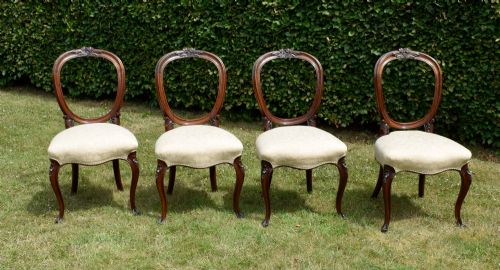


Mid Victorian Parlour Chairs
Mid victorian parlour chairs bring nineteenth-century reception rooms to life with carved rosewood frames and balloon backs.
Mid Victorian Parlour Chairs
The most common forms on this page include rosewood balloon back dining chairs and walnut salon chairs dating from the eighteen-fifties and eighteen-sixties. Buyers also encounter high-back parlour chairs and ladies chairs decorated with carved rails and needlepoint seats.
Judging quality
Quality rests in the crispness of the carved rails and the matching grain of the rosewood or walnut timber across a set. Superior examples display balanced proportions and substantial framing in mahogany or rosewood.
The integrity of the original construction and the preservation of carved walnut or rosewood elements separate standard seating from exceptional pieces. Sets that retain uniform colour and matching upholstery fabric command greater attention.
Duck egg blue needlepoint seats occasionally survive on nineteenth-century rosewood frames, offering a distinct burst of colour.
Charles Roodhouse
The Mid Victorian Parlour Chairs Glossary
- Balloon back
- A chair back shaped in an open oval curve resembling an inflated balloon. This outline defines many mid-nineteenth-century dining and salon seats.
- Parlour chair
- A domestic seat designed for entertaining guests in a formal reception room. These pieces prioritise ornamental carving and upholstered comfort.
- Needlepoint
- A type of canvas work embroidery used for seat covers. Needlepoint upholstery often introduces coloured wool designs to rosewood frames.
- Serpentine seat
- A chair base with a curved front edge that sweeps inward and outward. This shaping adds a fluid contour to dining and salon chairs.
- Salon chair
- An occasional seat intended for polite conversation in a drawing room. They frequently appear in walnut pairs or small groups.
Mid Victorian Parlour Chairs: Frequently Asked Questions
What defines a mid victorian parlour chair?
These chairs date from the mid-nineteenth century and typically feature rosewood or walnut frames with carved details. Makers produced them for formal reception rooms and drawing rooms.
They appear as single salon chairs, pairs, or larger dining sets with balloon backs and upholstered seats.
Were these chairs used for dining?
Many examples on this page served as dining chairs, particularly the sets fashioned from rosewood and mahogany. Others functioned as side chairs or ladies chairs in private parlours.
Their sturdy timber frames accommodated daily domestic use around dining tables and in drawing rooms.
How do I identify the wood used?
Rosewood displays a dark grain with reddish-brown undertones, often seen in mid-nineteenth-century balloon back sets. Walnut presents a lighter brown hue with varied figuring.
Mahogany offers a dense, uniform reddish-brown appearance common in formal dining chairs.
How do I care for antique upholstery?
Protect the fabric and needlepoint seats by avoiding direct sunlight and maintaining stable room humidity. Gentle vacuuming with a soft attachment removes surface dust.
Preserve the polished rosewood or walnut frames using appropriate wax applied sparingly with a clean cloth.