


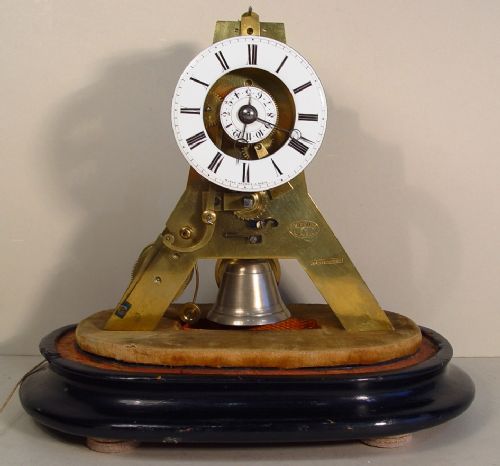
Mid Century Table Clock
These mid century table clock examples range from perpetual motion timepieces to promotional garage advertising desks, bringing mechanical character to any interior.
Mid Century Table Clock
A mid century table clock spans mantel clocks, desk clocks, and specialised timepieces originating primarily from the 1950 and 1960 decades alongside earlier nineteenth-century French pieces. Buyers encounter various forms including bell-jar models, skeleton timepieces, and promotional advertising pieces.
The selection frequently highlights Swiss and British manufacturing, merging practical timekeeping with decorative utility across surfaces, desks, and mantelpieces. Makers utilise distinct styling cues that cross paths with Mid-Century Modern and Art Deco aesthetics.
The assortment balances standard mechanical wind models with perpetual motion systems and alarm functions. Each object serves as a functional centrepiece tailored for domestic or office placement.
Materials and construction methods
Brass, gilt brass, and gilt bronze provide the primary structural housing for many movements, often complemented by rhodium plating or nickel finishes. Glass enclosures and dome covers protect delicate dials and skeleton mechanisms from dust.
Dials incorporate enamel, metal, and wood elements like burr walnut, while specialised versions integrate ceramic or painted panels. Internal movements rely on jewelled pivots, ranging from 8-day mechanisms to 15-jewel configurations and perpetual motion power sources.
Material selections span from humble brass and nickel plating to gilt bronze, burr walnut, and hand-blown glass domes.
Factors that separate examples
The sophistication of the internal movement dictates distinction, distinguishing standard mechanical wind variants from perpetual motion calibres or complex skeleton mechanisms. Original condition components and documented service histories elevate the standing of individual timepieces.
Enclosure materials and decorative treatments create further divergence, separating standard metal housings from gilt bronze cases, burr walnut timber bodies, and complex bell-jar models. Retained original packaging or promotional provenance adds historical depth to specific advertising editions.
Imhof·Smiths·Jaeger LeCoultre·Elliott of London·Luxor·Kienzle
The Mid Century Table Clock Glossary
- Atmos clock
- A mechanical clock created by Jaeger-LeCoultre that needs no manual winding, powered instead by hourly temperature changes in the surrounding air. This expansion and contraction winds the mainspring continuously.
- Skeleton timepiece
- A clock designed with transparent or removed plates to expose the entire gear train and internal movement. Such construction allows light to pass directly through the centre of the case.
- Gorge case
- A distinct rectangular brass or gilt metal housing style featuring stepped mouldings and a flat top handle, commonly found on nineteenth-century French carriage clocks. The design emphasises clean architectural lines.
- Bell-jar model
- A timepiece sheltered beneath a transparent blown glass dome that rests upon a circular base. This protective cover shields the delicate mechanical components while offering an unobstructed view from all angles.
Mid Century Table Clock: Frequently Asked Questions
How do Atmos clocks work?
An Atmos clock operates without a battery or manual winding by utilising a hermetically sealed capsule containing a gas and liquid mixture. Temperature fluctuations cause this mixture to expand and contract, winding the mainspring automatically.
This continuous thermal cycle maintains power indefinitely under normal indoor conditions. Care must be taken during relocation to lock the delicate torsion pendulum in place.
Where should I place a desk clock?
A desk clock functions best on stable flat surfaces away from direct sunlight, excessive moisture, and vibration sources. Placements on study desks, mantelpieces, or prominent side tables allow easy viewing of the dial.
Ensure the chosen location provides adequate clearance for winding keys or surrounding glass domes. Level surfaces are particularly crucial for mechanical escapements to beat evenly.
What is a skeleton clock?
A skeleton clock displays its gear train, escapement, and balance wheel openly between skeletal frame plates rather than hiding them behind a solid dial. This layout exposes the mechanical progression of time directly to the viewer.
Such designs require protective glass covers to prevent dust accumulation on the exposed pivots. Regular cleaning by a professional technician ensures the visible gears continue to mesh smoothly.