


Meiji Period Lidded Vase
These Japanese lidded vases bring the intricate palettes and disciplined forms of the Meiji period directly into a room.
Meiji Period Lidded Vase
A meiji period lidded vase combines a covered ceramic vessel with distinct decorative styles originating from Japan during the late nineteenth and early twentieth centuries. These pieces appear as ginger jars, baluster vases, and covered urns designed to sit on stands or anchor a mantelpiece.
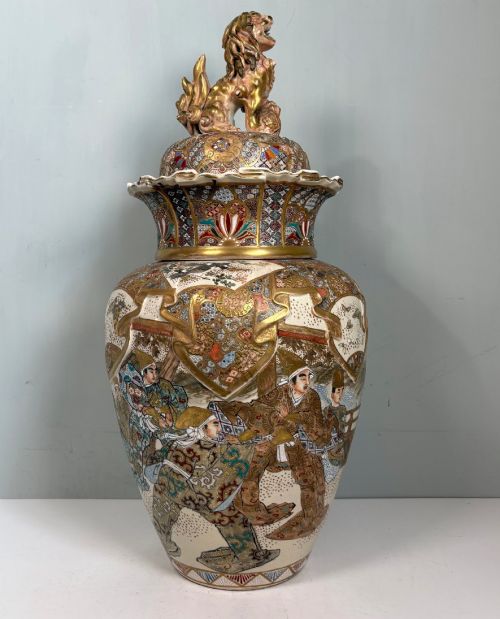
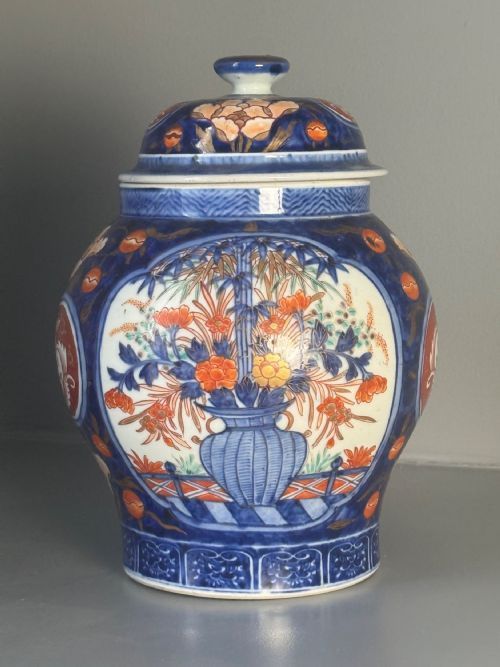
The version most commonly met on this page is the Japanese Imari lidded vase, alongside Satsuma and Kutani wares from the nineteenth century. These objects frequently measure on a large scale, standing as substantial decorative focal points with matching covers.
Materials and construction
Makers utilised porcelain and earthenware bodies as the foundation for these vessels, shaping them into octagonal baluster profiles and covered ginger jars. Artisans then applied glaze, enamel, cobalt enamel, and gold leaf to decorate the surfaces.
The painting draws on the Japanese Imari palette, combining deep blues and iron reds with gilding. Certain examples incorporate cloisonne techniques or feature sculpted elements such as Foo Dog lids.
Several lids are guarded by sculpted Foo Dogs, standing ready to ward off evil spirits from the ginger jar below.
Judgements of quality
The standard of a piece rests upon the precision of the hand-painted brushwork and the richness of the cobalt enamel and gold leaf application. Finer examples display crisp detail across complex floral and figurative panels without muddiness in the palette.
Proportion and the integrity of the matching cover determine distinction. A well-balanced baluster shape paired with an original, undamaged lid elevates the standing of an antique over mismatched or later replacements.
Fukagawa
The Meiji Period Lidded Vase Glossary
- Imari
- A traditional style of Japanese export porcelain characterised by a palette of underglaze blue, iron red, and gilt. It originated in Arita and became widely popular in the West.
- Meiji Period
- The era in Japanese history spanning from 1868 to 1912, marked by the reopening of trade with the West and a surge in refined decorative arts.
- Satsuma
- A type of Japanese earthenware featuring a crackled ivory glaze decorated with polychrome enamels and extensive gold leaf. It often depicts figures, landscapes, and floral motifs.
- Cloisonne
- A decorative technique where metal wires are soldered to a metal body to create compartments that are subsequently filled with enamel and fired.
- Baluster
- A vase form characterised by a swollen lower portion that tapers towards the neck, offering a stable and classical silhouette.
Meiji Period Lidded Vase: Frequently Asked Questions
What is an Imari lidded vase?
An Imari lidded vase is a porcelain vessel featuring a matching cover and decorated in the traditional Japanese palette of cobalt blue, iron red, and gilding. These pieces were produced in large quantities for export during the nineteenth century.
They serve as decorative mantel or table pieces that bring strong colour and pattern to an interior space.
How do I identify Satsuma ware?
Satsuma ware is recognised by its distinctive crackled, cream-coloured earthenware body and elaborate decoration in enamel and gold leaf. The designs frequently incorporate detailed figural scenes and dense floral motifs.
Unlike blue and white porcelain, these pieces have an opaque, stone-like finish that feels warmer to the touch.
Where were these vases made?
These vases were manufactured in historic Japanese pottery centres such as Arita, which served as the hub for Imari and porcelain production. Workshops across Japan created them specifically for export markets during the Meiji period.
They reflect the cross-cultural exchange between Japanese artisans and Western collectors of the late nineteenth century.
How should I display a lidded vase?
A large lidded vase makes a strong standalone statement on a heavy table, sideboard, or dedicated wooden stand. Because many examples are exceptionally tall and heavy, they require a stable surface away from high-traffic areas.
Keeping the matching cover paired securely with the body maintains the intended silhouette of the piece.