
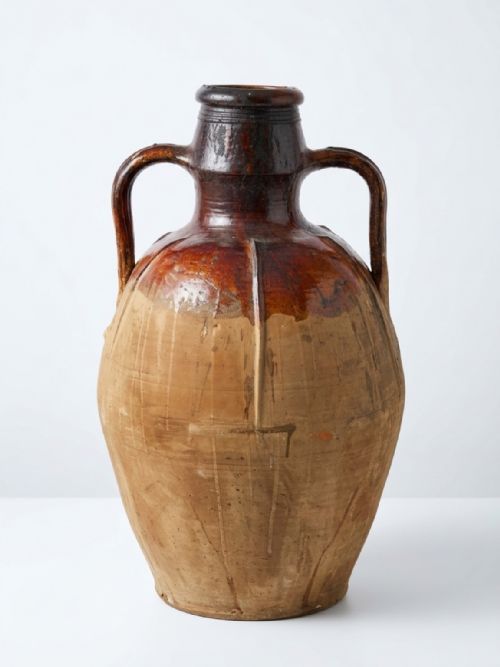


Mediterranean Terracotta Jar
A mediterranean terracotta jar brings sun-bleached warmth and honest utility to a garden or room.
Mediterranean Terracotta Jar
When you search for a mediterranean terracotta jar, you find heavy vessels created for practical agrarian tasks across the Mediterranean basin. These range from substantial Italian wine jars and tall Turkish olive vessels to Portuguese olive jars and painted pottery.
You are most likely to encounter nineteenth century examples, spanning the Victorian era through the early twentieth century. Many sit on wrought iron stands or display remnants of lime wash and glaze over porous clay.
These forms include large garden urns, planters, and amphorae designed originally to store oil, wine, and water. Their weathered surfaces reflect decades or centuries of exposure to sun and soil.
How they were made
Potters shaped coarse earthenware and clay by hand or on wheel, firing the mixture at lower temperatures to achieve a porous body. This breathability suited the storage of agricultural liquids.
Surface treatments included applied lime wash, partial glazes, and painted finishes over raw terracotta. Artisans often reinforced certain vessels or fitted them with wrought iron mounts for stability.
Listings feature nineteenth century earthenware and terracotta from Italy, Portugal, and Turkey, incorporating wrought iron stands and lime wash finishes.
What varies in quality
The character of the surface sets one jar apart from another, particularly where layers of historic lime wash or original paint remain intact. Pots that retain their structural integrity alongside rich patination command greater attention.
Proportion and scale also dictate distinction, from modest garden pots to huge wine jars with balanced, sweeping shoulders. The harmony of the thrown form combined with authentic weathering defines the better examples.
The Mediterranean Terracotta Jar Glossary
- Terracotta
- Baked earth pottery made from porous clay fired at relatively low temperatures. It develops a warm reddish-brown hue and weathers naturally outdoors.
- Amphora
- A tall storage vessel with two handles and a pointed or rounded base, historically used for transporting wine or oil. Many surviving examples sit within metal stands.
- Earthenware
- Basic pottery fired below vitrification point, remaining porous unless glazed. It forms the primary body of these traditional Mediterranean vessels.
- Lime wash
- A traditional coating made from slaked lime applied to exterior walls and pots. It gives a chalky, protective finish that flakes gently over time.
- Glaze
- A glassy coating fused to the ceramic body during firing to seal the porous clay. Partial glazes on these jars often create accidental drips and pooling.
Mediterranean Terracotta Jar: Frequently Asked Questions
Can these jars stay outside in winter?
Terracotta absorbs moisture, so heavy frost can crack porous clay if water freezes inside the walls.
Protect your vessel by moving it under cover during freezing weather or emptying soil and elevating the base.
How do I clean an old terracotta jar?
Wash the surface gently with soft water and a natural bristle brush to remove dirt without disturbing historic lime wash or patination.
Avoid harsh chemical cleaners and pressure washers, which strip away the aged character accumulated over generations.
How do I date a terracotta jar?
Examine the weight, throwing marks, and surface treatments like early paint or lime wash layers. Nineteenth century pieces often show hand-formed irregularities absent in later industrial production.
Compare the profile against documented forms from Italian, Turkish, and Portuguese regions to narrow the origin.
Were these jars used for decoration originally?
Most of these vessels served utilitarian roles storing olive oil, wine, and water on farms and in coastal trading ports. Their generous proportions and sturdy handles met rigorous agricultural demands.
Only later did their sculptural forms attract gardeners and collectors seeking rustic decorative accents.