
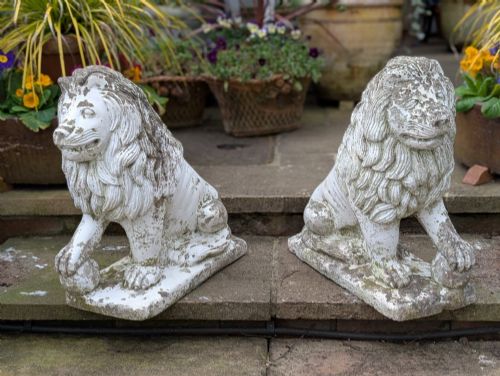
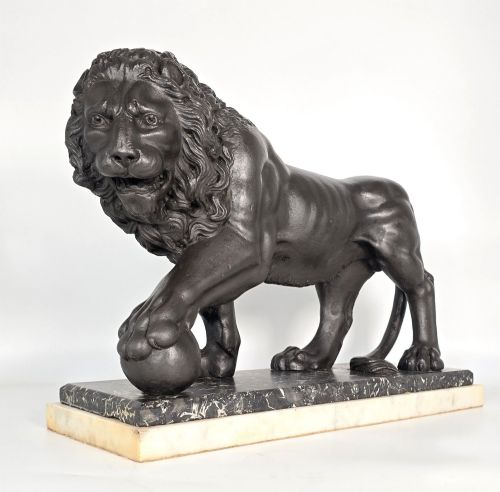


Medici Lion Statue
A medici lion statue commands attention with classic power, bringing centuries of sculptural heritage straight into your home or garden.
Medici Lion Statue
A medici lion statue draws directly upon the historic marble pair guarding the Villa Medici in Rome, capturing the fierce stance and resting paw that defined Neoclassical taste. When searching this phrase, you encounter interpretations spanning several centuries, from grand monumental carvings to smaller mantel ornaments.
The versions most frequently met on this page date from the nineteenth century, including Grand Tour souvenirs and decorative pottery figures. These sculptures appear in pairs or as single figures, rendered in various scales from diminutive earthenware to substantial stone.
Makers and materials range widely, encompassing bronze castings, carved wood, and glazed pearlware. Each piece reflects the enduring popularity of the Italian Baroque and Neoclassical motifs across different strata of domestic and garden decoration.
Methods and materials
Stoneware and earthenware versions employ moulding and casting processes, finished with glazes or hand-painted details. Lancaster and Sons of Hanley utilised local ceramic traditions to shape pottery figures.
Carved wooden and stone sculptures rely on hand-chiselling techniques executed by skilled artisans. These pieces exhibit the natural grain and texture of the chosen medium, whether marble, limestone, or timber.
Current listings span periods from the seventeenth century through to the mid-twentieth century, utilising bronze, marble, and earthenware.
Assessing quality
The distinction between standard decorative objects and exceptional works lies in the crispness of the modelling and the fidelity to the classical prototype. Superior casts and carvings display anatomical precision in the musculature and mane, whereas lesser items blur these fine details.
Proportion and stance dictate visual balance, with the finest pairs showing harmonious symmetry and a convincing sense of watchful repose. The choice of material and the depth of the subsequent finish further separate mass-produced pottery from bespoke bronze or marble creations.
Lancaster and Sons of Hanley
The Medici Lion Statue Glossary
- Grand Tour
- A traditional trip of Europe undertaken by upper-class young men of the eighteenth and nineteenth centuries to absorb classical art. Souvenirs purchased on these journeys included small-scale bronze and marble sculptures.
- Neoclassical
- A Western cultural movement drawing on the art and culture of classical antiquity. This style heavily influenced the posture and dignity of the sculptural figures seen here.
- Pearlware
- A type of refined earthenware developed in the late eighteenth century featuring a bluish glaze. It provided a smooth white surface suitable for painted ceramic figures.
- Plinth
- A heavy base or slab upon which a statue or pillar rests. Many smaller bronze sculptures feature dedicated marble plinths for display.
Medici Lion Statue: Frequently Asked Questions
What is a medici lion statue?
A medici lion statue is a sculptural representation of the iconic marble lions modelled after classical antiquities in Italy. They typically depict a male lion with one paw resting upon a sphere.
These figures serve as enduring symbols of strength and nobility, originating in large-scale garden statuary before being adapted for interiors.
Where should I place these statues?
Smaller bronze and ceramic versions suit interior placement on mantels, desks, or dedicated display plinths. Their classical lines complement traditional studies and libraries.
Larger stone and cast examples are traditionally positioned outdoors as pair sentinels flanking gateways, garden paths, or terrace entrances.
How do I distinguish bronze from cast stone?
Bronze objects feel cool and heavy, exhibiting metallic patinas and subtle casting seams rather than stone aggregate textures. Tapping the material yields a distinct metallic ring.
Cast stone and earthenware display porous matte surfaces with painted or glazed finishes, lacking the metallic sheen inherent to bronze alloy.
Are these statues always sold in pairs?
While many historic examples were sculpted as symmetrical pairs to guard doorways or fireplaces, many survive as single decorative figures. Both matched pairs and solo sculptures appear frequently in collections.
Matching pairs command distinct visual symmetry, whereas individual figures function well as standalone mantel ornaments or desk accents.