
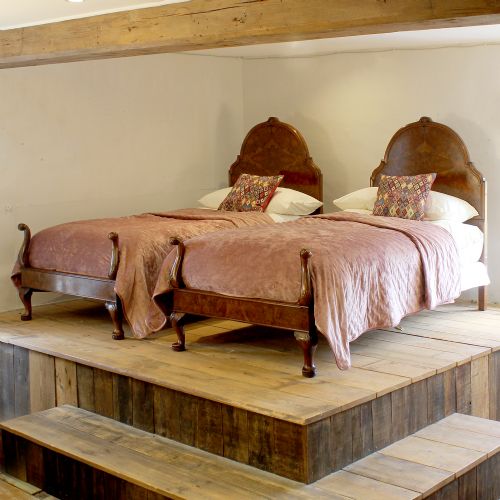
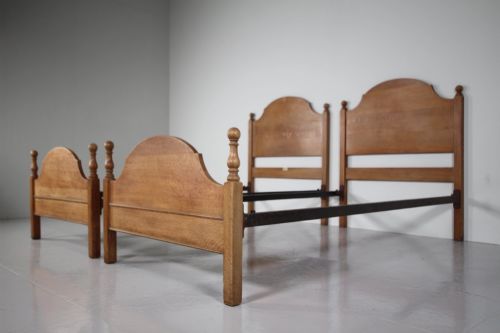


Matching Single Beds
Matching single beds are paired sleeping frames designed for symmetry in a shared room, offering period charm through wood and iron.
Matching Single Beds
Matching single beds emerge in pairs across the nineteenth and early twentieth centuries, fashioned primarily as coordinated bedsteads and platform beds for bedrooms. A buyer searching for matching single beds will frequently encounter Edwardian and Victorian examples, alongside pieces from the nineteen-thirties.
The forms span walnut, oak, satinwood, and cast iron, often reflecting specific regional preferences such as French stylistic revivals or English cabinet-maker production. These bed frames typically survive alongside related furnishings like bedside cabinets or chairs from the same suites.
Makers such as Heal and Son appear among the offerings, providing labeled examples of Edwardian walnut and oak framework. Buyers look to these matched sets to preserve historical symmetry while utilising functional twin sleeping arrangements.
Construction and Materials
Cabinet-makers constructed these bed frames utilising solid timbers like walnut, oak, and satinwood, frequently employing burr walnut veneers for decorative surfaces. Carved details, inlaid mahogany, and leather embossing punctuate the woodwork of Edwardian and nineteenth-century pieces.
Metal alternatives combine cast iron and brass, utilising black finishes paired with polished brass decoration. French pieces incorporate cane work or upholstered panels alongside painted finishes and Directoire styling.
Some nineteenth-century iron beds arrive ready for battle in stark black, softened only by polite brass buttons.
Quality Variations
The distinction between standard commercial output and superior craftsmanship rests in the depth of timber selection and the precision of carved or inlaid decoration. Examples bearing maker labels from established firms command attention through documented provenance and refined joinery.
Structural integrity relies on the preservation of original side rails, footboards, and headboards without intrusive modern alterations. Matched pairs displaying uniform timber grain and intact original hardware represent the upper tier of surviving stock.
Heal & Son
The Matching Single Beds Glossary
- Bedstead
- A framework of a bed designed to support a mattress and springs. It incorporates the headboard, footboard, and side rails.
- Satinwood
- A durable hardwood with a lustrous, yellow sheen utilised for fine cabinet-making. It was favoured during the Edwardian period for decorative bedroom suites.
- Directoire style
- A transitional French design movement preceding the Empire style, characterised by neoclassical restraint and clean lines. Pieces from this era often appear painted.
Matching Single Beds: Frequently Asked Questions
What periods do these beds come from?
The pieces span the nineteenth century through to the nineteen-thirties, covering Victorian, Edwardian, and Art Deco eras.
Most surviving examples date from the Edwardian period and the early twentieth century, showing distinct stylistic revivals.
Are mattresses included with these bed frames?
Listings generally provide the wooden or metal bedsteads and platforms, sometimes noting the inclusion of bed bases.
Buyers usually source modern mattresses separately to fit the historical single dimensions of each frame.
How do I identify an Edwardian bed?
Edwardian frames often feature satinwood, inlaid mahogany, or walnut panelling with lighter, refined proportions compared to heavy Victorian pieces.
Maker labels from firms like Heal and Son also help confirm this specific period of manufacture.
Can I find matching bedroom furniture?
Several pieces are offered alongside ensuite bedside cabinets or matching chairs created as part of an original bedroom suite.
These paired items allow for a cohesive interior scheme reflecting nineteenth or early twentieth-century design.