
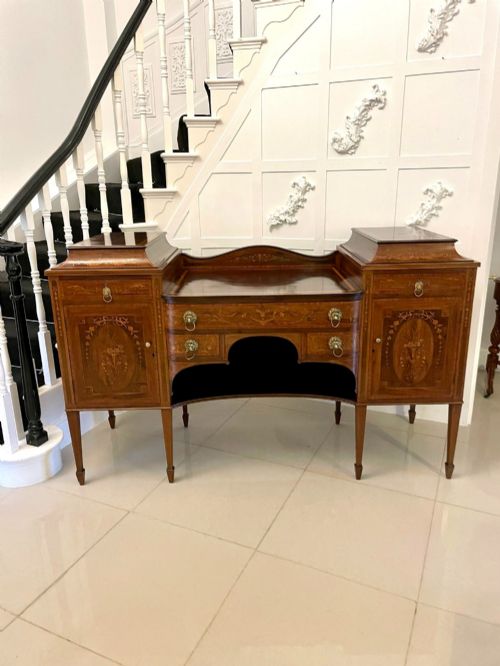
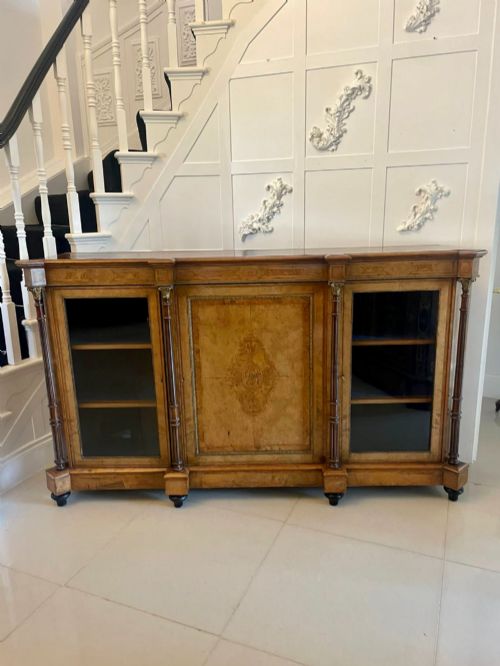
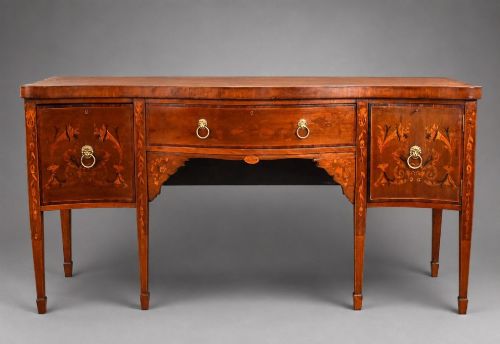
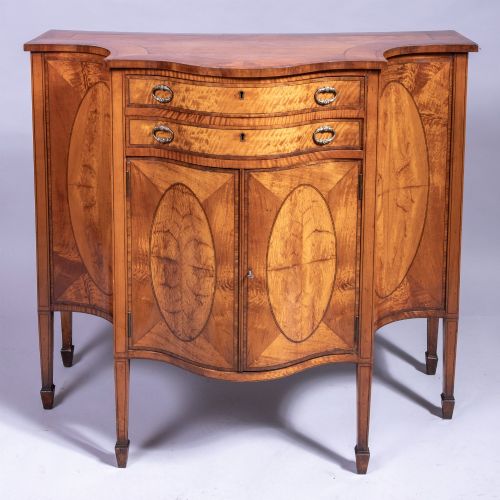
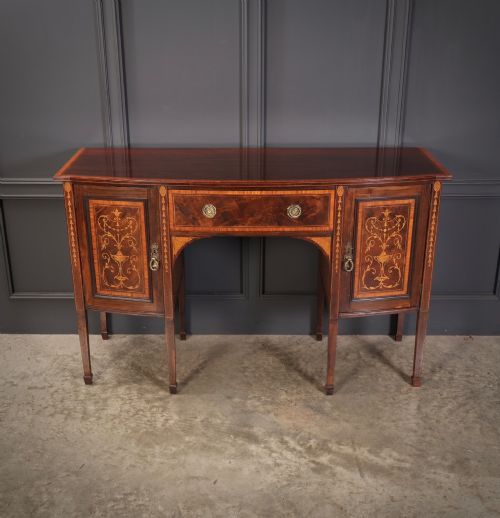
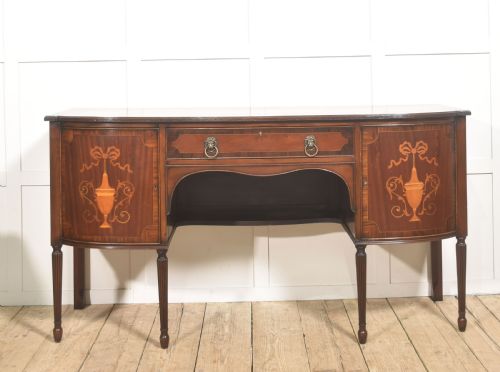

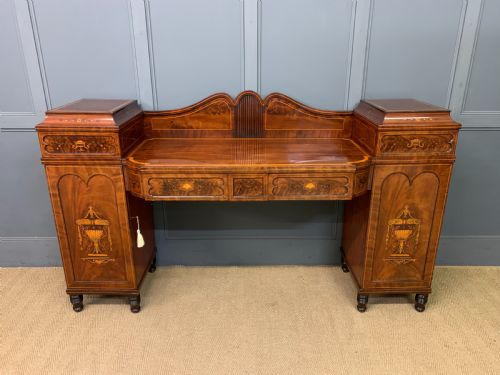


Marquetry Dining Sideboard
A marquetry dining sideboard brings intricate wood-inlaid panels and generous storage to a dining room, combining functional surface space with decorative craft.
Marquetry Dining Sideboard
A marquetry dining sideboard serves as a principal dining room storage piece, emerging primarily across Victorian, Edwardian, and George III revival periods. These items combine deep cupboards and drawers with decorative timber surfaces.
Buyers frequently encounter nineteenth-century mahogany and burr walnut examples featuring elaborate serpentine fronts, bow fronts, and mirrored back credenza variations. Edwardian satinwood pieces and Georgian-style revivals also populate the selection.
Originating largely from English workshops, these cabinets range from compact Edwardian sideboards to large breakfront configurations designed to hold dining silver and linen.
Timbers and inlay techniques
Craftsmen built these sideboards using solid and veneered timbers including mahogany, burr walnut, and satinwood over sturdy pine or oak carcases. Contrasting veneers allowed artisans to cut complex pictorial or geometric patterns directly into the surface.
Makers applied decorative stringing and banded borders in boxwood and rosewood to frame the primary marquetry panels. Ormolu mounts, brass handles, and occasional marble tops finished the constructed framework.
Some Victorian sideboards include secret cellarette drawers lined in lead to keep nineteenth-century bottled wine properly chilled.
Assessing quality and craftsmanship
Quality rests upon the precision of the marquetry cutting and the choice of figured veneers. Finer pieces demonstrate tight, seamless joints where contrasting woods meet without visible filler.
Superior items maintain structural integrity in their serpentine or bow fronts, utilising dense native and exotic timbers that age with depth rather than flat discoloration.
Hewetsons London·Edwards and Roberts·Howard And Sons
The Marquetry Dining Sideboard Glossary
- Marquetry
- A decorative technique applying fitted pieces of wood veneer to a structural structure to form pictorial or geometric designs. It differs from inlay by covering the entire surface rather than set-in recesses.
- Serpentine
- A furniture front curving outward at the centre and inward toward the ends in a continuous wave shape. This profile requires skilled carpentry to shape timber accurately.
- Credenza
- A low dining room cabinet or sideboard, frequently featuring mirrored backs and glass doors in Victorian examples. These pieces originally functioned for serving food and displaying silver.
- Satinwood
- A durable, lustrous timber with a golden-yellow sheen used extensively in Sheraton revival and Edwardian cabinetmaking. It provides a bright contrasting ground for darker marquetry details.
- Ormolu
- Gilded bronze or brass mounted onto furniture as decorative feet, handles, or gallery rails. It adds metallic contrast to polished wood surfaces.
Marquetry Dining Sideboard: Frequently Asked Questions
How do I clean marquetry?
Dust gently with a soft, dry cloth and apply a quality beeswax sparingly to nourish the timber.
Avoid liquid cleaners and excessive moisture, which can loosen delicate wood veneers.
Where should I place a sideboard?
Position the cabinet against a dining room wall away from direct heat sources and strong sunlight.
Keep the room humidity stable to prevent the timber and intricate veneer work from splitting.
How do I date a sideboard?
Examine the secondary woods inside the drawers, construction joints, and overall design style for period characteristics.
Victorian and Edwardian pieces often combine machine-cut elements with hand-finishing, whereas earlier Georgian items rely entirely on hand tools.
Can I use it for storage?
These cabinets offer deep cupboards and drawers originally designed for dining linen, cutlery, and serving dishes.
Ensure items stored inside are not overly heavy to protect internal shelving and antique drawer bases.