
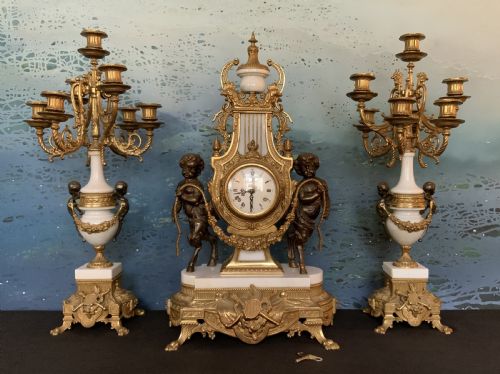


Marble Clock and Candelabras
These heavy, matched assemblies of marble clock and candelabras bring nineteenth-century French drawing-room symmetry to a mantelpiece.
Marble Clock and Candelabras
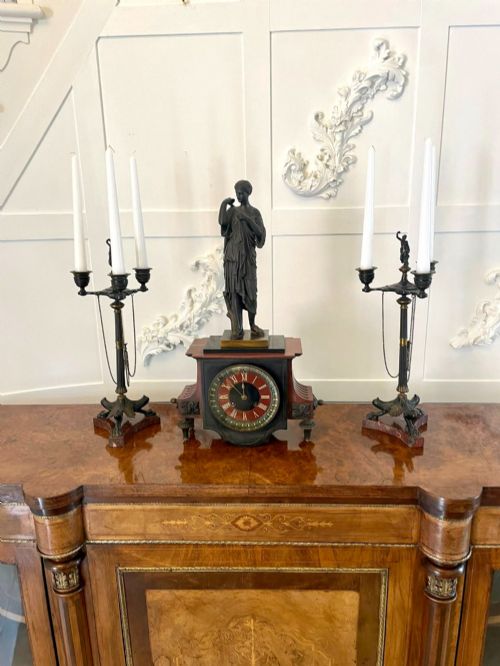
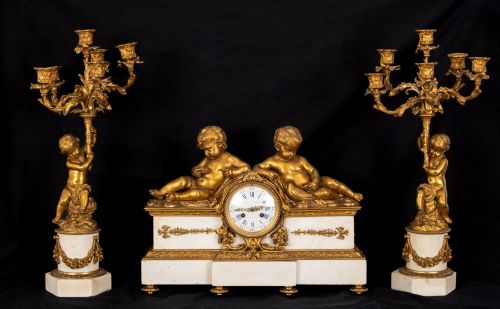
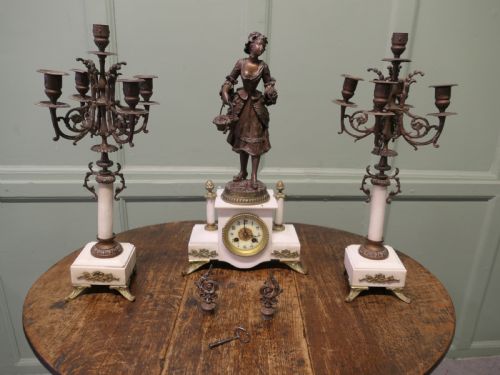
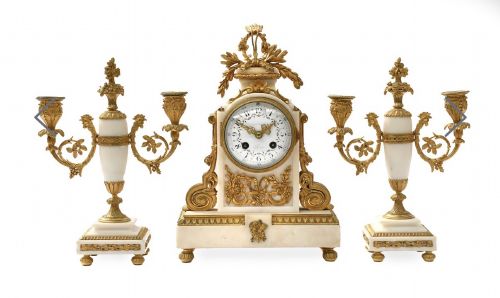
A marble clock and candelabras set combines a central mantel timepiece with a matching pair of side lights, forming a balanced three-piece garniture. The evidence shows these pieces span the nineteenth century, including Victorian, Napoleon III, and Edwardian periods.
Makers working in the Louis XVI revival and French Empire styles dominate the selection, often incorporating classical architectural lines or figural cherubs. Sets appear in various forms of marble, from white and black slate to siena and green onyx variants.
Most examples originate from French workshops, though occasional Italian pieces emerge alongside standard mantel clocks and garniture sets. The matching candelabras mirror the ornamentation of the central clock to create a unified decorative scheme.
How they were made
Foundries cast bronze and brass components into elaborate mounts, which workers then gilded with ormolu to provide a bright metallic finish against the stone. These decorative elements attach directly to carved marble bases using threaded pins and securing nuts.
Clockmakers fitted eight-day mechanical movements featuring enamel dials behind glass bezels, driven by internal springs or pendulums. Subsidiary pieces like candelabras received matching cast arms designed to hold candles securely above drip pans.
Listings feature nineteenth-century French mantel clocks paired with candelabras, utilising materials like white marble, siena marble, and gilt bronze.
What varies in quality
The precision of the bronze chasing separates basic production work from superior examples, as sharper relief work on cherubs and acanthus leaves defines better-made items. Heavier, more deeply coloured marbles indicate denser stone selection by the workshop.
Movement signatures from known makers elevate the standing of a clock set compared to unmarked assembly work. The thickness of the ormolu gilding also determines longevity, since thinner applications wear away to reveal the base brass underneath.
H Luppens Paris·AD Mougin Paris·Vincenti
The Marble Clock and Candelabras Glossary
- Garniture
- A set of ornamental objects designed to match and display together on a mantelpiece or sideboard. Typically comprises a central clock flanked by two matching candelabras or urns.
- Ormolu
- Finely ground high-carat gold mercury-gilded to a bronze or brass object. This technique produces a rich, durable golden surface common on nineteenth-century French decorative items.
- Enamel dial
- A clock face made by fusing powdered glass onto a metal plate at high temperatures. These crisp white surfaces usually feature painted Roman numerals.
- Louis XVI Style
- A neoclassical design vocabulary characterised by straight lines, symmetry, and classical motifs like urns, ribbons, and swags. It experienced a major revival during the nineteenth century.
- Visible pendulum
- A clock design featuring a glass viewing door or open escapement that displays the moving pendulum bob in action. This arrangement allows the observer to watch the mechanical beat of the clock.
Marble Clock and Candelabras: Frequently Asked Questions
How do I wind the clock?
Insert the matching winding key into the small apertures on the enamel dial and turn gently until resistance is felt. Care must be taken not to overwind the mainspring.
Most movements require a weekly turn to maintain the eight-day running cycle. Adjust the pendulum regulation slowly if the timekeeping drifts.
Where should I place a garniture set?
These heavy sets require a deep, sturdy mantelpiece or console table capable of supporting the combined weight of the marble and bronze components. Adequate clearance prevents accidental knocks to the projecting candelabra arms.
Direct sunlight and damp walls should be avoided to protect the marble surfaces and the internal brass clock movement from degradation.
How do I clean the ormolu and marble?
Dust the marble components gently with a dry, soft microfiber cloth to prevent surface scratching. Water and chemical cleaning products can damage porous stone and strip old gilding.
Ormolu mounts require no aggressive polishing, which removes the historic gold layer. A dry brush removes dust from tight crevices in the bronze casting.
How do I identify the period?
Examine the casting style, marble selection, and movement stamps to establish a manufacturing window. Mid-nineteenth-century pieces often favour ornate Victorian or Napoleon III styling, while later decades lean towards refined Louis XVI revival forms.
Maker stamps on the back plate of the clock movement provide the most reliable dating evidence alongside registry marks on the bronze mounts.