

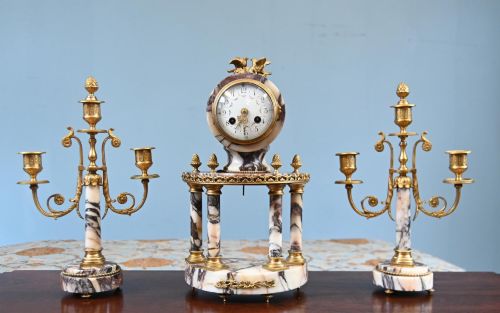
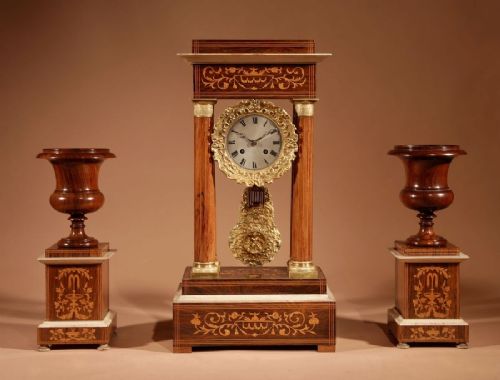


Portico Clock Set
A portico clock set brings together a towering columned mantel timepiece and matching garnitures, offering a formal symmetry beloved by nineteenth-century households.
Portico Clock Set
When you search for a portico clock set, you encounter architectural mantel timepieces flanked by matching candelabras, urns or side pieces. These arrangements form complete garnitures designed to create a balanced centrepiece on a mantelpiece.
The dominant examples on this page stem from the nineteenth century, including Victorian periods and French stylistic revivals. White marble, green marble, pink marble and onyx provide the foundational columned structures.
Many ensembles incorporate visible pendulums swinging between marble or wooden uprights. Ormolu and gilt brass mounts enrich the architectural framework with classical detailing.
Markers of quality
The weight and selection of the marble or onyx define the substance of a set. Dense, evenly coloured stone elevates the piece above simpler constructions.
Movement makers such as Samuel Marti, Japy Freres and AD Mougin stamped their brass mechanisms, marking higher tier production. Crisp chasing on the ormolu mounts separates superior garnitures from standard alternatives.
Portico Clock Set Retail Price Guide 2026
Typical asking prices for portico clock set among the pieces listed under this phrase on Sellingantiques today, from the lower quarter to the upper quarter. They describe what is for sale here now, not the wider market.
AD Mougin·Louis Japy·Samuel Marti·Japy Freres·Fritz Marti
The Portico Clock Set Glossary
- Garniture
- A set of matching decorative objects, typically comprising a central clock accompanied by a pair of candelabras or urns. These groups balance mantelpieces.
- Portico clock
- A mantel clock featuring an architectural case supported by columns reminiscent of a classical portico. The pendulum often swings openly between these pillars.
- Ormolu
- Gilt bronze created by applying a mercury and gold amalgam to cast bronze. This technique imparts a rich, durable golden finish.
- Enamel dial
- A clock face made by fusing powdered glass onto a metal plate at high temperatures. These surfaces provide a smooth, durable background for painted numerals.
Portico Clock Set: Frequently Asked Questions
How do I clean the marble?
Use a soft, dry microfibre cloth to remove dust from the polished stone surfaces. Avoid chemical cleaners or excessive water, which can damage the porous marble and the surrounding ormolu mounts.
Take care around the delicate enamel dial and the glass door housing the movement. Gentle maintenance preserves both the stone polish and the antique metalwork.
How do visible pendulums work?
A visible pendulum swings freely within the open space between the columns of the portico case. This suspended mechanism adds a dynamic visual element to the stationary architectural frame.
Many nineteenth-century French movements utilise this layout to showcase the rhythmic motion alongside the decorative ormolu bob.
Where should I place a set?
Mantelpieces and large sideboards provide the ideal depth and sturdy support required for these heavy marble and bronze groupings. The central clock sits flanked by its matching sidepieces to maintain the intended symmetry.
Ensure the surface is level so the pendulum beats evenly and the clock keeps accurate time.
Are these clocks difficult to maintain?
Mechanical movements require periodic winding using the appropriate key and occasional professional servicing to clean the gears. Setting the beat accurately ensures the pendulum continues to swing reliably.
Keeping the clock out of direct sunlight and away from damp areas protects both the internal brass springs and the external marble finish.