
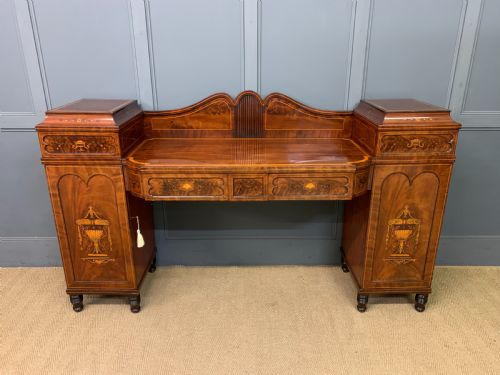


Mahogany Twin Pedestal Buffet
A mahogany twin pedestal buffet offers serious dining room presence, combining deep timber tones with twin pedestals.
Mahogany Twin Pedestal Buffet
A mahogany twin pedestal buffet represents a substantial dining room storage piece defined by two flanking pedestals united by a central section, often listed under sideboards and credenzas. When you search for a mahogany twin pedestal buffet, you encounter formats spanning the Georgian, Regency, and Victorian periods.
The versions most commonly met on this page range from George III and Regency examples to later Victorian pieces. These items serve as both display furniture and functional storage for dining rooms.
Origins vary from standard British cabinetmaking to Anglo-Indian workshops utilising padouk wood. The forms incorporate drop wells and brass galleries depending on the specific period of manufacture.
How they were made
Cabinetmakers constructed these sideboards using solid mahogany and applied flame mahogany veneer over secondary timbers. They highlighted the grain patterns on the drawer fronts and pedestal doors.
Detailed decoration involved contrasting timber inlays utilising boxwood and satinwood, paired with cast brass galleries and hardware. Padouk wood appears in specific Anglo-Indian examples from the Regency era.
Listings span multiple nineteenth-century styles, incorporating Georgian, Regency, and Victorian periods alongside Anglo-Indian variations.
What varies in quality
Quality rests upon the selection of timber veneers and the precision of the wood inlay work. Figured mahogany and well-matched flame veneer distinguish the finer examples from plain constructions.
The integration of brass galleries and the crispness of the joinery mark the difference between standard production and superior craftsmanship. Original hardware and sound structural integrity elevate the piece.
The Mahogany Twin Pedestal Buffet Glossary
- Pedestal
- A structural pillar or cabinet base supporting one side of the sideboard. Twin pedestals anchor each end of the piece.
- Drop well
- A lowered central section between the two pedestals of the sideboard. This profile appears frequently in Regency designs.
- Flame mahogany veneer
- A sliced layer of timber showing a flickering, flame-like grain pattern applied to the carcass. This veneer enhances the visual depth of the surface.
- Brass gallery
- A decorative metal rail mounted on the upper back edge of the sideboard. It prevents items from sliding off the top surface.
- Padouk wood
- A dense tropical timber utilised in Anglo-Indian furniture production. It provides a distinct reddish-brown tone.
Mahogany Twin Pedestal Buffet: Frequently Asked Questions
What is a twin pedestal buffet used for?
These pieces function as dining room servers for storing crockery, cutlery, and glassware. The top surface provides space for serving food or displaying decorative objects during meals.
Their robust construction allows them to handle heavy tableware inside the cupboards and drawers while anchoring the dining room decor.
How do I tell Georgian from Victorian pieces?
Georgian and Regency examples tend to feature refined proportions, delicate boxwood or satinwood inlay, and sometimes brass galleries. They display restrained elegance characteristic of the late eighteenth and early nineteenth centuries.
Victorian pieces generally present heavier proportions, bolder figured mahogany veneers, and more robust architectural details without the earlier stringing.
Where does the brass gallery go?
The brass gallery mounts along the rear top edge of the sideboard buffet. It acts as a low fence for retaining plates and serving dishes.
Many surviving pieces retain the fixing holes even if the original gallery rail is absent.
How do I care for mahogany furniture?
Maintain the timber by keeping the piece away from direct heat sources and strong sunlight to prevent the veneer from drying out. Regular dusting with a soft, dry cloth preserves the polished finish.
Apply high-quality beeswax sparingly when the wood appears dry, buffing gently to maintain the natural sheen.