
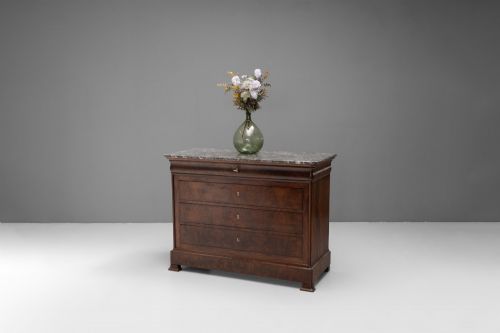


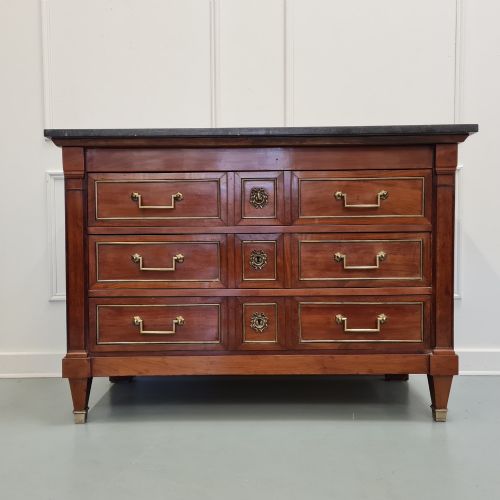
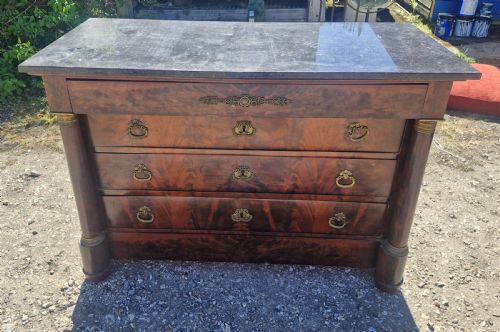


Mahogany Marble Commode
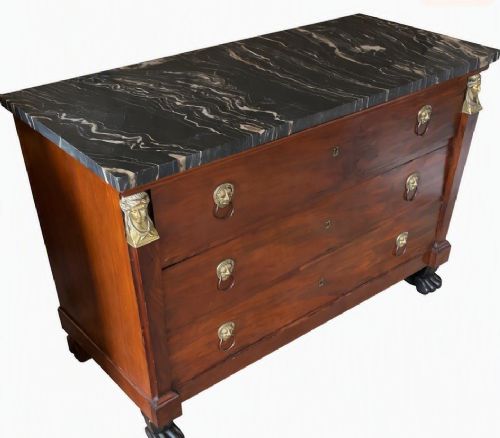
When choosing a mahogany marble commode, you select a substantial storage piece defined by dense timber and a cool stone slab.

Mahogany Marble Commode
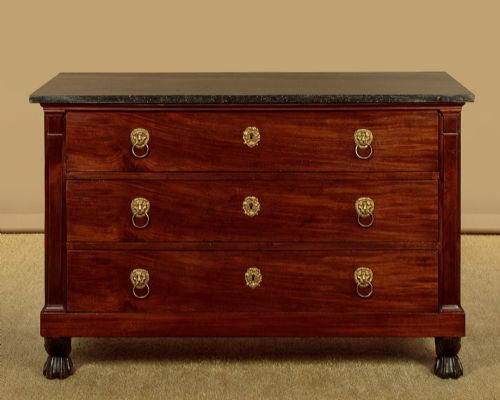
A mahogany marble commode functions primarily as a low chest of drawers or bedroom storage cabinet, topped with fitted stone.
Most pieces seen originate from nineteenth-century France, spanning the Empire, Louis Philippe, and Louis XVI revival styles.
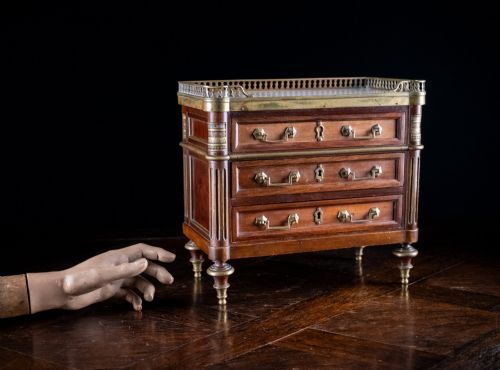
Forms range from straight-fronted chests and bow-front cabinets to compact bedside tables and miniature chests.
Materials and Construction
Carpenters constructed carcasses from solid pine or oak, then applied veneers of figured mahogany, flame mahogany, or tulipwood.
Heavy marble slabs, varying from grey and fossilised varieties to white or Verde Alpi, rest directly upon the timber surface.
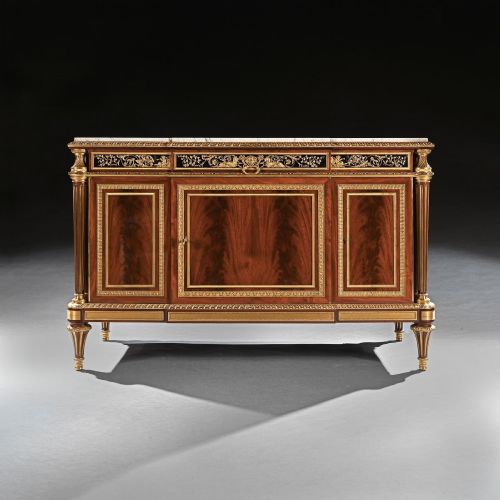
Mounts, handles, and key escutcheons utilise cast or gilt bronze and ormolu, fixed to the drawer fronts.
Listings feature eighteenth-century transitional pieces alongside nineteenth-century French Empire and Louis XVI revival cabinets.
Grading Quality
The choice of timber grain separates standard pieces from finer examples, with symmetrical flame mahogany veneers commanding greater attention.
The weight, thickness, and geological character of the marble top dictate the overall caliber of the construction.
Chiselled detail in the ormolu mounts and the precision of the dovetail joinery reveal the competence of the workshop.
Henry Dasson·Weisweiler·Mon Krieger·Jean-Henri Riesener
The Mahogany Marble Commode Glossary
- Commode
- A low French chest of drawers designed for domestic storage. It typically sits at a lower height than standard English chests.
- Ormolu
- Gilded bronze used for decorative mounts and feet. This technique provides metallic contrast against dark timber.
- Flame mahogany
- A veneer cut from the branch junction of the tree. The resulting grain pattern resembles flickering flames.
- Verde Alpi
- A dark green marble with white veining. It appears frequently on nineteenth-century French cabinet tops.
- Directoire
- A transitional style bridging Louis XVI and Empire periods. It relies on clean architectural lines rather than heavy ornamentation.
Mahogany Marble Commode: Frequently Asked Questions
How do I clean the marble top?
Use warm water and a soft cloth to wipe the stone surface clean. Avoid acidic liquids like vinegar or lemon juice that can etch the polish.
Dry the marble thoroughly with a clean towel to prevent water spots from settling into the porous stone.
Are these commodes suitable for everyday bedroom use?
These pieces provide deep drawers that hold folded clothing and linens easily. The stone surface acts as a durable platform for lamps and personal items.
Keep heavy objects away from the overhanging edges of the marble to prevent accidental tipping or cracking.
How do I distinguish Empire style from Louis Philippe?
Empire pieces display strong classical geometry, often featuring heavy ormolu mounts and strict symmetry. They reflect early nineteenth-century design influences.
Louis Philippe examples emphasise plain timber surfaces and curved ogee drawer fronts, favoring minimal decoration over classical bronze mounts.
Can I remove the marble top?
Most marble slabs rest unattached on top of the wooden frame, held in place only by their own heavy weight. Lifting the stone requires two people to prevent dropping or chipping the edges.
Check for wooden battens underneath before lifting, as some pieces secure the slab with internal brackets.