
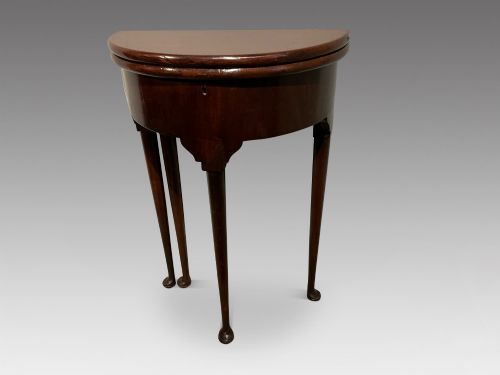


Mahogany Gate Leg Table
A mahogany gate leg table offers a folding design supported by swinging legs, combining compact storage with expandable surfaces for dining or display.
Mahogany Gate Leg Table
When you search for a mahogany gate leg table, you are looking at practical furniture designed to expand via hinged flaps and pivoting legs. These tables appear frequently in 18th-century Georgian forms as well as later Victorian and Edwardian iterations.
The pieces on this page span formats ranging from small occasional tables and spider leg designs to large dining tables intended to seat several people. You will encounter rectangular, oval, and round surfaces supported by timber frames that fold away when space is required.
How they were made
Cabinet makers utilised solid mahogany and Cuban mahogany timber alongside secondary woods like fruitwood and walnut for internal framing. Surfaces often feature satinwood inlay, boxwood stringing, or brass fittings depending on the period of manufacture.
Construction relies on hinged drop leaves attached to a fixed centre section, with pivoting gate legs that swing outward to support the extended flaps. Joinery includes turned legs, pad feet, and barley twist supports that stabilise the expanding structure.
Listings feature periods spanning from the 18th century through the Georgian, Victorian, and Edwardian eras up to the 1940s.
What varies in quality
Quality rests in the choice of timber density, grain figure, and the structural integrity of the pivoting gate mechanism. Examples featuring dense Cuban mahogany with rich patination sit at the top of the range compared to simpler utility pieces.
Refinement of the leg turning and the precision of the hinges distinguish finer examples from standard production. A well-constructed table maintains rigid stability when fully extended without sagging at the drop leaf joints.
The Mahogany Gate Leg Table Glossary
- Gate leg
- A table design where hinged legs swing outward like a gate to support drop leaves. This mechanism allows a compact surface to double in size.
- Drop leaf
- A hinged table flap that hangs down when lowered and locks into a horizontal position when raised.
- Pad foot
- A rounded foot shape resting flat on the floor, frequently seen on 18th-century Georgian furniture.
- Spider leg
- A style featuring very slender turned wooden legs that provide delicate support for small occasional tables.
- Sutherland table
- A narrow-profile drop leaf table with exceptionally slim gate legs designed to fold down to a minimal width.
- Barley twist
- A decorative turning technique resembling a spiral rope, popular in various periods of British furniture.
Mahogany Gate Leg Table: Frequently Asked Questions
How do you operate a gate leg table?
To open the table, you lift one of the hinged drop leaves upward until it rests level with the centre top. Then you swing the pivoting gate leg outward from beneath the frame until it locks into position under the leaf.
To close the table, you swing the gate leg back inward toward the centre base and lower the drop leaf gently. This allows the furniture to fold into a slim profile for storage against a wall.
What rooms suit a mahogany gate leg table?
Smaller spider leg and Sutherland variations fit easily into sitting rooms or hallways as occasional surfaces for display. They occupy minimal floor space while providing extra surface area when unfolded.
Larger Georgian and Victorian versions serve as dining tables in principal rooms. Their expandable nature accommodates multiple guests during meals before folding away to free up floor space.
How do I distinguish an 18th-century table from a later copy?
Eighteenth-century examples often display deep natural patination, hand-turned timber components, and traditional joinery marks specific to Georgian workshops. Woods like Cuban mahogany exhibit distinct weight and grain density.
Later Edwardian and 20th-century revivals typically show uniform machine shaping and different internal construction methods. Examining the underside and the hinge fixings reveals the age and manufacturing techniques employed.
Did these tables function as dining furniture originally?
Many large 18th-century versions served primarily as dining tables for households requiring flexible room arrangements. Their folding leaves allowed dining rooms to be cleared quickly after meals.
Smaller iterations functioned as tea tables, supper tables, or occasional furniture. Their dual purpose made them essential items in historic domestic interiors.