

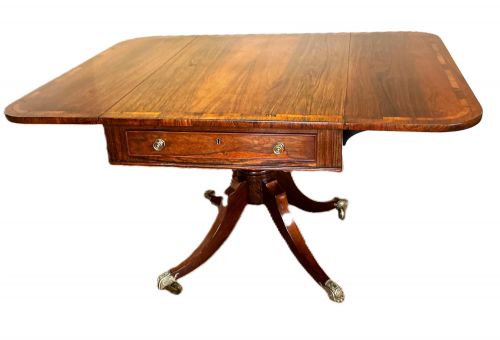

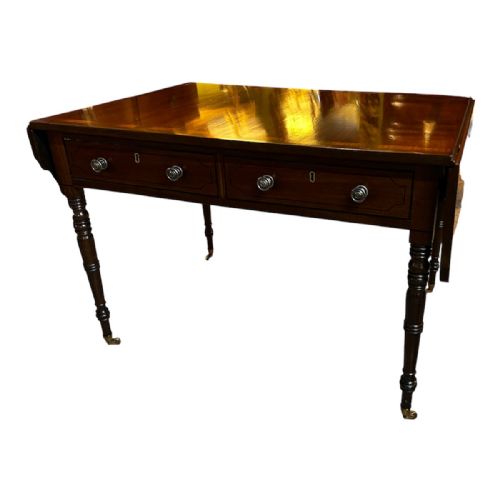


Crossbanded Drop Leaf Table
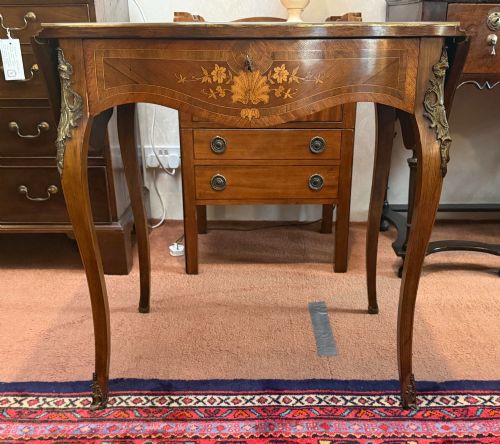
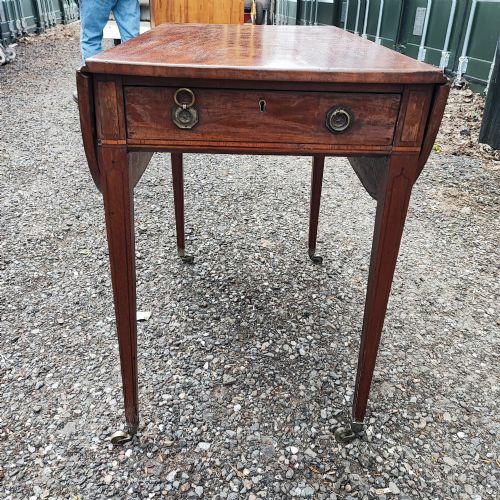
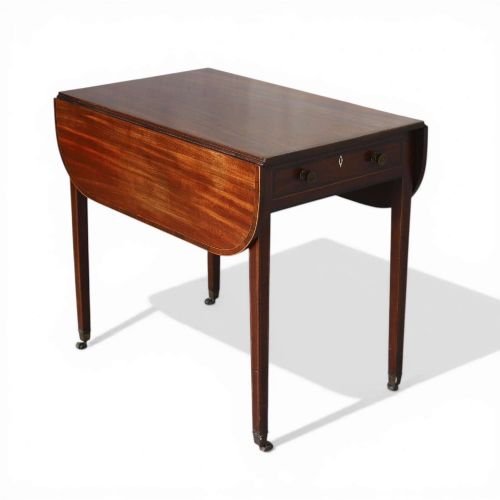
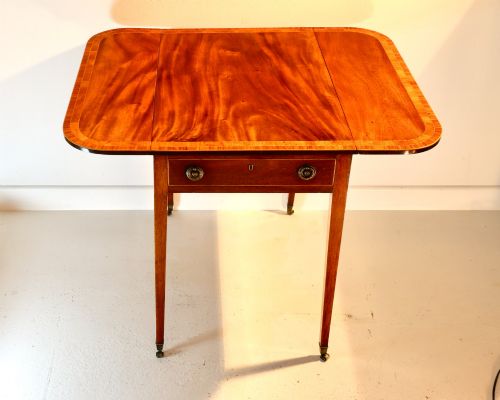
A crossbanded drop leaf table brings functional elegance to a room through contrasting timber borders and folding flaps.
Crossbanded Drop Leaf Table
A crossbanded drop leaf table encompasses forms such as sofa tables, Pembroke tables, and occasional pieces originating primarily from the Georgian, Regency, and Edwardian eras. Buyers searching for a crossbanded drop leaf table will encounter variants in mahogany, satinwood, and rosewood produced across the eighteenth and nineteenth centuries.
The Pembroke and sofa table predominate in this selection, often featuring drop flaps supported by hinged rule joints or swing brackets. Examples date from the late eighteenth century through to Edwardian interpretations, reflecting shifting domestic requirements for adaptable furniture.
Materials and construction
Cabinet makers utilised solid timbers and veneers of mahogany, satinwood, and rosewood, applying contrasting decorative borders in boxwood, kingswood, or partridge wood to frame the tops and flaps. Secondary woods provided structural stability beneath fine surface veneers.
Drop leaves operated through pivoted wooden flaps or under-frame brackets, while brass castors frequently aided mobility on larger sofa and library tables.
Listings feature mahogany, satinwood, rosewood, and walnut tables spanning the Georgian, Regency, and Edwardian periods.
Judging execution
Quality rests upon the precision of the timber matching and the subtlety of the crossbanding against the primary field. Grain selection and the crispness of inlaid stringing distinguish superior workshops from standard output.
The structural integrity of the drop leaf hinges and the smoothness of operating mechanisms determine daily utility and long-term preservation.
James Mein Kelso
The Crossbanded Drop Leaf Table Glossary
- Crossbanding
- A border veneer applied perpendicularly to the grain of the main surface. This technique frames the top of a table with contrasting timber.
- Pembroke table
- A small rectangular table with two hinged drop flaps on opposing sides. It often includes one or two small drawers.
- Sofa table
- A long, narrow table designed to stand in front of a sofa. Regency examples frequently feature dual pedestals or trestle ends.
- Rule joint
- A moulding profile applied to the meeting edges of a table top and its drop leaf. It conceals the gap and pivots around the hinge pin.
Crossbanded Drop Leaf Table: Frequently Asked Questions
Where should I place a drop leaf table?
These tables adapt well to central room placement or against a wall with one or both flaps lowered. Their compact footprint suits hallways, reception rooms, and spaces requiring flexible surface area.
Opening the leaves provides ample space for serving or writing, while dropping them returns the piece to a slender console profile.
How do I identify a Regency sofa table?
Regency sofa tables typically feature twin pedestals, lyre ends, or sabre legs terminating in brass castors. They often incorporate two small drawers and generous proportions suited to nineteenth-century drawing rooms.
The use of rosewood or figured mahogany with contrasting satinwood banding frequently marks the period style.
What is the difference between a Pembroke and a sofa table?
A Pembroke table is generally smaller and square or rectangular with short drop leaves on the long sides, historically used for breakfast or writing. Sofa tables are longer and narrower, traditionally positioned behind a sofa.
Sofa tables frequently feature trestle bases or twin pedestals joined by a central stretcher, unlike the four-legged configuration of standard Pembroke designs.
How do I care for polished veneer surfaces?
Maintain polished timber by dusting with a soft cloth and avoiding direct sunlight or excessive heat sources. Wax finishes benefit from occasional application of appropriate beeswax to nourish the wood.
Protect surfaces from moisture and heat by using coasters and mats beneath objects.