

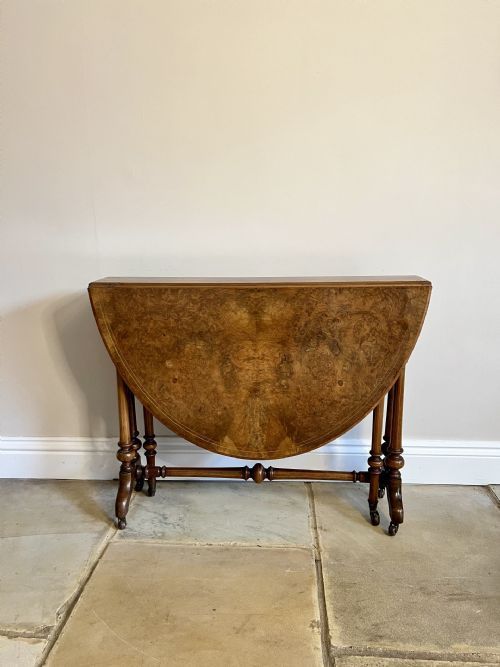


Antique Inlaid Sutherland Table
An antique inlaid sutherland table is a slender, folding gate-leg occasional piece offering both compact charm and a generous drop leaf surface when needed.
Antique Inlaid Sutherland Table
The search phrase antique inlaid sutherland table brings up a specific form of drop-leaf table that stands on narrow gate legs, designed to fold down flat against a wall when floor space is at a premium. These pieces emerge predominantly from the Victorian and Edwardian eras, spanning from the late nineteenth century into the early twentieth century.
On this page, buyers primarily encounter variations fashioned in mahogany, burr walnut, and rosewood, often enhanced with satinwood inlay or floral marquetry. The domestic forms function well as side tables, lamp tables, or small coffee tables within modern reception rooms.
The structure relies upon hinged flaps supported by pivoting legs, creating a narrow footprint when closed and a substantial oval or rectangular surface when fully extended. Many examples retain original brass and ceramic castors beneath their slender upright supports.
What varies in quality
The distinction between standard examples and superior pieces rests on the choice of timber and the complexity of the marquetry. Cabinet makers who employed highly figured burr walnut or rosewood achieved a richer visual depth than those who used plain mahogany.
The crispness of the inlay and the precision of the mitred joints reveal the skill of the original workshop. Finer tables balance decorative satinwood banding with delicate boxwood lines that remain flush with the surrounding wood.
Proportion and scale also separate the items, with diminutive baby sutherland tables requiring greater refinement to maintain stability while keeping the framework light and graceful.
Listings feature mahogany, burr walnut, and rosewood tables produced across the Victorian and Edwardian periods.
The Antique Inlaid Sutherland Table Glossary
- Sutherland table
- A narrow drop-leaf table with hinged flaps supported by pivoting gate legs. Richard Grenville, the third Duke of Sutherland, and his wife gave their name to this specific nineteenth-century design.
- Marquetry
- The art of applying pieces of veneer to a structure to form decorative patterns and pictures. Craftsmen cut various woods to fit together precisely before gluing them to the tabletop.
- Gate leg
- A leg hinged to a swing-out frame that supports a drop leaf when extended. This mechanism allows the side of the table to fold down completely.
- Satinwood inlay
- A contrasting light-coloured timber inserted into recesses in darker wood surfaces. It provides decorative borders and geometric lines.
- Drop leaf
- A hinged section of a table top that folds down when not in use. It enables the furniture to occupy minimal space.
Antique Inlaid Sutherland Table: Frequently Asked Questions
What is a sutherland table?
A sutherland table is a narrow drop-leaf design featuring hinged flaps supported by swinging gate legs. When folded down, the leaves hang almost vertically, allowing the piece to rest against a wall.
Cabinet makers developed this form during the Victorian period for flexible use in drawing rooms and parlours. The narrow profile makes them practical for modern hallway or living room spaces.
How do you date an antique sutherland table?
Dating relies on timber selection, construction methods, and decorative styles. Pieces from the Victorian era often feature burr walnut and rich marquetry inlay, while Edwardian versions frequently showcase mahogany with satinwood banding.
Hardware such as brass and ceramic castors also offers clues to the period of manufacture. Earlier nineteenth-century examples tend to display heavier turnings compared to later Edwardian variants.
How were sutherland tables used?
These tables served as versatile occasional furniture for tea, reading, or needlework in nineteenth-century homes. Families kept them folded against the perimeter of a room until extra surface area was required.
The pivoting gate legs allowed one person to raise or lower the leaves instantly. Today, collectors utilise them as lamp tables or compact coffee tables.
What is a baby sutherland table?
A baby sutherland table is a smaller, diminutive version of the standard drop-leaf design. These miniature pieces maintain the same gate-leg mechanism and inlaid top in a reduced scale.
Victorian and Edwardian makers produced them for tighter spaces or bedroom use. Their compact proportions make them suitable for placement beside a sofa.