
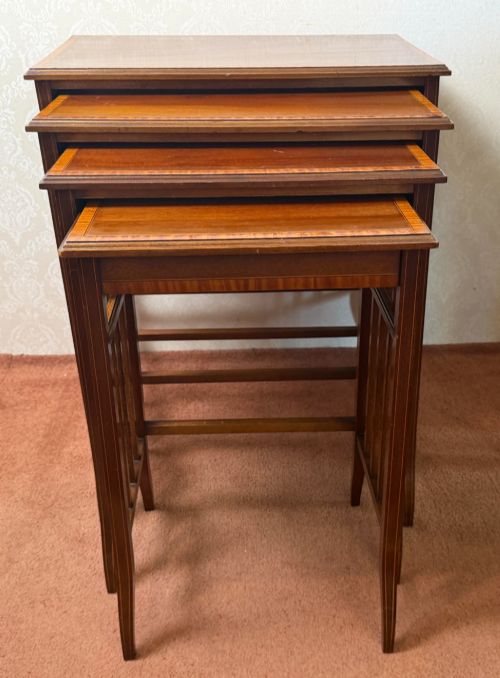


Satinwood Banded Table
Satinwood banded table designs bring together contrasting timbers and precise borders, offering refined surfaces for dining, writing and display.
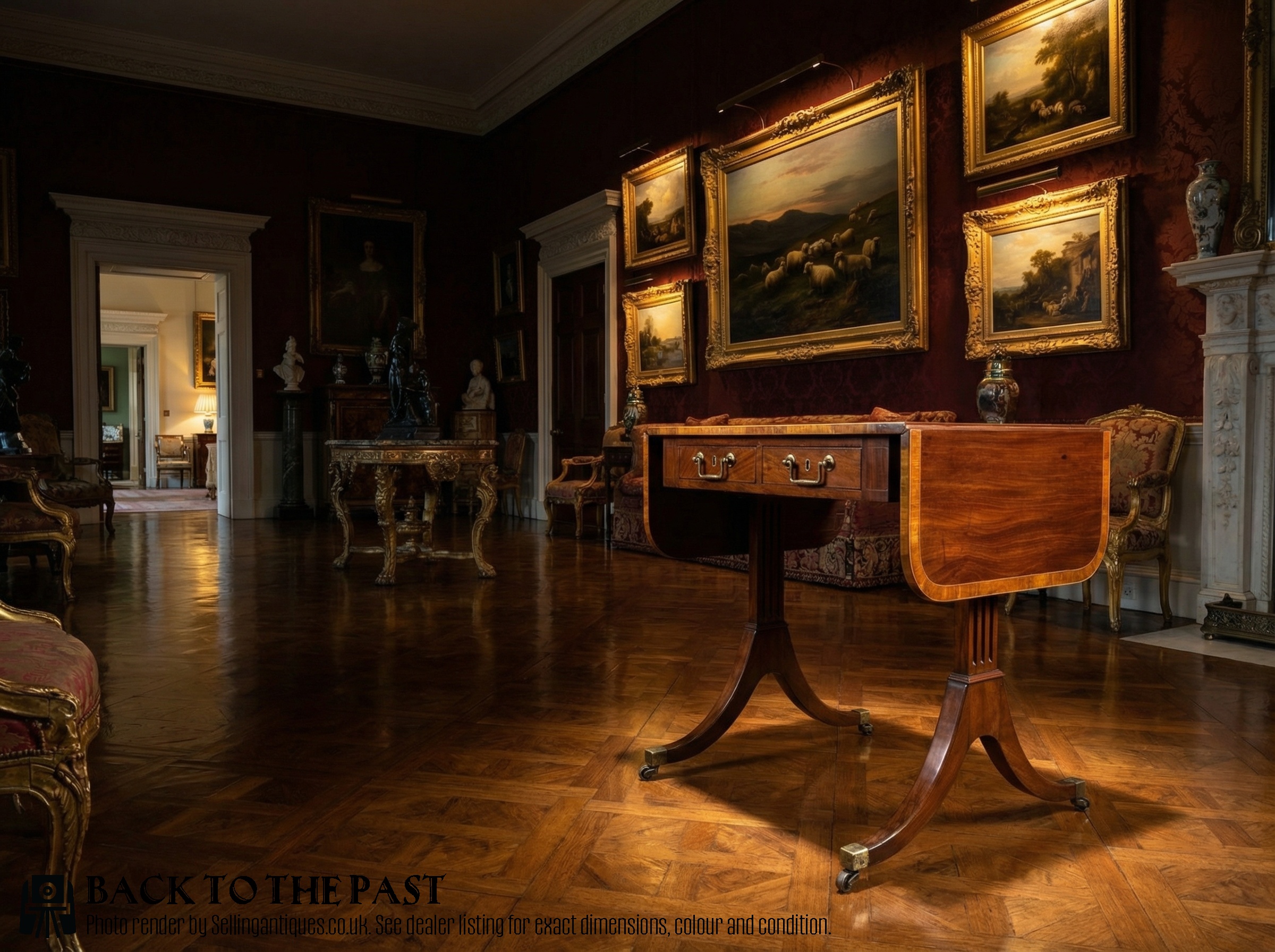
Satinwood Banded Table
A satinwood banded table employs contrasting light timber borders around primary woods like mahogany, rosewood or kingwood. The pieces span Georgian, Regency, Victorian and Edwardian periods, appearing in forms ranging from card tables and sofa tables to Pembroke and occasional tables.
The version most commonly encountered on this page is the mahogany or rosewood occasional or Pembroke table edged with satinwood bands. These tables demonstrate how cabinetmakers utilised lighter exotic veneers to frame darker surfaces during the eighteenth, nineteenth and early twentieth centuries.
How they were made
Cabinetmakers constructed these tables using solid primary timbers such as mahogany and rosewood for the main carcase and legs. They applied thin veneers of satinwood, tulipwood and kingwood to the edges and borders, often incorporating boxwood and ebony stringing to divide the contrasting zones.
Veneers were sawn by hand in earlier periods and later sliced with mechanical saws, then secured to the substrate using animal glues. Inlays and cross-banding required exact joinery to ensure the grain patterns met cleanly at the corners and curves.
Satinwood Banded Table Retail Price Guide 2026
Typical asking prices for satinwood banded table among the pieces listed under this phrase on Sellingantiques today, from the lower quarter to the upper quarter. They describe what is for sale here now, not the wider market.
Listings feature woods including satinwood, mahogany, rosewood, kingwood, tulipwood and boxwood across Georgian, Regency and Edwardian periods.
What varies in quality
The level of execution depends on the precision of the banding and the selection of the veneers. High-grade examples display tight, even grain matching along the borders and intelligent contrast between the satinwood and the secondary timbers.
Construction methods also dictate worth, distinguishing workshop pieces built with sturdy secondary woods and hand-cut dovetails from later mass-produced items. The handling of secondary details like tapered legs or inlaid stringing separates standard furniture from finer productions.
Ambrose Heal·Gillows
The Satinwood Banded Table Glossary
- Cross-banding
- A border of veneer laid so that the grain runs at right angles to the edge of the piece. This technique creates a distinct visual frame around tabletops and drawer fronts.
- Satinwood
- A lustrous, yellow-gold timber imported from tropical regions, valued for its reflective quality. It serves as the primary banding material on many mahogany and rosewood tables.
- Pembroke table
- A drop-leaf table with hinged flaps on two opposing sides, introduced in the eighteenth century. They frequently feature satinwood borders along the top and drawer edges.
- Stringing
- Thin lines of contrasting wood inlaid into channels on a tabletop or leg. Boxwood and ebony are common choices for this linear decoration.
- Sofa table
- A rectangular piece designed to stand in front of a sofa, typically featuring drop leaves and paired pedestal supports. The tops are frequently decorated with cross-banded veneers.
Satinwood Banded Table: Frequently Asked Questions
What periods do these tables cover?
The pieces span from the late eighteenth century through the Georgian and Regency eras into the Victorian and Edwardian periods. Later Sheraton revival items from around nineteen hundred also appear.
Craftsmanship and timber choices evolved across these eras, moving from hand-selected solid woods and fine veneers to later revival designs.
How do I identify satinwood banding?
Satinwood banding appears as a pale, golden border running along the perimeter of tabletops or drawer fronts. It contrasts sharply against darker woods like mahogany, rosewood or kingwood.
Close inspection reveals the natural chatoyant grain of the satinwood, which reflects light differently than the surrounding timber.
Where were these tables used originally?
They served multiple domestic functions in drawing rooms, dining rooms and parlours. Card tables and Pembroke tables were brought out for specific social activities, while serving and sofa tables remained against walls or behind furniture.
Smaller occasional and lamp tables occupied corners and bedside spaces to hold lighting or books.
How should I care for a veneered table?
Protect the surface from direct sunlight and excessive moisture to prevent the nineteenth-century veneers from lifting. Maintaining stable room humidity preserves the delicate animal glues beneath the satinwood borders.
Occasional application of appropriate wax polish helps nourish the historic timber without harming the polished finish.