



Louis XVI Walnut Bed
A louis xvi walnut bed brings French neoclassical grace to a bedroom through refined proportions and warm wood tones.
Louis XVI Walnut Bed
When you search for a louis xvi walnut bed, you are looking at French neoclassical sleeping furniture defined by architectural straight lines, symmetry, and carved detail. The pieces available here span from the late nineteenth century through the Edwardian era, predominantly capturing the Louis XVI revival taste.
The aesthetic draws heavily on eighteenth-century French chateau design, reinterpreted by later makers during the nineteenth and early twentieth centuries. These beds offer substantial presence in a bedroom while maintaining the restrained elegance characteristic of the neoclassical revival.
Materials and construction
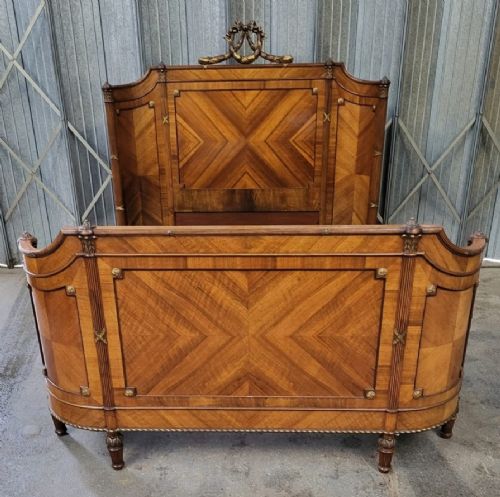
Construction relies primarily on solid walnut and fruitwood veneers, frequently arranged in quarter veneered or marquetry patterns to create geometric surface interest. Cabinetmakers utilised skilled woodworking techniques to build sturdy bed frames that could support decorative elements without warping.
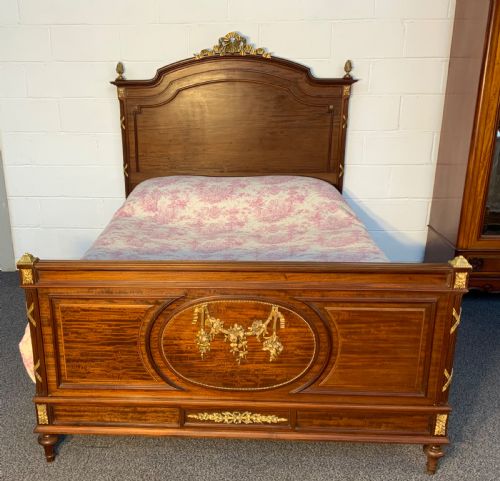
Metal detailing in brass and ormolu appears as mounts and trimming, highlighting the structural lines of the headboards and footboards. Certain examples introduce hand-painted floral panels or fabric upholstery to soften the dense timber framework.
Louis XVI Walnut Bed Retail Price Guide 2026
Typical asking prices for louis xvi walnut bed among the pieces listed under this phrase on Sellingantiques today, from the lower quarter to the upper quarter. They describe what is for sale here now, not the wider market.
The site's listings show walnut, mahogany, and fruitwood veneers used across nineteenth-century and Edwardian French revival bed frames.
Assessing quality
Quality in these beds rests on the crispness of the carving and the precision of the veneer work across the headboard and footboard. Pieces with intricate marquetry, balanced quarter veneers, or detailed brass mounts display a higher degree of workshop skill than plain panelled examples.
The choice of secondary timbers and the integrity of the joinery determine the overall durability and weight of the bedstead. Finer examples integrate hand-painted floral decoration or sophisticated French neoclassical motifs with harmonious proportions.
The Louis XVI Walnut Bed Glossary
- Walnut
- A dense, dark hardwood prized for its rich grain patterns and warm colour. It serves as the primary structural and visual material for these beds.
- Ormolu
- Gilded bronze applied as decorative mounts and hardware. It adds metallic contrast to the warm walnut timber.
- Marquetry
- The art of applying small pieces of veneer to a structure to form decorative patterns. This technique creates intricate surface designs on bed panels.
- Quarter Veneer
- Wood veneer sliced and arranged so the grain patterns mirror each other in four quadrants. This creates a symmetrical, decorative focal point on large surfaces.
- Neoclassical
- A style reviving classical Roman and Greek motifs, focusing on straight lines and symmetry. It defines the architectural silhouette of these pieces.
Louis XVI Walnut Bed: Frequently Asked Questions
What defines a louis xvi walnut bed?
These beds are characterised by straight architectural lines, symmetrical proportions, and classical revival ornamentation derived from eighteenth-century French design.
They typically feature walnut timber, sometimes enhanced with marquetry, brass mounts, or painted floral panels.
What periods do these beds come from?
The listings here feature pieces predominantly from the nineteenth and early twentieth centuries, including Edwardian interpretations.
These later periods embraced the French Louis XVI revival style, replicating earlier chateau aesthetics with period woodworking techniques.
How do I choose the right size?
Beds in this category appear in double and king sizes, accommodating modern mattresses while retaining their antique frames.
Consider the scale of the headboard and footboard in relation to your bedroom space, as revival pieces often feature prominent architectural crests.
What materials are used besides walnut?
While walnut forms the primary structure, makers incorporated fruitwood veneers, brass, ormolu, and painted finishes.
Upholstered panels in fabric and decorative marquetry also appear to add texture and visual variety to the headboards.