


Louis XVI Curio Cabinet
A louis xvi curio cabinet brings classical French symmetry and glazed display space into a room, framed by gilt mounts.
Louis XVI Curio Cabinet
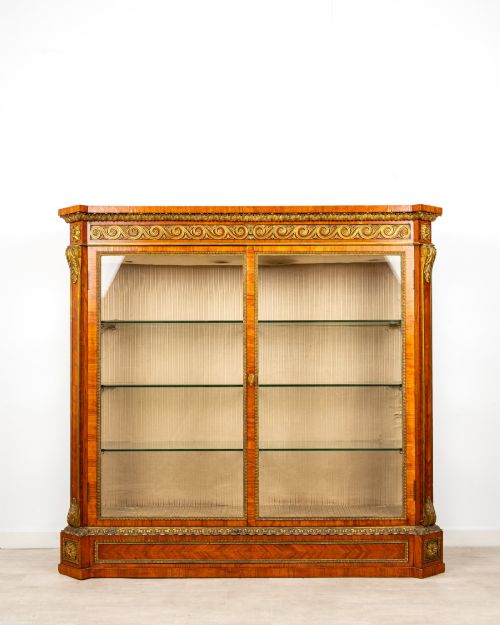
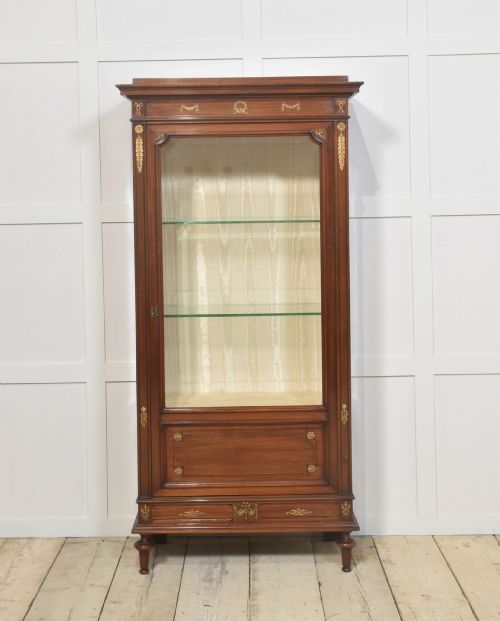
A louis xvi curio cabinet takes the form of a glazed display cabinet or vitrine, originating primarily in nineteenth-century France and Edwardian workshops. These pieces draw upon Louis XVI style, Louis XVI revival, and transitional aesthetics to house porcelain, silver, and curiosities.
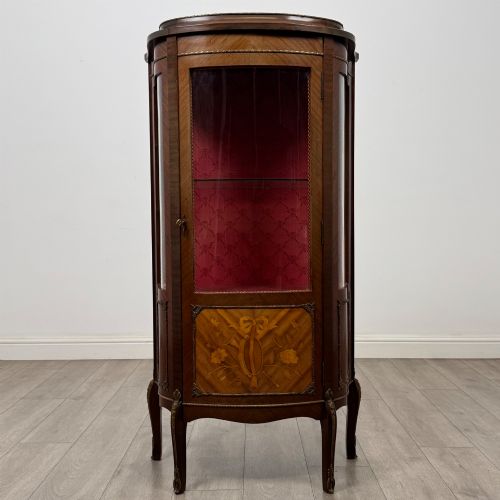
The versions most frequently met on this page span the nineteenth century up to nineteen hundred, constructed in mahogany, kingwood, and rosewood. They stand on slender tapered legs, carrying marble tops, parquetry, and marquetry in classical revival designs.
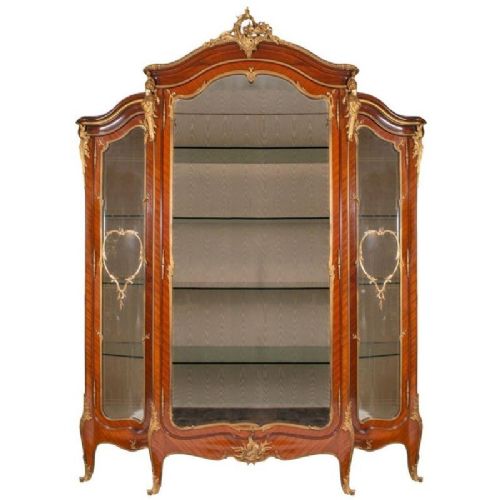
Makers such as François Linke, Maison Krieger, H. J. Hatfield and Sons, and Paul Somani produced these cabinets, ranging from freestanding oval vitrines to large exhibition pieces. They merge architectural symmetry with fine timber veneers and glass panels.
Materials and construction
Cabinetmakers built these pieces using foundational carcases of mahogany or oak, overlaid with decorative veneers of kingwood, rosewood, and marquetry. Marble tops in white or coloured varieties sit atop several of the larger cabinets.
Ormolu and gilt-bronze mounts decorate the corners, friezes, and feet, cast and chased in classical foliate and ribbon motifs. Glass panels are set into doors and sides to enclose the velvet or fabric-lined display interiors.
Listings feature pieces spanning the nineteenth century and Edwardian period, utilising mahogany, kingwood, rosewood, and ormolu mounts.
Judging quality and execution
The standard of an ormolu mount separates standard production from exhibition quality, seen in the crispness of the chiselling and the depth of the gilding. Heavier, finely chased bronze elements indicate superior workshop output.
Timber selection and the precision of the parquetry or marquetry patterns define the cabinetwork, alongside the weight and clarity of the curved or flat glass panes. Signed works by notable makers carry distinct evidence of master craftsmanship.
François Linke·Maison Krieger·H. J. Hatfield and Sons·Paul Somani
The Louis XVI Curio Cabinet Glossary
- Vitrine
- A glass-fronted cabinet designed for displaying porcelain, curiosities, and objects of vertu. These pieces rely on glazed doors and sides to maximise light penetration.
- Ormolu
- Gilded bronze applied as decorative mounts, feet, and capitals on furniture. The technique involves a mercury-gilding process on cast bronze bases.
- Kingwood
- A dense, heavily figured Brazilian timber featuring dark violet-brown streaks used extensively for high-end French veneers. Cabinetmakers prized it for contrasting parquetry panels.
- Vernis Martin
- A type of European lacquer developed in imitation of Asian screens, featuring painted pastoral scenes beneath a clear varnish. This finish appears on specialist display cabinets.
- Parquetry
- Geometric wood-veneer patterns arranged to create repeating designs across flat surfaces. It differs from marquetry by forming regular geometric grids rather than pictorial scenes.
Louis XVI Curio Cabinet: Frequently Asked Questions
How do I light inside a curio cabinet?
Cabinet interiors originally relied on ambient room light passing through glass panels and light fabric linings. Modern display methods often incorporate discreet LED strip lighting positioned behind the front stiles.
Positioning the cabinet near a window maximises natural illumination without altering the internal timber structure or requiring intrusive wiring.
What is the difference between a vitrine and a curio cabinet?
A vitrine specifically denotes a glass-fronted cabinet of French origin designed for luxury display, whereas curio cabinet serves as a broader term for any cabinet holding small objects.
French pieces from the nineteenth century frequently use the vitrine designation alongside Louis XVI stylistic elements and ormolu mounts.
How should I clean marble tops safely?
Marble surfaces require warm water and a soft cloth, avoiding acidic cleaners or abrasive scourers that etch the polished stone. Wiping spills immediately prevents staining on antique white and coloured tops.
Applying a neutral stone wax occasionally helps maintain the sheen without building up a heavy residue over the natural porous material.
Where should I place a mahogany vitrine?
Mahogany vitrines require stable interior environments away from direct sunlight and radiators to prevent timber splitting and veneer lifting. Placing them against interior walls protects the structure from temperature fluctuations.
Allowing sufficient clearance for the opening doors ensures the brass hinges and delicate ormolu mounts avoid accidental impact.