
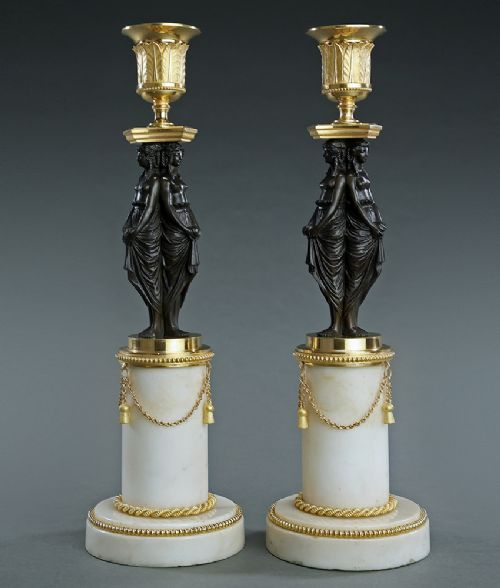


Louis XVI Candle Holders
Louis xvi candle holders bring neoclassical symmetry and patinated bronze to a room, offering the refined weight of eighteenth and nineteenth century French design.
Louis XVI Candle Holders
When you search for louis xvi candle holders, you enter a world of neoclassical proportion, patinated bronze, and white marble. The pieces appearing here span the eighteenth century and subsequent nineteenth century revivals, capturing an enduring French taste.
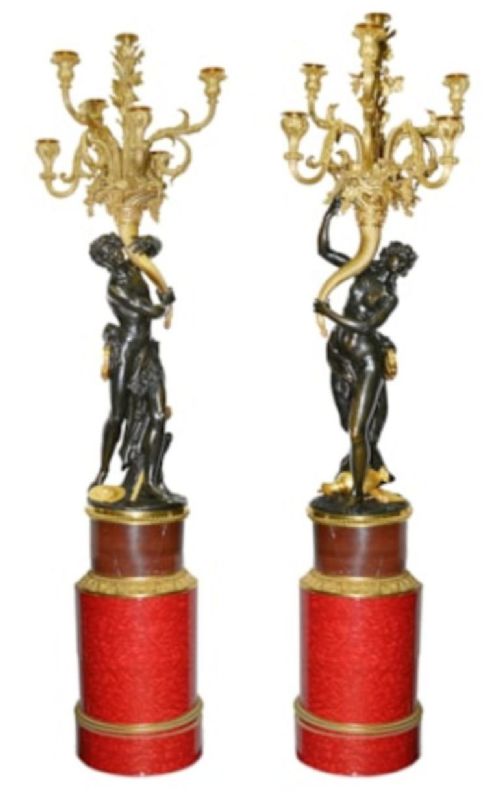
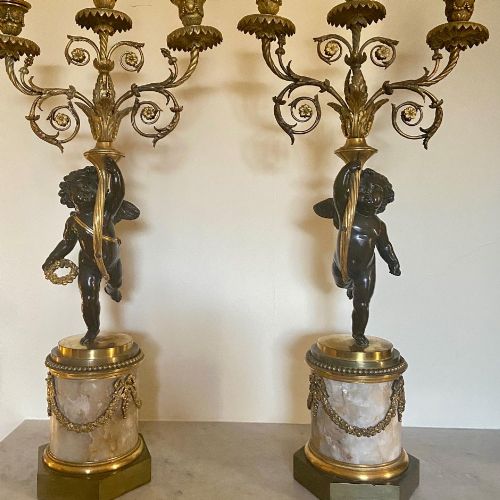
Most examples on this page take the form of paired candelabra or candlesticks, frequently incorporating figures such as putti, cherubs, or caryatids. Alongside standard candle holders, the selection extends to wall lights, girandole mirrors, and complete clock garnitures.
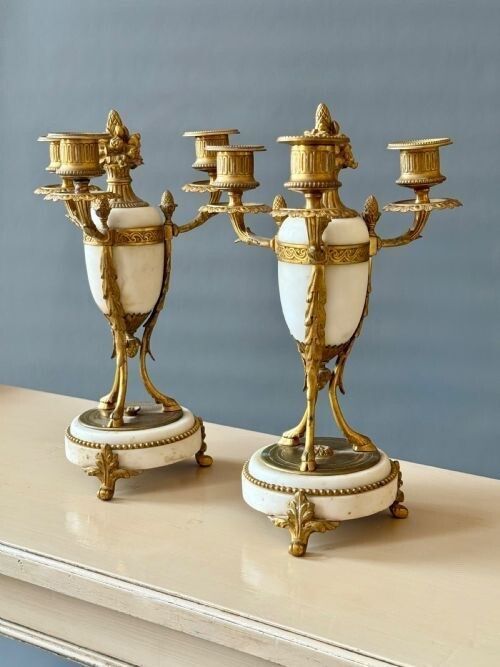
Makers and designers of the period, along with later revivalists, drew on classical motifs like urns, acanthus leaves, and fluted columns. These items served both to illuminate grand interiors and to anchor symmetrical mantelpieces.
How they were made
The construction of these pieces relies heavily on cast metals, specifically gilt bronze, ormolu, and patinated bronze, combined with contrasting white marble or brass. Artisans also utilised glass, crystal, and occasionally mahogany or giltwood to achieve varied textures.
Foundry work involved intricate casting and chasing of bronze elements, which were then fire-gilded to produce the characteristic deep lustre of ormolu. Stonemasons shaped the white marble bases and columns to support the heavy metal branches securely.
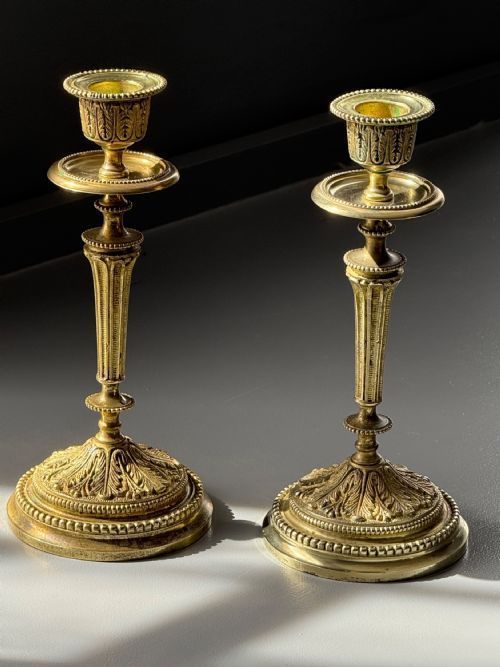
Object forms span simple candlesticks, multi-armed candelabra, wall lights, girandole mirrors, and clock garnitures.
What varies in quality
The selection of materials also dictates the tier of the piece, with dense statuary marble and heavy fire-gilded bronze marking the finest productions. Structural integrity, particularly in multi-armed candelabra, separates master workshops from routine manufacturing.
Francois Redmond·Dugourc·Claude Clodion
The Louis XVI Candle Holders Glossary
- Ormolu
- Gilded bronze produced by applying an amalgam of gold and mercury to a bronze base and heating it until the mercury vaporised. This technique creates a rich, durable surface finish typical of fine French decorative arts.
- Candelabra
- A branched candlestick designed to hold multiple candles simultaneously. They often feature removable nozzle inserts and central shafts adorned with classical figures.
- Clock Garniture
- A matching set comprising a mantel clock flanked by two matching side pieces, such as candelabra or urns. These ensembles created a balanced decorative scheme for nineteenth century interiors.
- Caryatid
- A sculpted female figure serving as an architectural support in place of a column. In these pieces, they frequently form the central stem of a candlestick.
- Girandole
- An ornamental bracket wall light featuring mirrors to reflect and multiply candlelight. The mirrored backplates enhance the illumination within a room.
Louis XVI Candle Holders: Frequently Asked Questions
How do I date a pair?
Dating relies on examining the casting technique, the wear on the bronze, and the composition of the marble base. Eighteenth century originals differ subtly in patination and hand-chasing depth from nineteenth century revival pieces.
Evidence on this page shows a strong concentration of pieces from the 1860s to the 1890s, alongside eighteenth century examples. Comparing the style of the mounts and the type of bronze helps clarify the period of manufacture.
What is ormolu?
Ormolu refers to gilded bronze, created by applying a gold and mercury mixture to a cast bronze object before firing. This historic method yields a warm, enduring golden surface distinct from modern electroplating.
You will find ormolu frequently combined with white marble and patinated bronze across many pieces listed here. The finish requires gentle dusting and avoids harsh chemical cleaning to preserve the underlying metal.
Are these pieces functional?
Most of these items remain fully functional for holding standard dinner or taper candles, though many buyers choose to display them purely as decorative sculptures. The bobeches, or drip pans, catch melted wax and protect the metalwork below.
When burning candles, ensure the piece stands on a stable, level surface to support the weight of multi-armed branches. Period candelabra often feature removable nozzles for easier cleaning.
What is a clock garniture?
A clock garniture is a coordinated decorative set consisting of a central mantel clock accompanied by matching side ornaments, typically candelabra or vases. These sets were designed to sit harmoniously on a fireplace mantel or console table.
Listings here include sets featuring gilt bronze, marble, and cherub motifs. They provide a complete decorative ensemble characteristic of French interior styling.