
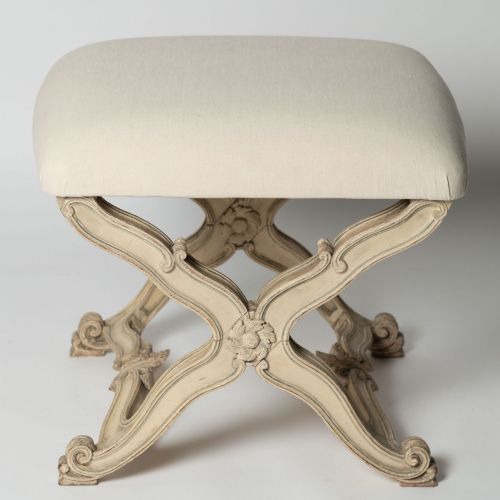
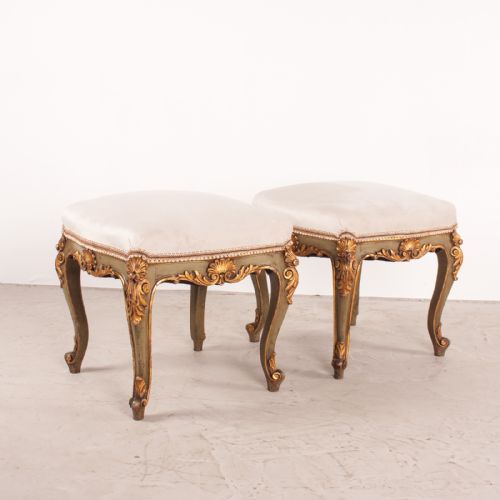
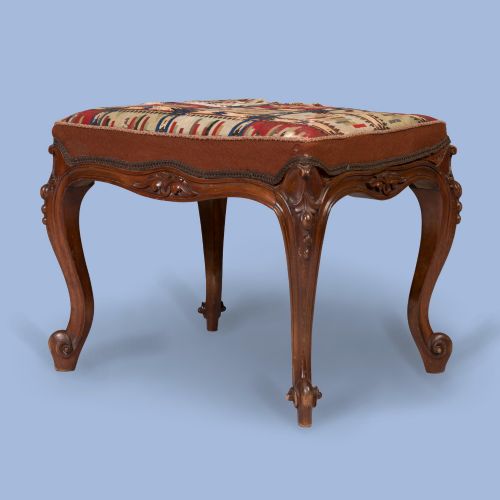
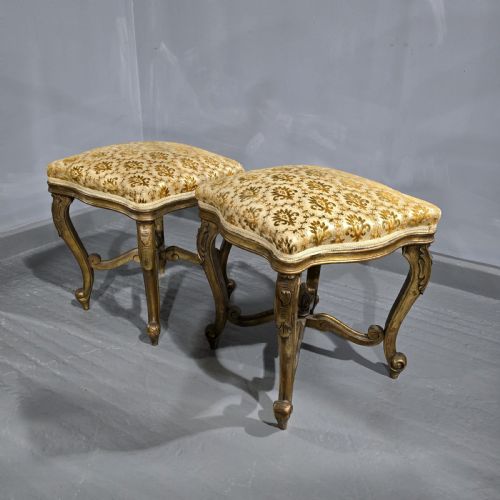
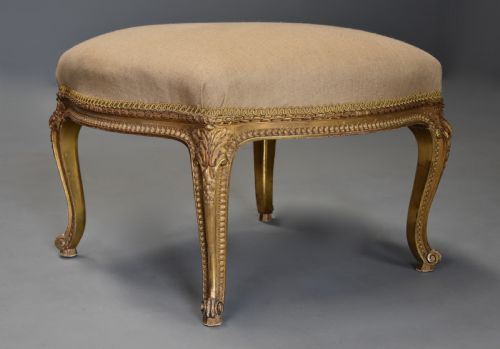


Louis XV Vanity Stool
These pieces known as louis xv vanity stool encompass low seating crafted in French and Continental revivals, offering elegant proportions for dressing areas and boudoirs.
Louis XV Vanity Stool
A louis xv vanity stool is a low seating form designed for the dressing room or bedroom, drawing on eighteenth-century Rococo curves and ornamentation. These pieces emerge across the nineteenth and twentieth centuries in various revivals, capturing the essence of French chateau and provincial interiors.
The most common examples on this page are French in origin, spanning periods from the mid-nineteenth century through to the early decades of the twentieth. They appear as single seats or matched pairs, functioning as footstools, boudoir stools, and low benches.
Makers and craftsmen of these periods adopted the asymmetric cartouche motifs, cabriole legs, and scroll feet typical of the style. The forms range from simple circular boudoir seats to long, carved frames meant to sit beneath a dressing table.
Materials and Construction
Carpenters utilised solid hardwoods such as walnut and beech to carve the complex curvilinear frames required for the style. These woods provided the necessary strength for slender cabriole legs while allowing deep relief carving along the seat rails.
Surface treatments relied heavily on giltwood, gold leaf applied over gesso, alongside painted finishes in muted or gilded tones. Upholstery materials included traditional textiles like velvet, linen, and decorative fabric stretched over padded seats.
Listings feature pieces spanning from the mid-nineteenth century to the early twentieth century, utilising walnut, beech, giltwood, and fabric upholstery.
Assessing Quality and Execution
Quality rests primarily in the depth and crispness of the hand carving upon the wooden frame. Superior examples show confident, fluid chisel work along the rails and knees, whereas lesser pieces rely on mechanical stamping or shallow surface moulding.
The choice of primary timber and the execution of the finish dictate the standing of a piece. Solid walnut frames with genuine hand-applied gilding occupy the upper tier, distinct from later painted wood versions finished with simpler modern techniques.
LOIDRAULT FRERES PARIS
The Louis XV Vanity Stool Glossary
- Cabriole leg
- A furniture leg that bends outward in a convex curve and tapers inward in a concave curve, ending in a scroll or pad foot. This defining feature of the style mimics animal limbs.
- Giltwood
- Timber coated with a thin layer of gold leaf over a prepared gesso ground. It provides the brilliant metallic lustre seen on formal period seating.
- Rococo
- An artistic style originating in France characterised by elaborate ornamentation, asymmetrical scrollwork, and naturalistic plant motifs. It forms the basis of Louis XV design.
- Boudoir stool
- A small, low seat traditionally kept in a private dressing room or bedroom. These pieces are scaled for personal grooming spaces.
- Cartouche
- An ornamental frame resembling a rolled-up piece of paper or parchment, frequently carved into the centre of seat rails.
Louis XV Vanity Stool: Frequently Asked Questions
What is a louis xv vanity stool?
A louis xv vanity stool is a small, low seat designed for a dressing table or boudoir, featuring the curved legs and carved ornamentation of the eighteenth-century French style. They provide compact seating that fits neatly beneath vanity tables.
These pieces were produced in substantial numbers during nineteenth-century revival periods, reflecting ongoing admiration for French chateau aesthetics.
How do I date these stools?
Dating relies upon examining the timber, tool marks, and overall wear patterns visible on the frame. Nineteenth-century examples often display hand-carving techniques and period joinery distinct from twentieth-century production.
Makers' stamps or specific upholstery remnants can also help narrow down the period of manufacture.
Where were these stools used?
These pieces were traditionally placed in private dressing rooms, bedrooms, and boudoirs for personal grooming and relaxation. Their low height and compact footprint suited confined spaces near wardrobes and dressing chests.
Today, they serve similar functions in modern bedrooms or act as decorative footstools in living spaces.
Are painted and gilt finishes original?
Many pieces retain their period painted or gilded surfaces, though refreshing and re-gilding occurred frequently across the nineteenth and twentieth centuries. Close inspection reveals whether the gold leaf or paint layers show age-appropriate wear and underlying gesso cracking.
Distinguishing between original finishes and later decorative painting requires looking at how the finish settles into the carved recesses.