



Louis XV Tallboy Chest
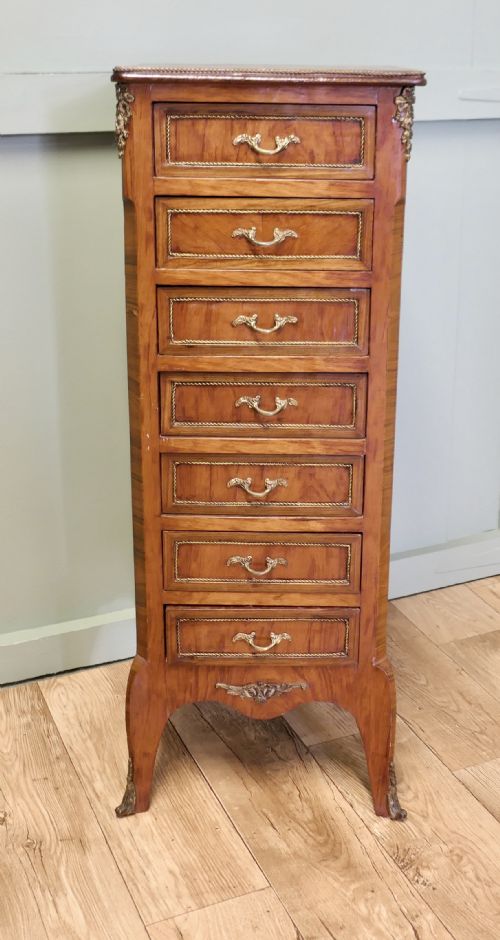
A louis xv tallboy chest brings serpentine curves and fine French parquetry into a room, offering upright storage without the heavy footprint.
Louis XV Tallboy Chest
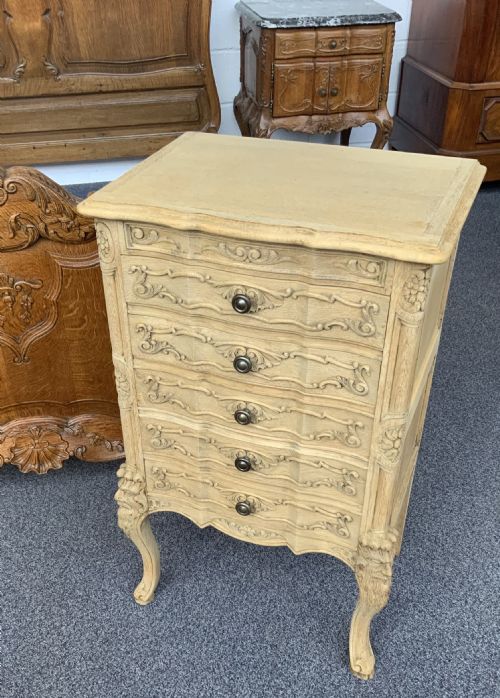
A louis xv tallboy chest typically takes the form of a tall chest of drawers, a semainier, or a slim side cabinet designed to maximise vertical space in smaller rooms. These pieces originate across the eighteenth, nineteenth, and early twentieth centuries, capturing both authentic period craftsmanship and later revival movements.
The most common examples on this page reflect French Provincial and Louis XV revival styles, often featuring seven drawers, marble tops, and slender cabriole legs. Alongside these, buyers find related bedside cabinets and smaller chests that share the characteristic serpentine or bombe contours of the aesthetic.
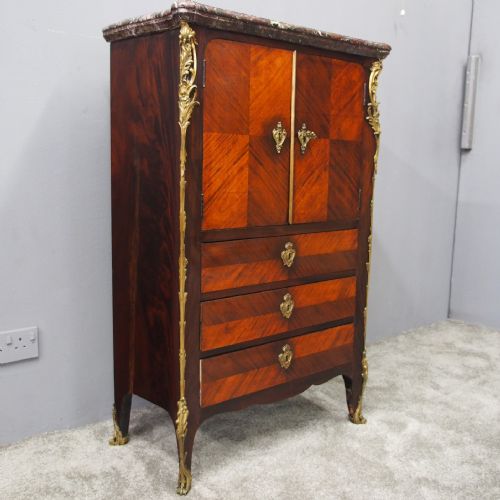
Materials span native timbers like walnut and bleached or carved oak alongside exoticveneers including kingwood, rosewood, and tulipwood. Brass, ormolu, gilt bronze mounts, and metal hardware frequently complete the decorative scheme of these tall storage pieces.
Materials and construction methods
Cabinetmakers built these tall chests using solid structural frames of oak or walnut, applied with intricate veneers of kingwood, rosewood, and tulipwood to create geometric marquetry and parquetry patterns. The timber selection dictates both the weight and the visual depth of the facade.
Gilt bronze, ormolu, and brass mounts were cast and chased to accentuate the sweeping lines of the corners and drawer pulls, often fixed with pinned tenons or screws. Heavy marble slabs, cut to fit the exact profile of the top surface, added functional durability and a contrasting cool texture to the warm wood.
Materials recur across multiple decades, pairing native oak and walnut with exotic veneers like rosewood, kingwood, and tulipwood alongside marble.
Assessing quality in tall chests
The distinction between standard production and exceptional work rests on the precision of the veneer matching and the fluidity of the carved cabriole legs. Finer examples display continuous grain flow across drawer fronts and hand-chiselled mounts that integrate seamlessly with the timber contours.
Internal construction reveals the maker's hand through traditionally dovetailed drawer boxes and the weight of the marble top. Superior pieces maintain crispness in their carved oak details and retain stamped signatures or well-cast hardware that shows no signs of modern replacement.
Leonard Boudin
The Louis XV Tallboy Chest Glossary
- Semainier
- A tall, narrow chest traditionally featuring seven drawers, one for each day of the week. This form is particularly favoured in French furniture design for compact upright storage.
- Ormolu
- Gilded bronze mounts applied to furniture for decoration and edge protection. These metallic elements define the corners and handles of finer period pieces.
- Kingwood
- A dense, richly grained exotic timber imported from Brazil and utilised extensively in seventeenth and eighteenth-century cabinetmaking. It yields deep brown and golden tones with striking figuring.
- Cabriole leg
- A furniture leg that bends outward and then tapers inward, imitating animal limbs. This defining feature of the style ends gracefully in a pad or scroll foot.
Louis XV Tallboy Chest: Frequently Asked Questions
What is a semainier?
A semainier is a tall, narrow chest of drawers designed with seven distinct tiers. It offers vertical storage while occupying minimal floor space.
Cabinetmakers originally conceived these pieces to hold a week's worth of personal linens or garments. Today they function well in bedrooms and dressing rooms for similar organisational needs.
How do I care for marble tops?
Marble surfaces require gentle cleaning with damp cloths and neutral soaps rather than acidic household cleaners. This prevents etching and preserves the polish of the stone.
Using coasters and mats protects the polished top from moisture rings and scratches. The stone itself provides a durable, heat-resistant counter surface for daily use.
Are these chests heavy?
These tall chests possess considerable weight due to their dense hardwood carcasses and solid marble slab tops. Two people are generally required to lift and position them safely.
Despite their slender appearance, the combination of timber and stone creates a stable piece of furniture. Wall fixings are sometimes utilised for added security in homes with children.
How do I distinguish revival pieces?
Nineteenth and twentieth-century revival pieces often exhibit machine-cut dovetails, standardised hardware fixings, and slightly stiffer carving compared to eighteenth-century originals. Timber conditioning and internal secondary woods also offer clues to the exact era of production.
Examining the underside and drawer linings reveals the construction methods characteristic of later French workshops. Both original and revival pieces offer distinct decorative merits depending on the desired interior scheme.