


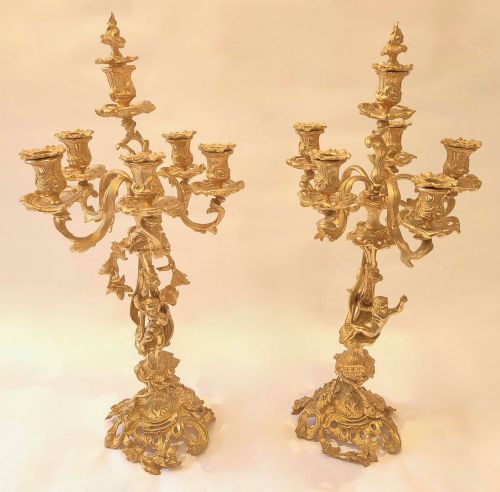


Louis XV Style Candlesticks
Louis xv style candlesticks bring asymmetric curves and naturalistic ornamentation into a room, capturing the decorative grace of eighteenth-century France.
Louis XV Style Candlesticks
These pieces encompass lighting fixtures produced primarily during the nineteenth century, drawing heavily on French Rococo Revival aesthetics and earlier eighteenth-century designs. Collectors encounter matched pairs constructed as standard candlesticks, elaborate multi-branched candelabra, and converted table lamps.
The dominant forms display the characteristic asymmetric scrolls, leaf motifs, and flowing contours associated with the Louis XV style and French Chateau interiors. Many examples incorporate figural elements, including musicians and mythological maidens, alongside porcelain components.
How they were made
Manufacture relies heavily on cast bronze, often finished with fire gilding known as ormolu to achieve a brilliant golden surface. Brass and standard gilt bronze also appear frequently in the structural foundations of these pieces.
Craftsmen integrated decorative elements such as enamel detailing and sculpted porcelain figures, combining metalwork with ceramic arts. Marble is utilised for heavy foundational bases that anchor the upward sweep of the metal branches.
Seated porcelain musicians occasionally find themselves permanently holding up heavy bronze branches in place of musical instruments.
What varies in quality
The refinement of the chasing and the crispness of the cast bronze ornament distinguish superior examples from simpler production. Master metalsmiths achieved depth and fluidity in the asymmetric scrollwork that lesser workshops merely approximated.
The integration of secondary materials dictates the overall calibre of an object. High-grade pairings involve finely painted Sevres style porcelain or carefully selected marble, whereas basic versions rely solely on cast metal.
Meissen·Sevres
The Louis XV Style Candlesticks Glossary
- Ormolu
- Gilt bronze produced by applying a mercury and gold amalgam to a bronze object and heating it until the mercury vaporised, leaving a durable golden coating. This technique defines the rich surface lustre of many nineteenth-century French pieces.
- Rococo revival
- A nineteenth-century design movement that reinterpreted the ornate, asymmetric forms and natural motifs of the eighteenth-century French court. It governs the visual language of these candlesticks and candelabra.
- Candelabra
- A branched lighting fixture designed to hold multiple candles simultaneously, differing from a single candlestick. These often feature removable central finials or intricate arm configurations.
- Cassolette
- A decorative vessel shaped like a vase or urn, frequently adapted into a candlestick with a reversible top. They appear in French decorative arts alongside standard candleholders.
- Sevres style
- A descriptor for porcelain decorated in imitation of the famous French royal manufactory, often featuring hand-painted scenes or delicate floral motifs set against coloured grounds.
Louis XV Style Candlesticks: Frequently Asked Questions
What is the difference between candlesticks and candelabra?
Candlesticks are designed to hold a single candle in an individual socket atop a vertical shaft. Candelabra feature branched arms that support multiple candles from one central base.
Pairs of both types dominate historical French dining tables and mantlepieces, serving practical illumination and decorative display.
How do I identify nineteenth-century French pieces?
Look for the weight and warmth of genuine cast bronze beneath the surface gilding, along with the hand-chased details in the scrollwork. Nineteenth-century interpretations often exhibit precise casting techniques combined with Rococo revival asymmetry.
Examining the underside of the base frequently reveals construction methods and patination consistent with the period of manufacture.
Where should I place these in a room?
These pieces suit side tables, mantels, and chests of drawers where their metallic surfaces can reflect ambient light. Their sculptural profiles function effectively as decorative focal points even when unlit.
Pairing them with antique mirrors enhances the visual impact of the gilt bronze and porcelain elements.
Can converted table lamps be restored?
Many examples from this category were adapted for electricity during the twentieth century by running wiring through the central column. Reversibility depends on whether original components were drilled or altered during the conversion process.
Consulting a specialist in antique lighting helps determine the preservation of the original ormolu and bronze structure.