

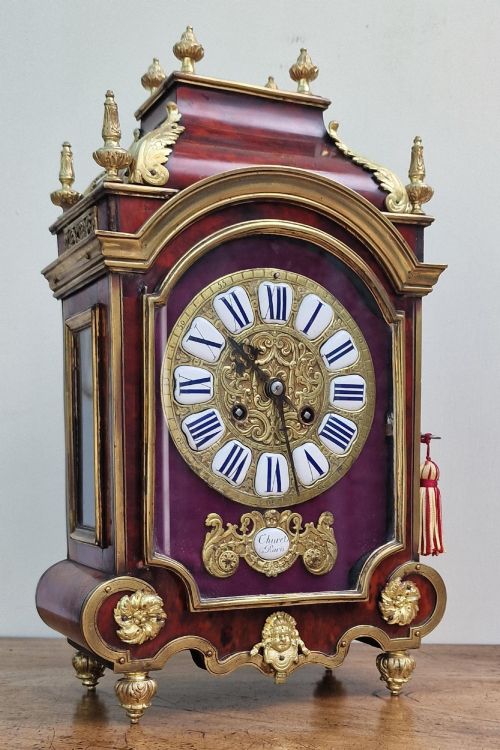


Louis XIV Style Clock
These louis xiv style clock examples bring grand French Baroque presence into a room through elaborate gilt bronze and tortoiseshell.
Louis XIV Style Clock
A louis xiv style clock connects a room to the theatrical opulence of the French Baroque and its later Victorian revival. These pieces take the form of substantial mantel clocks and wall brackets designed to command attention on a shelf or table.
Most examples encountered here date from the nineteenth century, including pieces from the eighteen-eighties and the Napoleon III period, alongside a few later twentieth century items. Makers and workshops drew heavily upon seventeenth century originals to create these decorative timepieces.
The aesthetic leans heavily toward dramatic architectural cases, often paired with matching brackets for wall display. Buyers will find mantel clocks as the most frequent format, constructed to evoke the royal court of Versailles.
Materials and construction methods
Craftsmen built these cases using robust timber frames overlaid with tortoiseshell and brass marquetry in the Boulle technique, or cast them entirely in heavy metals. Ormolu and gilt bronze mounts were meticulously applied to corners, feet, and crests to accentuate the rich surfaces.
Dials frequently feature enamel cartouches with individual numerals, protected beneath glass doors and bezels. Interior movements were produced by established French clockmakers and housed within these ornate decorative shells.
Louis XIV Style Clock Retail Price Guide 2026
Typical asking prices for louis xiv style clock among the pieces listed under this phrase on Sellingantiques today, from the lower quarter to the upper quarter. They describe what is for sale here now, not the wider market.
Listings demonstrate a strong preference for tortoiseshell and brass Boullework alongside gilt bronze mounts across nineteenth century formats.
Assessing quality and execution
Quality reveals itself in the crispness of the gilt bronze casting and the precision of the tortoiseshell and brass inlay. Finer examples display deeply chased ornamentation and substantial weight in the metal components rather than superficial plating.
The integration of the movement with a named maker adds distinct standing to a piece. Cases executed with genuine care in the proportions and surface depth distinguish the finer workshop outputs from standard commercial production.
Thuret·Samuel Marti·Henri Dasson·Vincenti·Charles Hour·Japy Fréres
The Louis XIV Style Clock Glossary
- Boulle
- A form of marquetry using contrasting brass and tortoiseshell inlay developed by furniture maker André Charles Boulle. It creates a shimmering, highly decorative surface pattern across the clock case.
- Ormolu
- Gilded bronze used extensively for decorative mounts and accents on furniture and clocks. The technique involves applying a mercury and gold amalgam to cast bronze.
- Mantel clock
- A domestic timepiece designed to stand upon a fireplace mantelpiece or a flat shelf. These objects combine timekeeping with sculptural presence.
- Bracket clock
- A portable clock originally designed to sit on a wall bracket to aid in sound projection and visibility. Many retain their matching wall supports.
- Enamel
- A glassy substance fused to metal dials through firing to create a smooth, white surface for painted numerals. It provides a durable contrast against gilt bezels.
Louis XIV Style Clock: Frequently Asked Questions
Where should I place a bracket clock?
Bracket clocks are traditionally hung upon their matching wall brackets or placed securely on heavy wooden furniture. This elevation helps the sound of the striking movement carry through the space.
Ensure the wall fixing is robust because these gilt bronze and hardwood cases carry considerable weight.
How do I wind the clock?
Winding requires a matching key inserted into the winding holes on the enamel dial to tension the springs. Care must be taken not to overwind the movement.
Most nineteenth century mechanical movements require gentle handling and occasional professional servicing to keep accurate time.
Are these clocks from the seventeenth century?
The vast majority of these pieces date from the nineteenth century, specifically the Victorian era and the eighteen-eighties, adopting the Louis XIV style of the seventeenth century. A few twentieth century examples also appear.
Revival pieces capture the grand aesthetic of the earlier royal period while utilising nineteenth century manufacturing techniques and mechanical movements.