
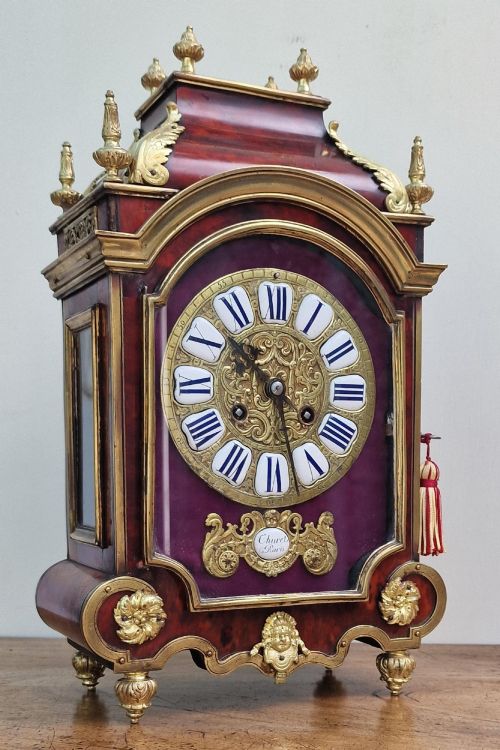


Louis XIV Mantel Clock
A louis xiv mantel clock brings heavy French Baroque drama into a room, trading quiet lines for bold gilt bronze and tortoiseshell.

Louis XIV Mantel Clock
A louis xiv mantel clock carries the ornate weight of French Baroque design into domestic spaces, usually taking the form of a substantial mantel clock or a bracket clock complete with its matching wall bracket. These pieces draw heavily on seventeenth-century court aesthetics, though the examples met on this page date predominantly from the nineteenth century and later revival periods.
Makers leaned into complex architectural silhouettes and rich surface decoration, producing clocks that command attention on any surface they occupy. The aesthetic leans away from simplicity, preferring instead the dense visual rhythm of tortoiseshell, brass marquetry, and deep patinated bronze.
Materials and construction
The construction of these pieces relies on a foundation of timber such as mahogany, which is then sheathed in elaborate boulle marquetry utilising tortoiseshell and brass inlay. Ormolu and gilt bronze mounts define the corners, feet, and crests, cast with high relief and finished with bright or antique gold tones.
Enamel dials with individual cartouche numerals sit recessed behind glass panels, protected by heavy cast bezels. The internal movements are driven by brass gear trains that demand precise mechanical skill from the Parisian workshops that assembled them.
Louis XIV Mantel Clock Retail Price Guide 2026
Typical asking prices for louis xiv mantel clock among the pieces listed under this phrase on Sellingantiques today, from the lower quarter to the upper quarter. They describe what is for sale here now, not the wider market.
Periods represented on this page range from Victorian and 1860 through to 1960 interpretations of the French Baroque style.
Assessing quality
Quality reveals itself in the crispness of the gilt bronze chasing and the depth of the tortoiseshell ground beneath the brass inlay. Lesser examples display flat, muddy castings where the ornament blurs, whereas superior pieces show sharp chisel work and meticulous hand-finishing.
The integration of the movement with the case marks another division, as master horologists ensured that maker signatures on the dial matched the stamped plates within. The survival of an original matching bracket on bracket clocks elevates the integrity of the piece.
Thuret·Samuel Marti·Vincenti·Charles Hour
The Louis XIV Mantel Clock Glossary
- Boulle
- A form of marquetry using contrasting slices of tortoiseshell and brass, named after the famed cabinetmaker André-Charles Boulle. This technique creates a rich, shimmering surface pattern.
- Ormolu
- Gilded bronze used extensively for decorative mounts and accents on furniture and clocks. The process involves applying a mercury and gold amalgam to the bronze base.
- Bracket clock
- A portable clock designed to sit on a matching wall bracket rather than a floor or mantelpiece. Many incorporate elaborate wooden carcase construction.
- Cartouche
- A small enamelled plaque or panel bearing a single numeral on the clock dial. These are often individually pinned to the dial plate.
Louis XIV Mantel Clock: Frequently Asked Questions
How do I wind a louis xiv mantel clock?
Winding requires a dedicated key inserted into the winding holes on the dial face, turning gently until resistance meets you. Care must be taken not to overwind the mainspring.
Most movements run for a week on a full wind and keep time through a pendulum regulated from the back or front.
Where should I place a bracket clock?
Bracket clocks require a secure wall fixing to support the weight of both the clock and its wooden wall bracket. Placing them away from direct sunlight and damp walls protects the delicate tortoiseshell and gilt surfaces.
The matching wall bracket distributes the heavy load safely while displaying the piece at optimal viewing height.
Are these clocks strictly from the seventeenth century?
The vast majority of pieces available date from the nineteenth century during the revival of French Baroque styles. True seventeenth-century examples are extremely scarce and reside mostly in museum collections.
Nineteenth-century makers faithfully copied the earlier aesthetic using traditional materials and techniques.
How do I clean tortoiseshell and gilt bronze?
Dusting with a soft, dry microfibre cloth keeps the surfaces free of grime without scratching the vulnerable polish. Water and chemical cleaners must be avoided entirely.
Professional conservation is recommended for any deeper maintenance of the brass inlay or bronze mounts.