

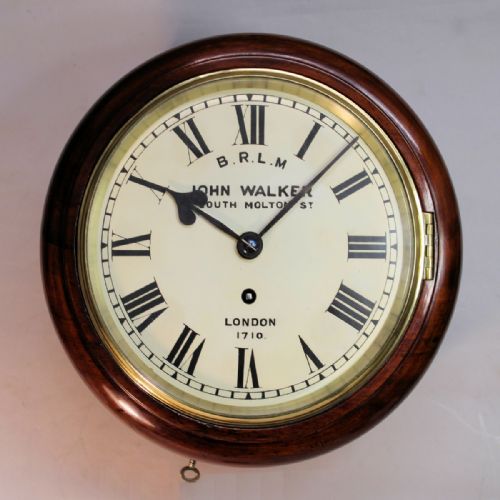


London Fusee Movement Clock
A London fusee movement clock is a precise timekeeper driven by a chain and cone pulley system designed to maintain constant force.

London Fusee Movement Clock
A London fusee movement clock represents the pinnacle of traditional British horology, designed to regulate time with exceptional accuracy through a conical pulley and chain system. When you search for a london fusee movement clock, you encounter various forms ranging from mahogany railway wall dials to elaborate bracket and library clocks housed in glass, brass, and gilt bronze.
The pieces available span from the 18th century through the Regency and Victorian periods up to the early 20th century, reflecting the enduring legacy of London workshops. Wall clocks and dial clocks dominate utilitarian and transport settings, whilst mantel and bracket clocks serve domestic and institutional interiors.
Makers in this tradition utilised robust mahogany, ebonised wood, and polished brass cases to protect intricate brass and steel movements. Every example embodies the mechanical ingenuity of London clockmakers who supplied timepieces for railways, shipping lines, and grand residences.
How they were made
Makers constructed these clocks using seasoned mahogany, rosewood, and ebonised wood for the outer cases, frequently incorporating glass panels and brass bezels to showcase the interior. The mechanical heart relies on a brass and steel movement governed by a fusee cone and chain, which equalises the declining power of the mainspring.
Some railway clocks survived decades of engine soot and vibration to keep ticking with stubborn British grit.
What varies in quality
The distinction between standard utility pieces and finer examples rests upon the sophistication of the movement and the integrity of the case. Clocks featuring twin fusee movements with striking or automation mechanisms demand greater skill than a single fusee time-only timepiece.
The crispness of the engraving on the backplate, the quality of the mahogany veneer, and the original state of the painted dial elevate certain pieces above standard railway and station clocks. Retaining signed movements by prominent London makers secures a higher level of historical and mechanical interest.
John Walker·Dent·William Payne·John Barwise·Phillips Brothers·Kelvin White And Hutton·Somersall London·Chater And Son·John Leroux·Hay London·Plumbly And Tupman·Edwards Of London·Henry Berkeley Square·FB Adams·John Massey·Leith Of London·J Fisher Esq·Payne Of London
The London Fusee Movement Clock Glossary
- Fusee
- A conical pulley with a helical groove used to maintain an even pull on the mainspring as it unwinds. This mechanism ensures consistent torque and improves the timekeeping accuracy of the clock.
- Bracket clock
- A portable clock originally designed to sit on a bracket on the wall, though later placed on mantelpieces and tables. These often feature elaborate wooden or gilt bronze cases.
- Library clock
- A small, portable timekeeper housed within a glass-sided case that allows the movement to be viewed from multiple angles. They are typically executed in brass and bevelled glass.
- Dial clock
- A wall-mounted clock featuring a prominent circular face and a short wooden drop box underneath to house the pendulum. They were widely utilised in railway stations and offices.
- Twin fusee
- A movement incorporating two separate fusee cones and chains, usually dividing the timekeeping train from the striking or chiming train. This configuration requires sophisticated synchronisation.
London Fusee Movement Clock: Frequently Asked Questions
How does a fusee movement work?
A fusee movement uses a conical pulley connected to the mainspring via a fine steel chain. As the spring unwinds and loses tension, the chain moves to a wider part of the cone, maintaining constant torque.
This ingenious mechanical compensation prevents the timekeeper from losing speed as the power diminishes.
Where were railway dial clocks used?
Railway dial clocks were mounted in station master offices, ticket halls, and operational platforms across the network. They ensured strict punctuality for staff and passengers alike.
Their robust construction and clear painted dials made them easy to read in busy industrial environments.
What is the difference between a timepiece and a clock?
In horological terms, a timepiece measures the hours and minutes without incorporating a striking or chiming mechanism. A clock, conversely, includes an audible striking train that chimes the hours.
Single fusee models are frequently timepieces, whereas twin fusee examples often include striking functions.
How should I care for a fusee clock?
Keep the clock away from direct sunlight, extreme temperature fluctuations, and damp environments to protect the wood case and delicate steel components. Ensure it is placed on a stable, level surface to keep the pendulum swinging evenly.
Wind the movement gently using the correct key, avoiding over-winding to prevent strain on the chain.