
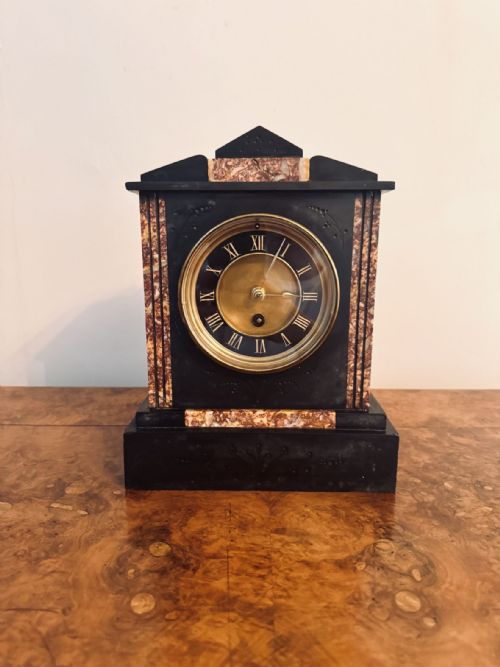
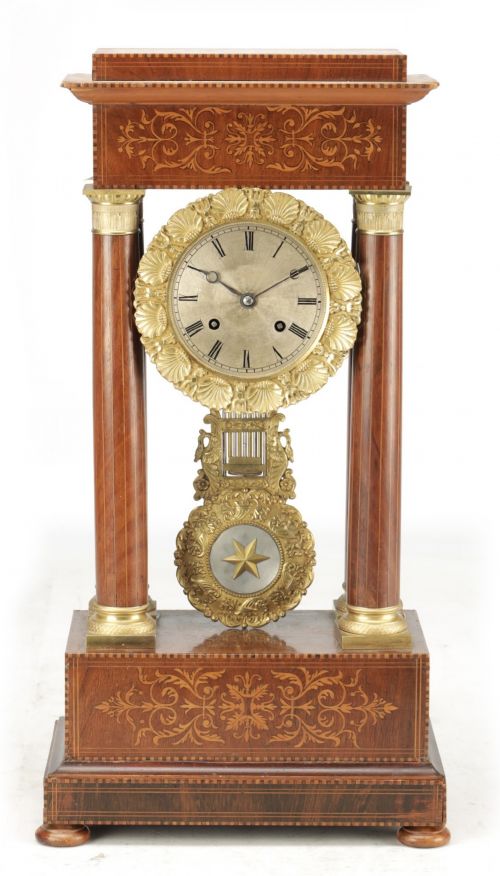


Victorian Inlaid Timepiece
A victorian inlaid timepiece brings together precision engineering and fine cabinet-making, offering a functional centrepiece shaped by nineteenth-century design.
Victorian Inlaid Timepiece
A victorian inlaid timepiece encompasses various forms including mantel clocks, wall clocks, and bracket clocks produced during the nineteenth century. These items showcase decorative surface work on timber carcases, reflecting the domestic tastes of the period.
The pieces on this page span several stylistic influences, from French portico designs to English drop-dial wall clocks and steeple bracket clocks. Rosewood and mahogany serve as the primary timber foundations across these differing formats.
Makers and retailers such as Bryson of Edinburgh, Kleyser of London, and Dumont appear among the listings, alongside English and French provincial examples. Buyers encounter both wall-mounted timepieces and heavy mantel models requiring flat surfaces.
Materials and construction
Cabinet makers utilised rosewood and mahogany for the main structures, applying boxwood, lemon wood, and brass inlay directly into the timber surfaces. Ormolu mounts and bovine details appear on specific French portico and mantel formats.
Dials feature enamel finishes protected by glass bezels, while movements rely on brass components, fusee mechanisms, and pendulum regulation. Marble variants such as Sienna stone provide heavier structural alternatives to timber cases.
Some French rosewood mantel clocks secretly hide bovine cherub inlay right beside the dial.
Assessing craftsmanship
Quality rests in the precision of the timber inlay and the crispness of the brass or ormolu mounts fixed to the case. Finely executed stringing and contrasting wood selections distinguish superior cabinet work.
The reputation of the maker, evident in signed dials or movements like those by Bryson or Kleyser, elevates the standing of an individual clock. Movement complexity, such as double fusee systems, also separates standard timepieces from higher-tier examples.
Bryson Edinburgh·Kleyser of London·Dumont
The Victorian Inlaid Timepiece Glossary
- Portico clock
- A architectural clock design featuring pillars or columns supporting the upper entablature. This French style frequently incorporates rosewood and ormolu.
- Fusee
- A conical pulley used in clock movements to maintain even driving force as the mainspring unwinds. English bracket clocks often utilise this mechanism.
- Drop dial
- A wall clock featuring an extended lower case enclosing the pendulum swing. Mahogany versions represent a common nineteenth-century domestic format.
- Boulle
- A form of marquetry employing brass and tortoiseshell inlaid in contrasting patterns. This technique appears on French mantel pieces.
- Steeple bracket clock
- A clock featuring a triangular or steeple-shaped top silhouette. These architectural wooden cases house spring-driven movements.
Victorian Inlaid Timepiece: Frequently Asked Questions
Where should I place a heavy wall clock?
Wall-mounted timepieces require secure fixing directly into wall studs or solid masonry to support the weight of mahogany or rosewood carcases. Ensure the chosen wall remains free from excessive vibrations to maintain accurate pendulum beat.
Position the dial at eye level to allow easy reading of the time and convenient access for periodic winding.
How do I wind a fusee movement?
Insert the winding key into the dial aperture and turn it steadily in the direction specified by the mechanism, taking care not to overwind the spring. Most fusee timepieces require weekly attention to keep the pendulum moving.
Keep the winding key in a safe, consistent location near the clock so it remains available whenever the movement stops.
Can I place my clock near a window?
Direct sunlight causes fading and drying in nineteenth-century rosewood and mahogany veneers, which damages delicate boxwood and brass inlay over time. Temperature fluctuations near glass also affect the contraction and expansion of timber cases.
Select an interior wall or mantelpiece away from direct heat sources and sunlight to preserve the finish.
How do I distinguish French from English clocks?
French mantel and portico pieces frequently utilise ormolu mounts, marble, and Boulle marquetry alongside distinct pendulum suspensions. English bracket and wall clocks commonly employ mahogany or rosewood with fusee movements and painted enamel dials.
Signatures on the dial or movement backplate often confirm the origin and workshop of the maker.