


Lion Mask Handle Chest
A lion mask handle chest brings classical sculpture into domestic storage, offering robust brass mountings that anchor formal timber furniture.
Lion Mask Handle Chest
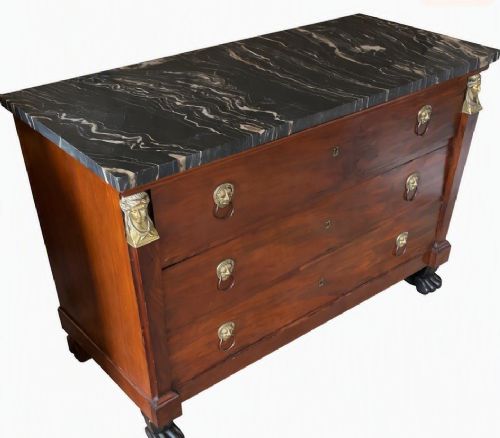
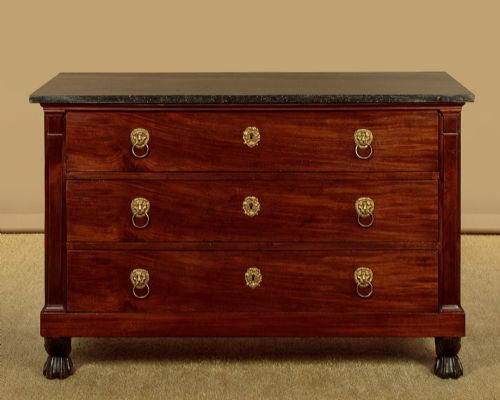
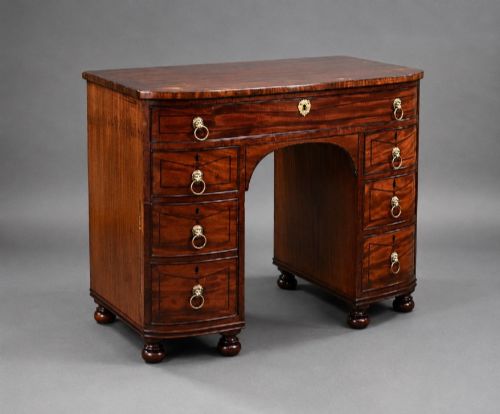
When you search for a lion mask handle chest, you encounter case furniture and storage boxes featuring cast brass mounts modelled as roaring or calm feline faces. The pieces on this page span the Georgian, Regency, and Victorian periods, taking forms ranging from large chests of drawers and commodes to compact tea caddies, cellarettes, and wine coolers.
You are most likely to meet mahogany chests of drawers and sarcophagus wine coolers from the Regency era, executed in rich timber with heavy neoclassical brass hardware. Smaller vessels such as jewellery caskets and tea boxes also appear, utilising the same fierce metalwork on rosewood, cherry, and leather-bound surfaces.
The aesthetic bridges domestic utility with grand architectural references, drawing on French Empire and Egyptian Revival vocabularies. Each piece integrates the mask motif either as structural drawer pulls or as flanking handles for lifting heavy storage boxes.
How they were made
Cabinetmakers constructed these pieces primarily using dense tropical hardwoods like mahogany and rosewood, frequently incorporating secondary timbers such as pine and boxwood for structural depth and stringing. Surfaces were polished to a deep lustre that contrasted against the bright metallic flash of the hardware.
The distinctive handles are cast in brass or ormolu, often securing through the drawer face or box side with threaded pins held by interior nuts. These mounts required skilled foundry work, capturing deep mane texture and facial expression before being hand-finished and fire-gilt or polished.
Listings feature mahogany, rosewood, cherry, pine, boxwood, leather, and marble alongside cast brass and ormolu hardware.
What varies in quality
Cabinetwork precision marks the upper tier of these items, visible in tight dovetail joints, well-matched flame mahogany veneers, and original locks that operate smoothly. The integrity of the carcass, undamaged timber edges, and the retention of original matching handles elevate a piece far above one with replaced or mismatched hardware.
The Lion Mask Handle Chest Glossary
- Commode
- A low French-style cabinet or chest of drawers designed for formal rooms. These pieces often feature marble tops and heavy classical mounts.
- Cellarette
- A lockable container used for storing wine bottles near the dining table. They frequently take sarcophagus or chest forms with robust carrying handles.
- Ormolu
- Gilded bronze or brass applied as decorative mountings on furniture. The technique creates a rich gold-coloured finish that contrasts with dark timber.
- Sarcophagus
- A coffin-shaped container form adopted during the Regency period for tea caddies and wine coolers. The sloping sides and heavy feet lend a monumental presence to small boxes.
- Semainier
- A tall, narrow chest traditionally featuring seven drawers, one for each day of the week. French examples often pair cherry wood with marble surfaces.
Lion Mask Handle Chest: Frequently Asked Questions
What periods do these pieces date from?
The inventory spans the late Georgian, Regency, William IV, and Victorian eras, stretching from around eighteen hundred into the late nineteenth century.
Most examples cluster firmly within the Regency and French Empire periods, reflecting a widespread neoclassical taste for heavy classical hardware.
How were wine coolers used?
Wine coolers and cellarettes sat in the dining room during formal meals, keeping bottles chilled near the table before service.
Lined interiors held ice or water, while the sturdy lion mask handles allowed servants to transport the heavy wooden vessels.
Are the handles original to the furniture?
Many pieces retain their original cast brass or ormolu lion masks, secured through the drawer fronts or box sides with period fixings.
When examining a piece, look for consistent patination between the metal mount and the surrounding timber to confirm authenticity.
What woods appear most frequently?
Mahogany forms the primary structural and decorative timber across the majority of these chests, commodes, and serving vessels.
Rosewood, cherry, boxwood, and pine also appear in specific forms such as tea caddies, French semainiers, and fireside coal bins.