
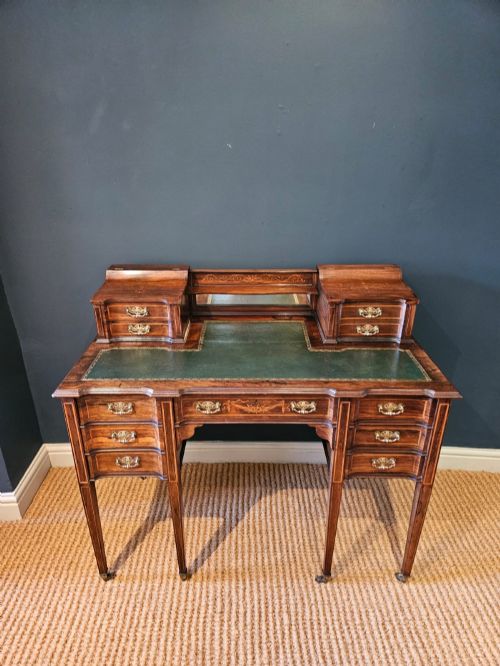
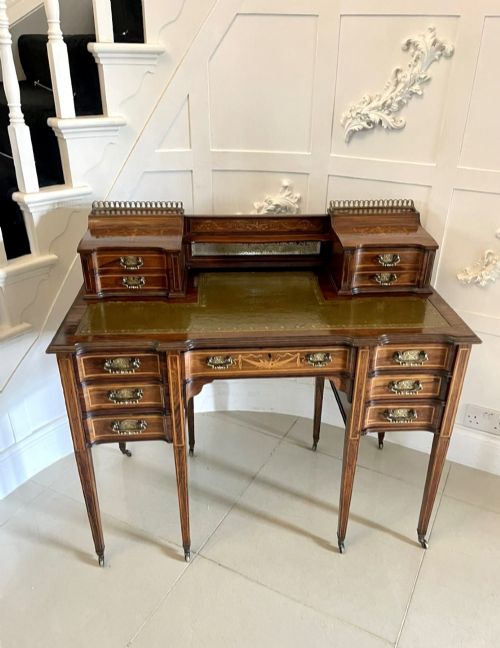
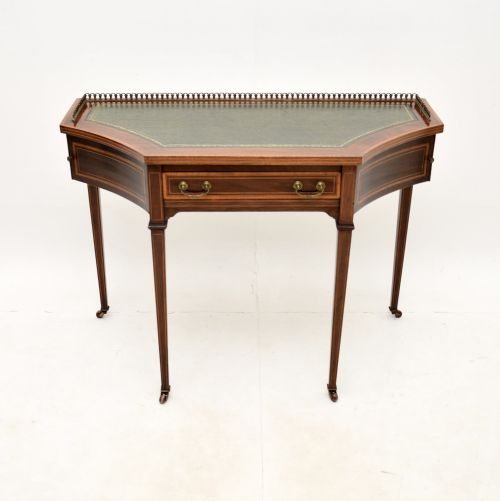
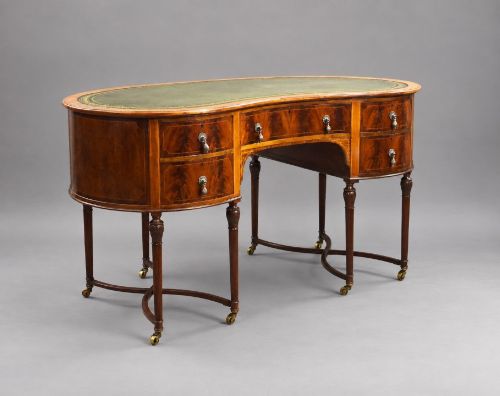


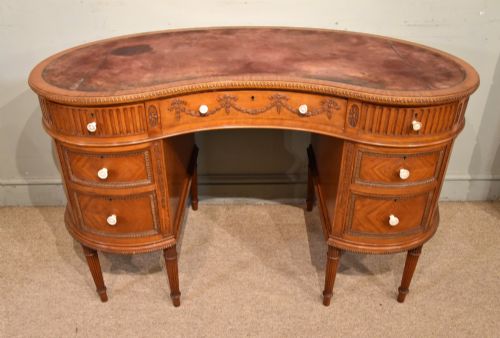

Leather Inlaid Table
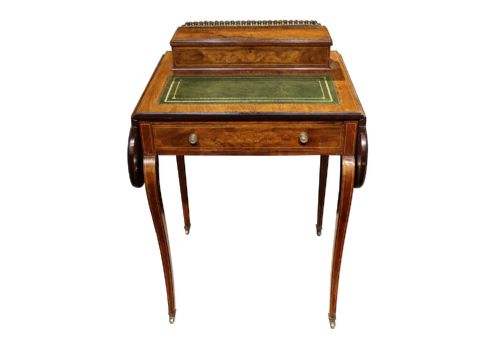
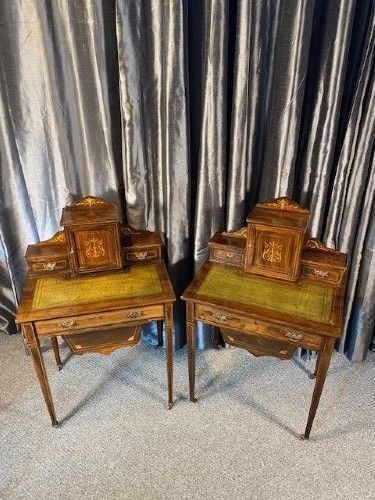
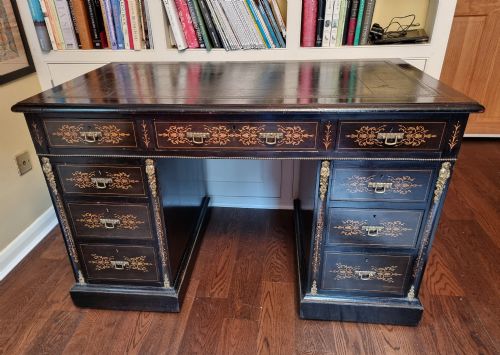
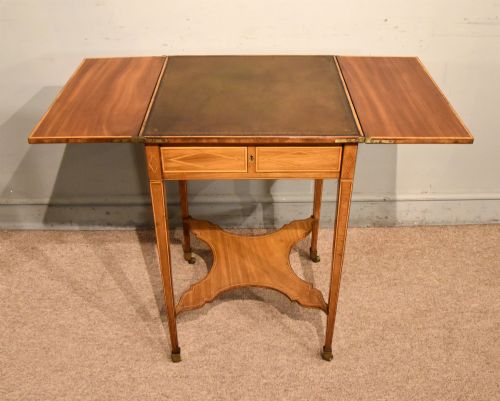
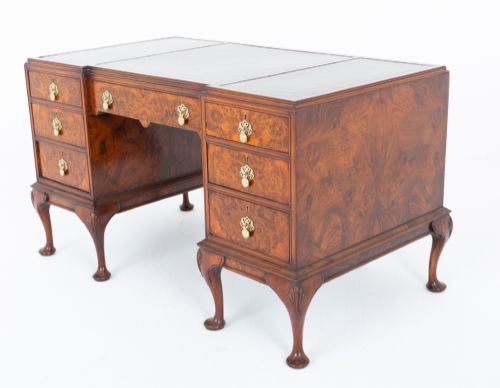
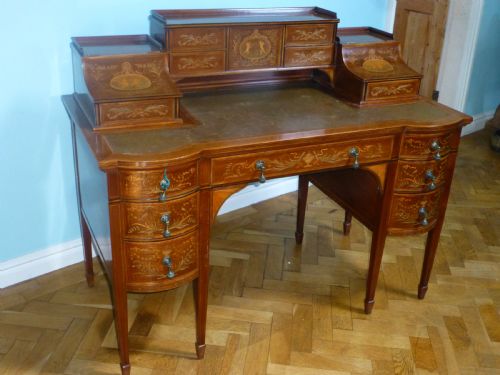
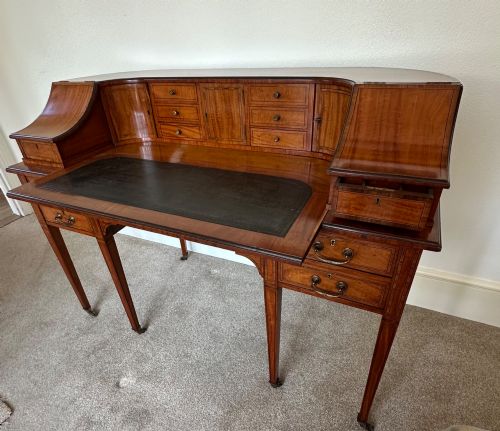
A leather inlaid table brings rich warmth to a study, offering a smooth surface set within polished timber.
Leather Inlaid Table
When you search for a leather inlaid table, you encounter writing desks, library tables, and writing tables spanning the Victorian and Edwardian periods.
The most common forms on this page are Edwardian mahogany writing tables and kidney-shaped desks, alongside Victorian library pieces.
Cabinetmakers constructed these pieces in styles ranging from Sheraton Revival and Regency to Queen Anne, utilising timbers like mahogany, satinwood, and rosewood.
Materials and construction methods
Maker workshops built carcasses in solid mahogany, walnut, or oak, applying veneers of flame mahogany, satinwood, burr walnut, and rosewood to visible surfaces.
Craftsmen inset panels of tooled leather into the timber tops, often framing the hide with fine stringing, banding, and marquetry inlay.
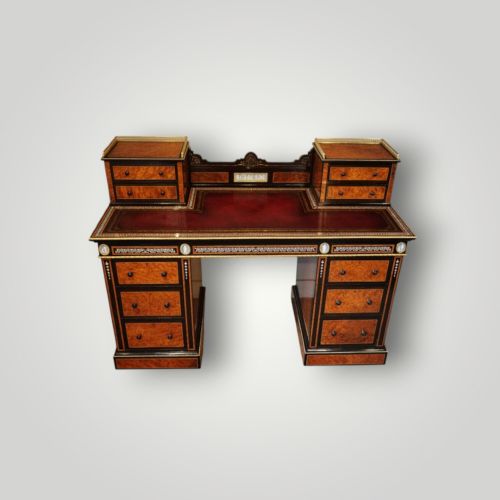
Structural details include brass handles, ormolu mounts, and fitted internal compartments with small drawers and pigeonholes.
Listings feature mahogany, satinwood, rosewood, and burr walnut timbers across Victorian and Edwardian forms.
Distinctions in craftsmanship
The standard of a piece rests on the precision of the marquetry and the choice of timber veneers, such as richly figured flame mahogany or selected satinwood.
Renowned makers integrated thoughtful design details like serpentine curves, kidney contours, and fully finished backs for freestanding placement.
The quality of the internal joinery, the execution of the gilt tooling on the leather, and the integration of secondary woods dictate the standing of an individual desk.
Maple and Co·Jackson and Graham·Edwards and Roberts·Wolfe and Hollander·Gill and Reigate·S and H Jewell
The Leather Inlaid Table Glossary
- Carlton House desk
- A form of writing desk featuring a superstructure of small drawers and pigeonholes arranged in a curved tier around the back and sides.
- Kidney shape
- A curved desk profile resembling a kidney bean, designed to wrap around the seated user.
- Marquetry
- Decorative patterns formed by fitting together thin slices of various woods, veneers, and shell into a wooden panel.
- Stringing
- Thin lines of contrasting timber inlaid into grooves in the surface of furniture to create geometric borders.
- Ormolu
- Gilt-bronze mounts applied as decorative ornaments to furniture drawers and legs.
Leather Inlaid Table: Frequently Asked Questions
What periods do these tables come from?
The listings span the nineteenth and early twentieth centuries, with a heavy concentration of Victorian and Edwardian examples.
Maker workshops produced many of these pieces during the Sheraton Revival movement around nineteen hundred.
How were these writing tables used?
These tables served as functional writing surfaces in private studies, libraries, and withdrawing rooms.
Owners utilised the fitted interiors and drawers for correspondence, keeping stationery and ledgers close to hand.
Are the leather tops original?
Many pieces retain their original tooled leather inserts, showing age appropriate patination and gold leaf decoration.
Some examples feature replacement leather selected to match the historic character of the surrounding timber.
How do I distinguish Edwardian from Victorian pieces?
Victorian examples often employ dense timbers like rosewood and walnut, sometimes paired with heavy brass banding or porcelain plaques.
Edwardian pieces frequently display lighter satinwood or mahogany veneers, influenced by eighteenth-century Sheraton designs.