


Late Victorian Rug
Late victorian rug pieces bring regional Persian, Caucasian and Anatolian weaving traditions into interior spaces through hand-knotted wool and natural dyes.

Late Victorian Rug
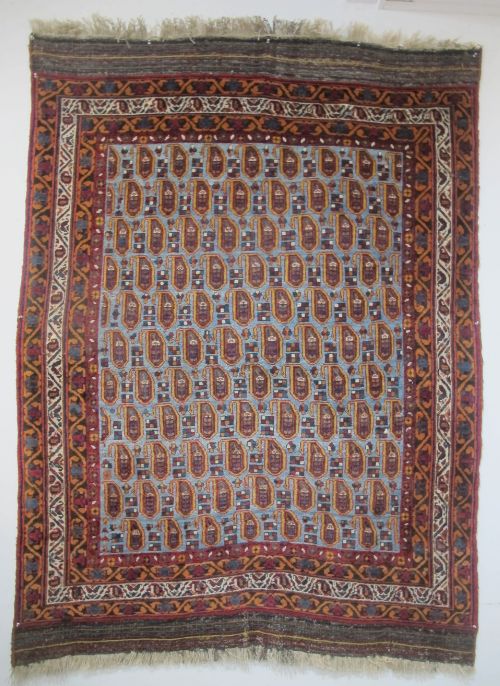
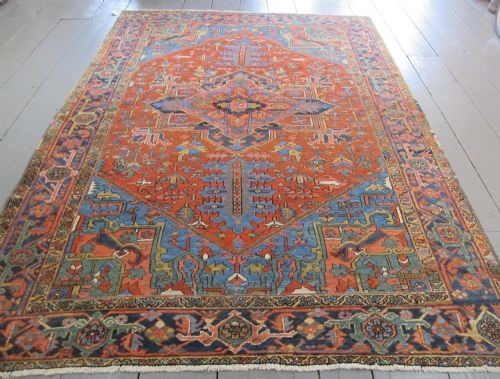
A late victorian rug encompasses room-size Persian carpets, smaller tribal prayer rugs, runners and carpet formats originating from workshops and nomadic confederations during the nineteenth century. Buyers examine pieces originating from Heriz, Serapi, Sultanabad, Fereghan, Kerman, and various Caucasian and Turkmen districts.
The selection on this page centres heavily on Persian tribal and village formats alongside Caucasian prayer rugs and Anatolian examples. These floor coverings bridge the gap between utilitarian nomadic weaving and decorative Western interior schemes of the late nineteenth century.
Geographic attribution dictates the visual vocabulary, separating the geometric layouts of Caucasian Kazak and Gendje pieces from the sweeping floral medallions of Heriz carpets. Buyers encounter formats ranging from compact prayer rugs to expansive area carpets designed for principal reception rooms.
What varies in quality
Quality rests on the integrity of the natural dye palette, where rich tones from madder, indigo and weld retain vibrancy and develop patina over time. The precision of the knotting and the fineness of the hand-spun wool determine the structural resilience of the carpet.
Design execution separates standard village production from master workshop output, visible in the balance of borders and the crispness of geometric or floral motifs. Preservation of the original edge bindings, fringes and pile depth governs the overall integrity of the piece.
Listings feature nineteenth-century Persian workshop carpets alongside Caucasian, Kurdish, Baluch and Turkmen tribal rugs.
The Late Victorian Rug Glossary
- Warp
- The vertical threads stretched across the loom that form the foundation of the rug and terminate in the fringe.
- Weft
- The horizontal threads passed between the warp threads to secure the rows of knots in place.
- Pile
- The dense surface of cut wool loops that forms the tactile face of the carpet and displays the pattern.
- Natural dye
- Colourants derived from plant, insect and mineral sources prior to the widespread adoption of synthetic aniline dyes.
- Prayer rug
- A small format rug featuring a mihrab or niche design, traditionally used for personal devotion.
Late Victorian Rug: Frequently Asked Questions
How do I clean a late victorian rug?
Professional specialist cleaning is essential for antique textiles woven with natural dyes and hand-spun wool. Routine maintenance relies on gentle suction vacuuming without a beater bar.
Avoid chemical spot treatments and excessive moisture, which can destabilise historical foundations and cause dye migration across the wool pile.
Where were these rugs made?
Production centres span Persia, the Caucasus, Anatolia, Turkmenistan and India. Village weavers and nomadic confederations produced distinct regional styles.
Workshop cities like Kerman, Sultanabad and Heriz manufactured larger carpets for international export markets.
Are these rugs durable for daily foot traffic?
Hand-knotted wool construction on cotton foundations provides substantial natural resilience for everyday domestic environments. Quality of wool and knot density determine how well the pile withstands friction.
Picturing them in corridors or living spaces aligns with their historical purpose as functional floor coverings.
How do I identify a Caucasian rug?
Caucasian pieces typically display bold geometric motifs, stars, hooked polygons and saturated primary colours on indigo or yellow grounds. Regional types like Kazak, Gendje and Shirvan exhibit distinct tribal medallion arrangements.
The structural use of wool foundation threads and characteristic end finishes further distinguish these mountain and valley weaves from Persian workshop carpets.