


Late Victorian Centre Table
A late victorian centre table stands freely in a room, offering a functional surface shaped by walnut, mahogany, and brass.
Late Victorian Centre Table
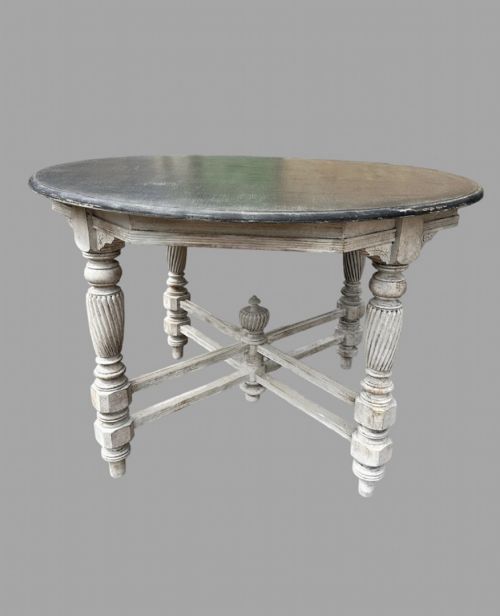
When you search for a late victorian centre table, you find freestanding tables designed to occupy the middle of a room rather than sit against a wall. These pieces date from the late nineteenth century, predominantly the 1880s and 1890s, spanning various interpretations of Victorian design.
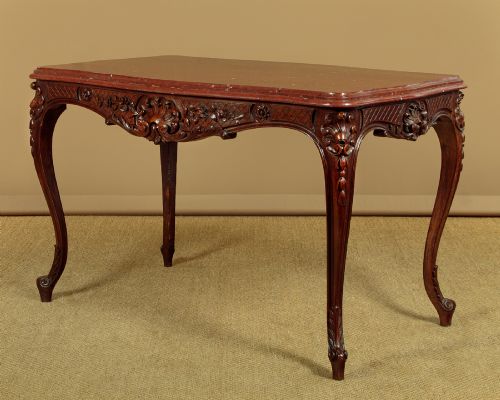
Makers of this period drew upon diverse historicist impulses, producing examples in the Aesthetic Movement, Reformed Gothic, and French Rococo Revival styles. Such variety ensures that these tables range from sober, leather-insets library pieces to heavily carved decorative forms.
Materials and Construction Techniques
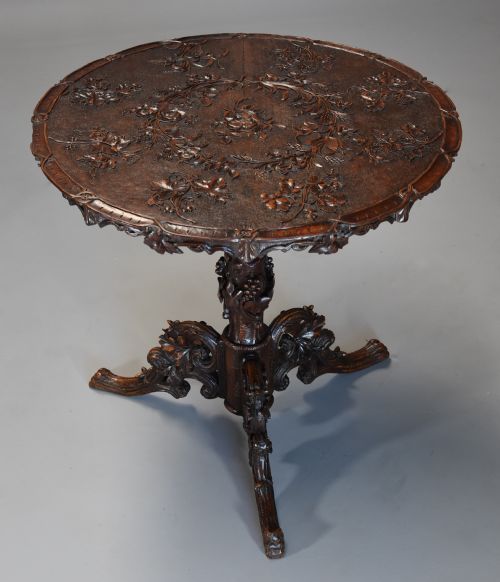
Cabinet makers of the period relied heavily on dense timbers such as walnut, mahogany, oak, and rosewood, often enhancing plain surfaces with parquetry, marquetry, or inlaid details. Alternative materials such as linden wood facilitated deep, profuse carving, while metals like brass provided structural or decorative elements.
Surface treatments included French polishing to highlight timber grain, alongside specialised inserts like tooled Moroccan leather or inset rouge marble slabs. Structural stability was achieved through turned spindle bases, heavy pedestals, or robust framed legs tailored to support substantial table tops.
Late Victorian Centre Table Retail Price Guide 2026
Typical asking prices for late victorian centre table among the pieces listed under this phrase on Sellingantiques today, from the lower quarter to the upper quarter. They describe what is for sale here now, not the wider market.
One particularly adaptable piece doubles as a campaign bed, proving that Victorian furniture could easily accommodate a sudden afternoon nap.
Distinctions in Quality
Quality reveals itself in the ambition of the design and the execution of the carving, distinguishing mass-produced items from individually conceived pieces. Profuse, crisp hand-carved ornamentation on linden wood or walnut denotes superior craftsmanship compared to shallow, mechanical stamping.
The choice of secondary materials also elevates a piece, such as selecting solid rosewood, satin birch, or integrating specialised components like inset marble and tooled leather. Joinery execution and the preservation of original surfaces further separate standard utility tables from exceptional examples.
Gillows·Elkington
The Late Victorian Centre Table Glossary
- Centre table
- A freestanding table finished on all sides to sit in the middle of a room rather than against a wall.
- Aesthetic Movement
- A late nineteenth-century design style emphasising decorative art and aesthetic value over narrative content.
- Marquetry
- The art and craft of applying pieces of veneer to a structure to form decorative patterns and pictures.
- Parquetry
- A geometric mosaic of wood pieces used for decorative flooring or table tops.
- Reformed Gothic
- A nineteenth-century architectural and decorative style simplifying and rationalizing medieval Gothic forms.
Late Victorian Centre Table: Frequently Asked Questions
Where should I place a centre table?
These tables are designed to stand away from walls, making them suitable for the middle of a reception room, library, or large entrance hall. Their finished appearance on all sides allows them to act as a focal point in open spaces.
Ensure there is adequate walkaround space to appreciate the octagonal or circular geometry and to access the surface comfortably from any angle.
What is the difference between a centre table and a side table?
A centre table is finished identically on all sides because it is meant to be viewed from every direction in the middle of a room. Side tables and hall tables are typically built to back up against a wall.
This finishing distinction affects both the framing underneath and the detailing of the timber or inlay work across the entire perimeter of the top.
How do I identify an Aesthetic Movement table?
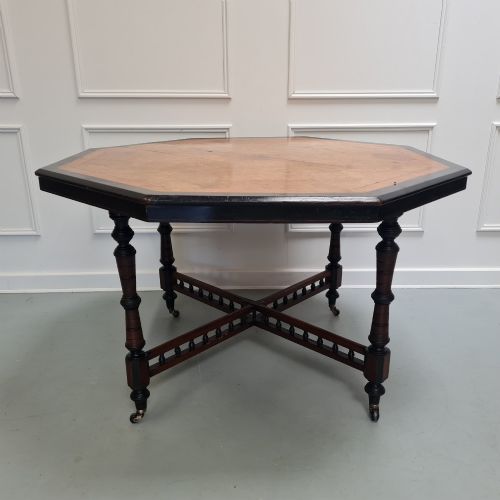
Aesthetic Movement tables often feature geometric forms, particularly octagonal tops, alongside stylized inlay work and influences from Japanese design. They avoid heavy historical revivalism in favour of cleaner lines and artistic surface decoration.
Look for contrasting timbers, subtle incised carving, and structural simplicity paired with refined decorative execution.
How do I care for a leather-inset top?
Tables featuring tooled leather inserts, such as Reformed Gothic library examples, require protection from direct sunlight and excessive moisture. Use dry cloths for dusting and specialised leather balms sparingly to maintain suppleness.
Avoid placing hot cups or unsealed vessels directly on the leather surface to prevent permanent marking of the material.