





Late Regency Rosewood Table
A late regency rosewood table brings rich timber grain and architectural restraint into a room, offering both beauty and utility.
Late Regency Rosewood Table
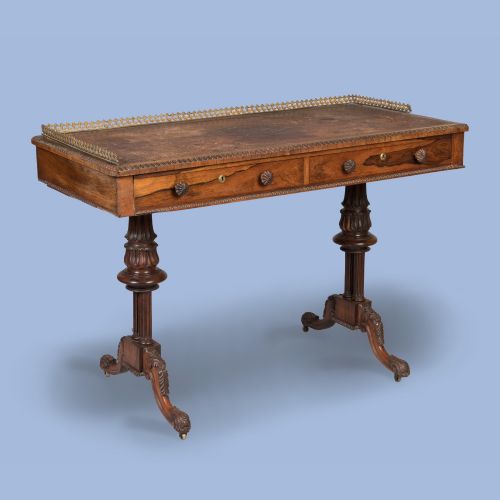
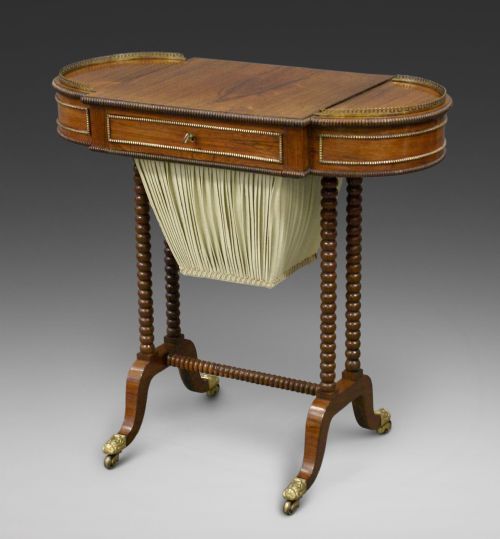
A late regency rosewood table is a piece of furniture originating from the early decades of the nineteenth century, spanning periods noted as Georgian, Regency, and the wider nineteenth century. These tables appear in forms intended for diverse rooms, including library tables, occasional tables, games tables, sofa tables, and writing desks.
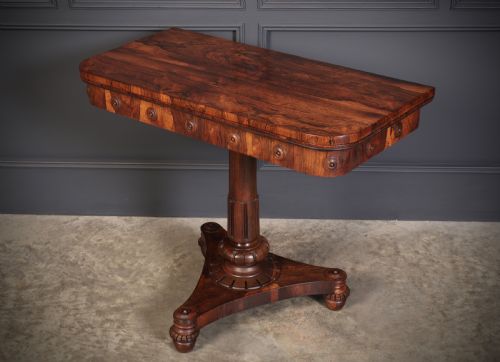
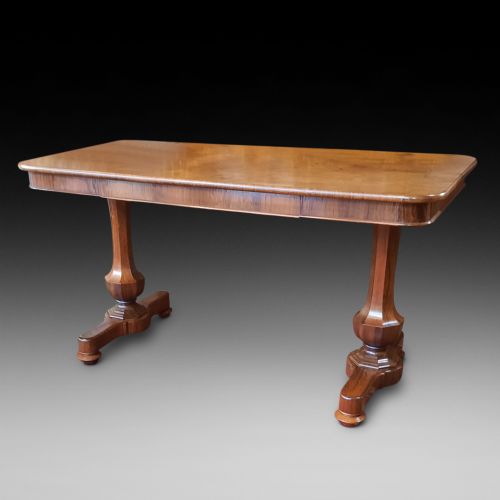
The versions most commonly met on this page are card tables, library tables, and centre tables, often bearing the rich dark tones characteristic of rosewood. Makers and cabinetmakers of the period produced both formal dining pieces and smaller tables for specific domestic tasks.
Examples from this era frequently demonstrate a transition from strict classical lines to slightly heavier proportions, whilst retaining the dark, dense grain that defines the style. A buyer searching this phrase looks for the characteristic warmth of the timber paired with the classical restraint of the late Regency aesthetic.
Materials and construction
Cabinetmakers utilised dense rosewood veneers applied to secondary timbers, taking advantage of the rich, dark grain patterns to create striking table tops. Brass inlay and wood inlay frequently embellish the surface, adding linear contrast to the dark timber.
Many of the folding and games tables incorporate secondary materials such as baize or leather to line the playing and writing surfaces. Structural stability is provided by sturdy pedestals and stretcher frames, which support the heavy rosewood tops without cluttering the floor space.
The listings here draw on multiple forms including library tables, card tables, and occasional pieces, all fashioned from rosewood, mahogany, and brass.
Distinctions in quality
The quality of a late regency rosewood table rests primarily on the selection and matching of the timber veneers, where continuous grain patterns indicate superior craftsmanship. Lesser pieces rely on uniform, plain timber with minimal attention to how the grain wraps around the edges and aprons.
Precision in brass inlay and the crispness of turned pedestal elements separate standard workshop production from finer cabinet work. The smoothness of folding mechanisms on card tables and the stability of drawer construction further distinguish the finer examples available to a collector.
The Late Regency Rosewood Table Glossary
- Rosewood
- A dense, dark timber prized for its dramatic black and purple grain patterning. It was the material of choice for fashionable furniture during the Regency period.
- Centre table
- A freestanding piece designed to be viewed from all sides rather than pushed against a wall. These tables often anchor the middle of a principal reception room.
- Pembroke table
- A small occasional table featuring drop leaves supported by hinged brackets. It offers flexible surface area for writing or sewing.
- Marquetry
- The art of applying decorative pieces of veneer to a structure to form intricate patterns or pictures. This technique lifts plain timber surfaces into decorative focal points.
- Tilt top table
- A table equipped with a mechanism allowing the top to pivot to a vertical position when not in use. This design saved valuable floor space in nineteenth-century homes.
Late Regency Rosewood Table: Frequently Asked Questions
How do I care for rosewood?
Rosewood benefits from minimal interference and stable indoor humidity away from direct sunlight. Excessive heat can dry out the dense timber and cause the veneer to lift from its base.
Apply a traditional wax polish sparingly only when the wood appears dry. Regular dusting with a soft, dry cloth preserves the natural lustre of the grain.
Where were these tables placed?
Library tables and writing desks typically stood in studies or parlours to serve intellectual pursuits. Card tables and centre tables occupied drawing rooms to host evening entertainment and social gatherings.
Smaller occasional and lamp tables found spots beside seating or in hallways. Their versatile forms allowed them to move easily between rooms as domestic needs shifted.
How do I distinguish Regency from Georgian?
Regency design generally draws more direct inspiration from classical Greek and Roman archaeology. The proportions lean toward slender supports, bolder brass mounts, and crisper carved details.
Georgian pieces often display slightly heavier structural elements and more restrained surface ornament. The two periods overlap considerably in late examples, sharing similar forms and timber choices.
Can I use a card table daily?
Most folding card tables were built to withstand active use with sturdy hinges and pivoting legs. Opening and closing the top requires care to protect the internal timber pivots and lined surfaces.
Placing heavy objects on the unsupported corners of an open leaf should be avoided. With gentle handling, these tables function reliably for modern dining or games.