
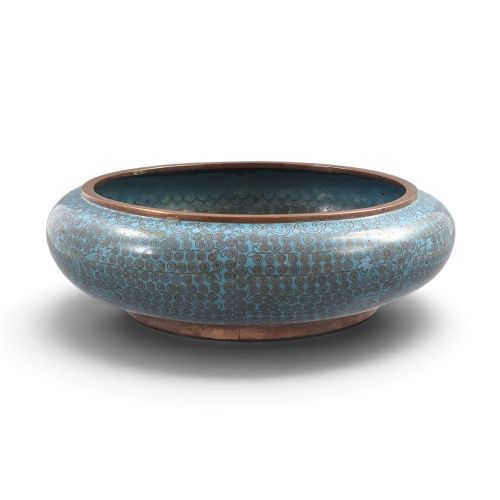


Late 19th Century Cloisonne
Late 19th century cloisonne pieces are enamelled vessels and trays built with wire cells on copper, brass or bronze bases.
What late 19th century cloisonne is
Late 19th century cloisonne brings together detailed metalwork and vibrant coloured enamels from Japanese Meiji and Chinese Qing contexts. Collectors searching this phrase encounter decorative bowls, chargers, jars and vases dating from the 1880s through the Edwardian era.
The objects available range from large dragon chargers and leaping koi trays to covered jars and jardinieres. Both Japanese and Chinese workshops produced these pieces for export and domestic markets during periods of high technical skill.
Vessels span both copper and bronze foundations, often featuring bird or floral motifs executed in wire. These decorative forms represent the standard repertoire of late nineteenth century production seen on this page.
How they were made
Artisans formed vessels from copper, brass or bronze before soldering thin metal wires to the surface to create cellular patterns. These wire boundaries, or cloisons, outlined the intended pictorial designs such as birds, dragons and koi.
Workers filled the resulting compartments with coloured enamel pastes before firing the piece in a kiln. Repeated firings and polishings ensured the glass paste fused evenly with the metal matrix and wire outlines.
Retail Price Guide 2026
Typical UK retail prices for late 19th century cloisonne, calculated from the Sellingantiques database of over a million retail prices indexed since 2003. This retail price guide relies exclusively on Sellingantiques data; no external sources or auction records are used, so the figures do not describe the wider market.
Some heavy bronze bowls weigh over a kilogram, proving that these Victorian decorators took their desk accessories very seriously.
What varies in quality
The precision and fineness of the soldered wirework set the baseline for quality in these enamelled objects. Tighter cell geometry and thinner dividing lines demand greater skill from the artisan than broader, coarser layouts.
Surface finish and colour saturation also separate standard production from finer examples. Even polishing across the metal wires and glass paste reveals the level of care taken during the final stages of manufacture.
The Late 19th Century Cloisonne Glossary
- Cloisonne
- Enamelling technique where metal wires are soldered to a base to form cells that hold coloured paste. This method creates the characteristic cellular grid pattern visible on the surface.
- Meiji Period
- Japanese historical era spanning from 1868 to 1912. Many decorative exported works date from this time of rapid industrial and artistic exchange.
- Charger
- Large ornamental plate intended for display rather than dining. These heavy pieces often display complex motifs like dragons across their wide surfaces.
- Jardiniere
- Large decorative pot or planter designed to hold growing plants. Examples from this period typically utilise heavy bronze or copper bases with enamelled decoration.
- Enamel
- Vitreous substance fused to a metal substrate through firing. It provides the coloured ground within the wire cloisons.
Frequently Asked Questions
Were these pieces meant for daily use?
Most items such as decorative bowls, chargers and jardinieres served primarily as ornamental display pieces in homes. Their intricate enamel surfaces were vulnerable to heavy wear and physical impacts.
While some jars and trays had practical functions, their delicate construction made them better suited for decorative presentation.
How can I tell Japanese from Chinese pieces?
Japanese Meiji period works often utilise lighter copper bases with very fine, precise wirework depicting natural subjects like birds and koi. Chinese pieces from the same decades frequently employ heavier bronze foundations with bolder decorative styles.
Examining the weight, metal composition and wire thickness helps distinguish between these regional manufacturing traditions.
Why are some pieces mounted as lamps?
Vases and jars were frequently converted into lamps during the twentieth century to suit changing interior decoration tastes. This practice involved drilling or adapting the base to fit electrical wiring.
While alteration changes the original format, converted pieces remain a common part of the historical record.