


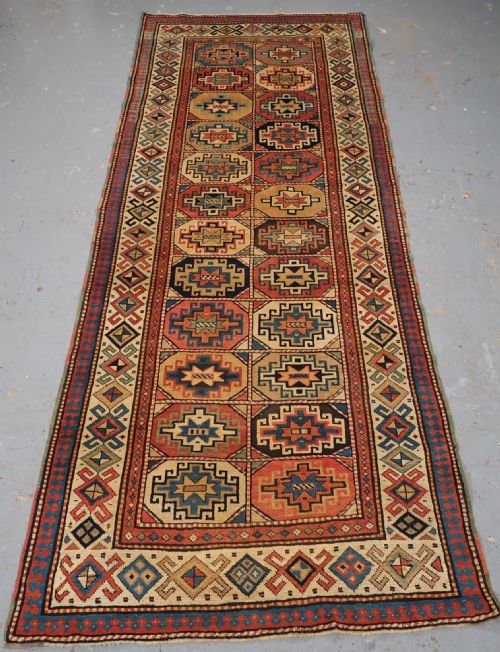


Latch Hook Medallion Rug
These latch hook medallion rug examples bring authentic tribal artistry into a room through geometric motifs and rich wool pile.
Latch Hook Medallion Rug
A latch hook medallion rug is a tribal floor covering defined by distinctive geometric motifs with hooked edges. These pieces originate from nineteenth-century weaving traditions across the Caucasus and Persia, spanning periods from 1870 to 1910.
You are most likely to meet Kazak, Baluch, Moghan, and Kurdish rugs and runners on this page. These textiles showcase traditional nomadic designs, featuring central medallions and elongated lattices worked in wool and camel hair.
The regional styles represented here lean heavily towards Caucasian, Caucasian Tribal, and Persian Tribal aesthetics. Each rug serves as a practical floor covering and a historical textile displaying distinctive tribal artistry.
How they were made
Weavers constructed these rugs using hand-spun wool and camel hair for the pile and foundation yarns. These natural animal fibres provided the durable structure necessary for everyday use in nomadic tents and village homes.
The distinctive patterns were built knot by knot, translating traditional tribal symbolism into dense, textured surfaces. Artisans relied on natural dyes to colour the wool, creating the soft hues seen in nineteenth-century examples.
Latch Hook Medallion Rug Retail Price Guide 2026
Typical asking prices for latch hook medallion rug among the pieces listed under this phrase on Sellingantiques today, from the lower quarter to the upper quarter. They describe what is for sale here now, not the wider market.
Listings feature Caucasian and Persian tribal styles, specifically Kazak, Baluch, Moghan, and Kurdish rugs and runners dated between 1870 and 1910.
What varies in quality
The refinement of the latch hook medallion design distinguishes the finer examples from simpler village work. Crisp geometry and balanced placement of the central motifs reflect greater technical control by the weaver.
Pile integrity and the harmonious ageing of the natural wool and camel hair define the upper tier of these rugs. Softer colour palettes resulting from age and dye quality elevate the visual character of the piece.
The Latch Hook Medallion Rug Glossary
- Latch hook
- A geometric motif featuring stepped or hooked outlines along its edges. This design element is characteristic of tribal weaving traditions.
- Medallion
- A central ornamental design motif placed in the field of the rug. It anchors the symmetrical composition of the textile.
- Kazak
- A style of antique rug originating from the Caucasus region. These pieces are celebrated for bold geometric designs and saturated wool piles.
- Camel hair
- Natural undyed animal fibre utilised in the pile or foundation of specific tribal rugs. It provides a durable and soft handle.
- Runner
- A long and narrow format of rug designed for hallways or narrow spaces. These pieces maintain tribal patterns across an elongated field.
Latch Hook Medallion Rug: Frequently Asked Questions
Where were these rugs made?
These rugs were produced by tribal and nomadic weavers across the Caucasus and Persia during the late nineteenth and early twentieth centuries.
Production centres included regions associated with Kazak, Baluch, Moghan, and Kurdish weaving traditions.
What materials did weavers use?
Weavers utilised natural animal fibres, primarily sheep wool and camel hair, for both the pile and the foundational structure.
These natural materials ensured the rugs could withstand daily wear while developing a softer handle over time.
How do I style a tribal runner?
Tribal runners work well in hallways, corridors, or narrow spaces where their elongated format can guide movement through a home.
Their geometric designs complement both traditional interiors and modern minimalist rooms by adding texture and historical depth.
How do I date these antique rugs?
Dating relies on stylistic analysis, material assessment, and structural characteristics typical of nineteenth-century weaving.
Surviving examples on this page span specific decades from 1870 through 1910, identified by their dyes and regional motifs.