
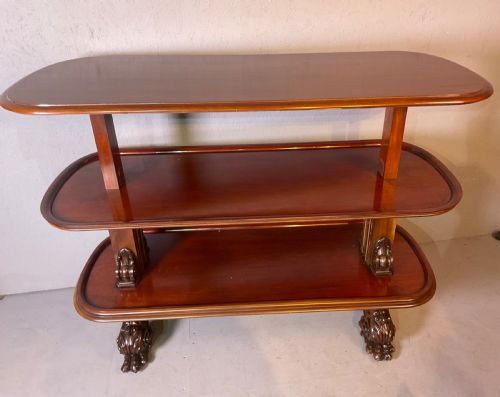


Large Mahogany Serving Table
A large mahogany serving table anchors a grand dining room with solid timber presence and formal proportions.
Large Mahogany Serving Table
A large mahogany serving table sits comfortably at the heavier end of formal dining furniture, spanning styles from Georgian country house pieces to Regency and Victorian creations. Buyers searching for a large mahogany serving table will encounter sideboard hybrids, console tables, and tiered dumb waiters that served similar functional roles in large houses.
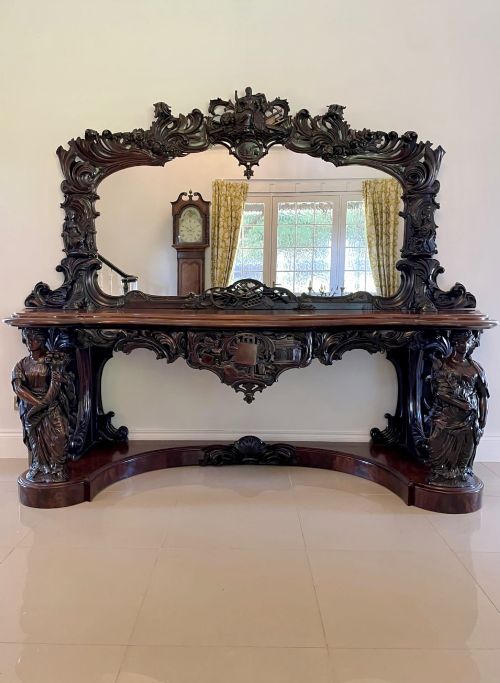
The pieces on this page draw on George III, Adam Revival, Regency, and Victorian Rococo idioms. Most examples date from the nineteenth century, though earlier Georgian roots and Edwardian revivals appear regularly.
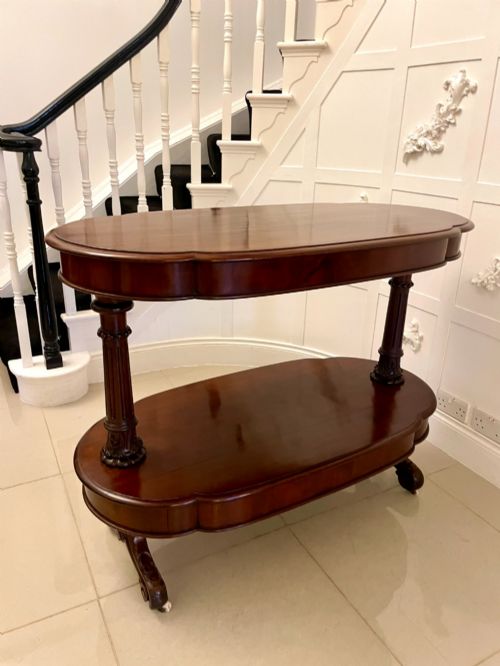
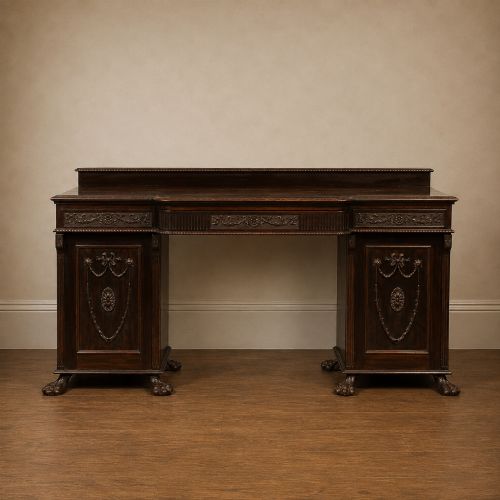
Formats vary from breakfront sideboards with paw feet to oval freestanding console tables and multi-tiered serving furniture. Makers utilised flame veneers, figured timbers, and gilt highlights to suit formal interiors.
Judging the work
Quality rests on the choice of timber and the control of the veneer. Plain boards sit a tier below rich flame mahogany or figured stock that has been matched symmetrically across a wide top.
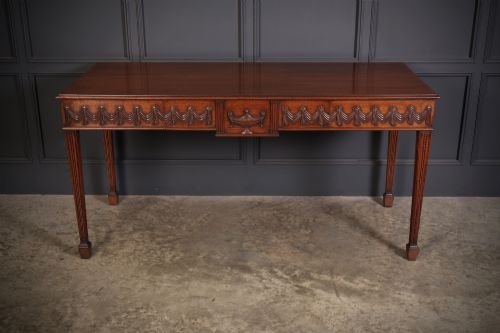
Carving depth and the precision of revival details like Adam swags or paw feet set better workshops apart from standard production. Original surface patination and uncompromised structural mass dictate the standing of an individual piece.
Nineteenth-century pieces form the numerical core here, bridged by 18th-century Georgian and Edwardian revival items.
Whytock And Reid·Gillows·George Smith
The Large Mahogany Serving Table Glossary
- Breakfront
- A piece of furniture where the central section projects forward from the flanking wings. This layout creates depth and shadow across large sideboards.
- Dumb waiter
- A tiered freestanding serving stand designed to hold dishes without domestic staff present. These pieces often feature multiple rotating or fixed trays.
- Flame mahogany
- Timber cut at an angle to the branch junction to produce a flamelike grain pattern. Cabinet makers reserved this veneer for primary focal surfaces.
- Console table
- A table designed to stand against a wall, frequently secured with brackets. In larger formats, these double as serving tables.
- Serpentine shaped
- A front edge curving outward in the centre and inward at the sides. This contour requires skilled carpentry to shape timber accurately.
Large Mahogany Serving Table: Frequently Asked Questions
How were serving tables used originally?
These tables stood in dining rooms to hold heavy dishes, silver, and wine before servants placed them on the main dining table. They functioned as staging surfaces for large households during formal meals.
In grand settings, dumb waiters also held courses near the dining table to reduce the need for servants during private meals.
Where should I place a large serving table?
A large piece needs a generous dining room or a wide hallway to balance its substantial proportions. Freestanding oval models work well away from walls if space permits.
Pairing the timber tone with existing dining furniture helps ground the piece in a modern room without overwhelming the floor plan.
How do I tell a Georgian table from a Victorian one?
Georgian and George III pieces tend to display restrained classical lines, simpler carving, and heavy solid timber construction. Proportions follow strict Neoclassical or Palladian rules.
Victorian examples often embrace bolder revival styles like Rococo or heavy figured veneers, reflecting changing nineteenth-century domestic tastes and machining advances.
What is the difference between a sideboard and a serving table?
Traditional serving tables are open-framed console tables with legs and a top surface. Sideboards frequently incorporate enclosed cupboards and drawers beneath the main top.
Many nineteenth-century cataloguers used the terms interchangeably, especially when describing large country house dining furniture.