

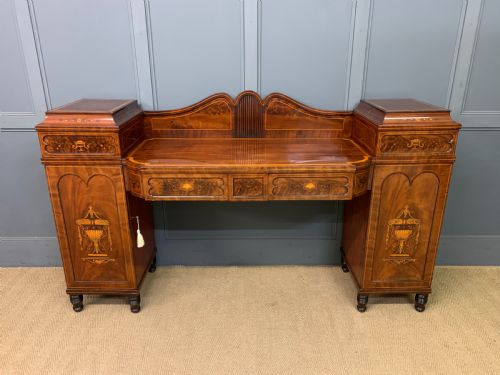


Twin Pedestal Sideboard
A twin pedestal sideboard anchors a dining room with serious storage and presence, built from rich timbers like mahogany.
Twin Pedestal Sideboard
A twin pedestal sideboard provides substantial dining room storage with two distinct lower cabinets supporting a central surface or recessed section. Buyers searching for a twin pedestal sideboard will find Georgian, Regency, and Victorian examples spanning the nineteenth century.
Mahogany dominates the selection, appearing alongside flame mahogany veneer, oak, pine, padouk, and walnut. Forms range from classical pedestal arrangements to drop well configurations and side cabinets.
Georgian and Regency pieces bring classical proportions and delicate boxwood stringing, while Victorian interpretations offer heavier proportions and robust timber figures.
How they were made
Cabinet makers utilised solid mahogany, oak, and pine for the main structures, applying figured flame mahogany veneers to drawer fronts and door panels to create dramatic grain patterns. Secondary timbers like oak and pine appear in drawer linings and internal framing.
Surface enrichment relied on contrasting wood inlay, such as boxwood stringing, alongside cast brass galleries mounted to the upper tiers. Joinery combined traditional hand-cut dovetails for drawers with sturdy carcase construction to support the heavy pedestals.
Twin Pedestal Sideboard Retail Price Guide 2026
Typical asking prices for twin pedestal sideboard among the pieces listed under this phrase on Sellingantiques today, from the lower quarter to the upper quarter. They describe what is for sale here now, not the wider market.
Listings feature mahogany, oak, pine, walnut, and padouk across Georgian, Regency, and Victorian periods.
What varies in quality
The choice of timber grain defines the visual tier, moving from plain sawn boards to highly figured flame mahogany veneers matched symmetrically across panels. Finer examples display meticulous wood inlay and well-chosen brass galleries rather than plain or later replacement hardware.
Structural refinement separates standard production from superior workshops, visible in the precision of the dovetail joints and the weight of the timber used in the pedestals. Proportion and balance dictate the architectural success of the piece.
The Twin Pedestal Sideboard Glossary
- Pedestal
- A structural support column or cupboard base positioned at either end of the sideboard beneath the main counter surface. These compartments often house cellarets or shelving.
- Flame mahogany
- A veneer cut from the branch forks of the mahogany tree that yields a distinctive flickering flame pattern. Cabinet makers prized this timber for central display panels.
- Brass gallery
- A decorative metal rail mounted along the rear upper edge of the sideboard top. It prevented serving dishes from sliding off during use.
- Drop well
- A lowered central section set between the two heavy pedestals of the sideboard. This profile eased the task of serving food.
- Padouk
- A dense tropical hardwood with a rich reddish brown tone utilised in Anglo Indian furniture production. It provided exceptional durability and a deep natural lustre.
Twin Pedestal Sideboard: Frequently Asked Questions
What is a twin pedestal sideboard?
A twin pedestal sideboard is a large dining room furniture form featuring two distinct cabinet bases joined by a central top surface or recessed section. It was designed to store serving dishes, cutlery, and wine.
The layout provides generous interior capacity while maintaining a formal architectural presence against the dining room wall.
How do I date a sideboard?
Dating relies on observing the timber selection, decorative motifs, and construction methods characteristic of different periods. Georgian and Regency pieces favour elegant proportions and delicate inlay, while Victorian examples show heavier mouldings and robust timber.
Secondary woods inside drawers and the style of the brass hardware offer further clues to the decade of manufacture.
Where should I place it?
These sideboards require a substantial wall in a dining room, hallway, or large living space to accommodate their deep pedestals and length. Ensure adequate clearance around the piece for opening the heavy cabinet doors.
They serve effectively as serving stations during meals or as display surfaces for lamps and decorative objects.
Are these pieces suitable for modern homes?
The deep cupboards and drawers provide practical storage for modern dining rooms, functioning well as credenzas or serving stations. Their classic timber tones integrate smoothly with both traditional and contemporary interior schemes.
Positioning them away from direct heat sources helps protect the antique veneers and solid wood construction.