

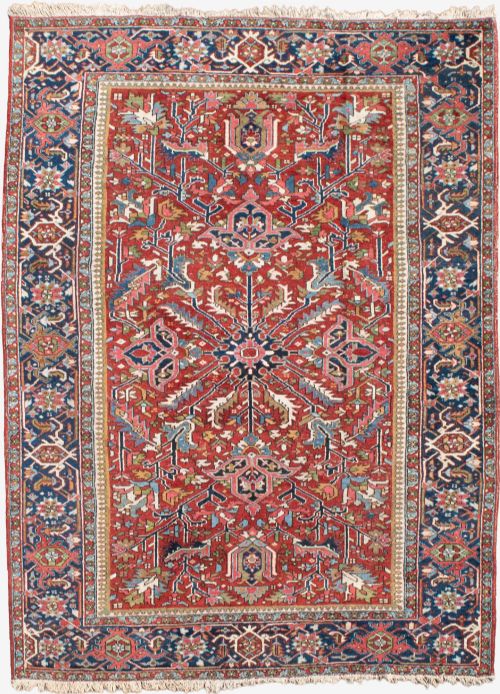


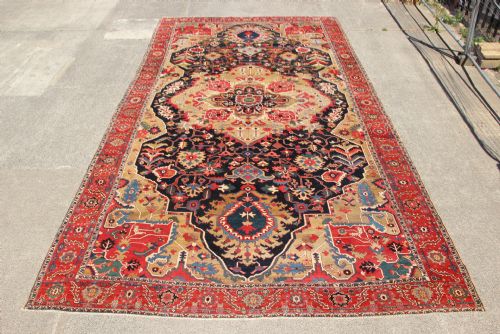
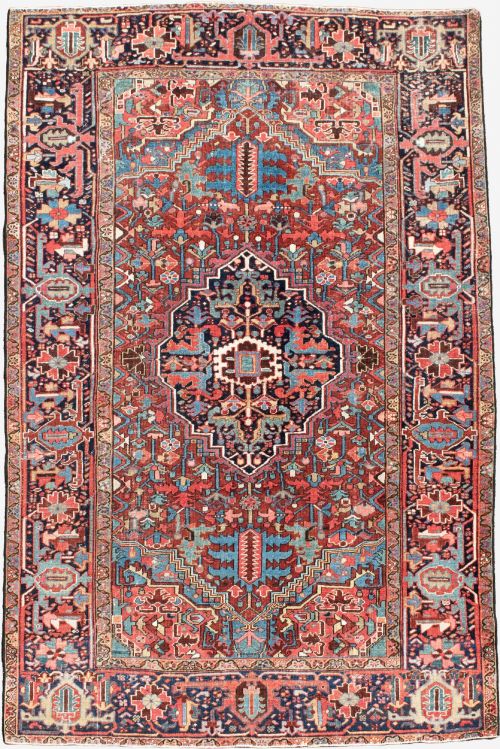
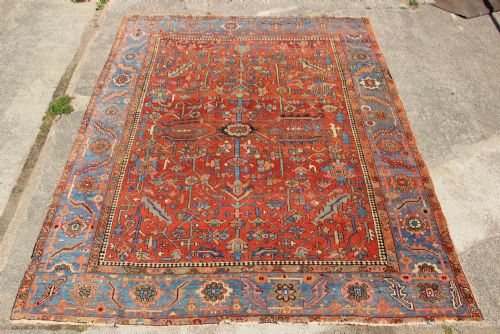
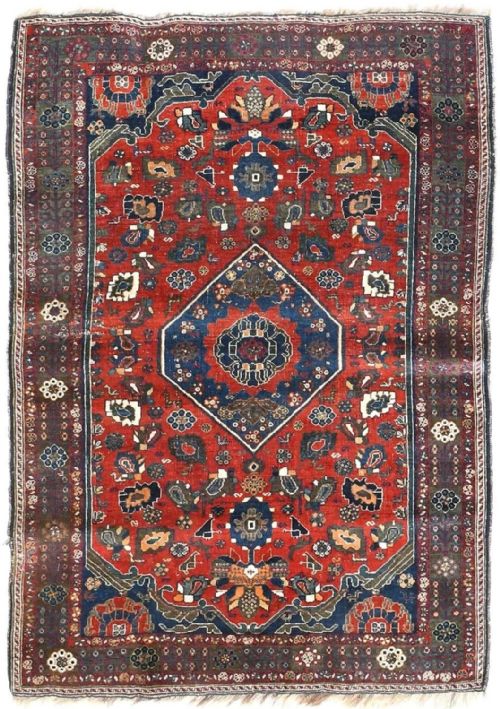
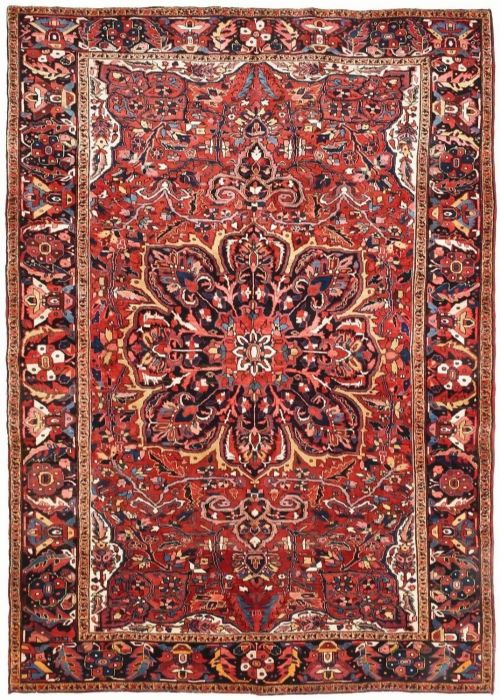


Large Heriz Rug
A large heriz rug delivers geometric punch and monumental scale, anchoring a room with the bold patterns woven in north-west Persia.
Large Heriz Rug
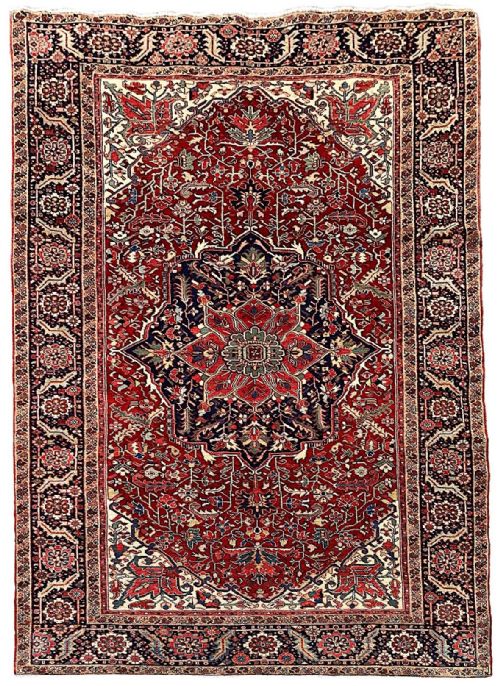
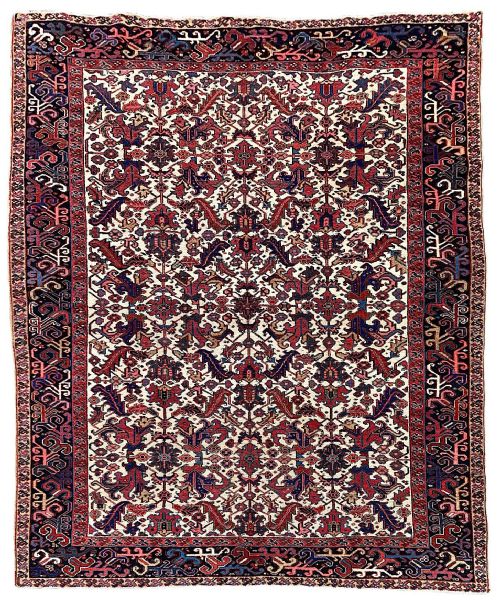
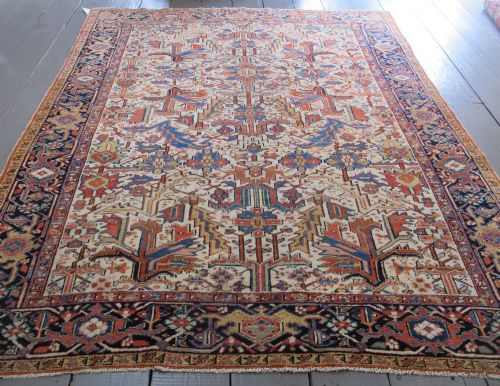
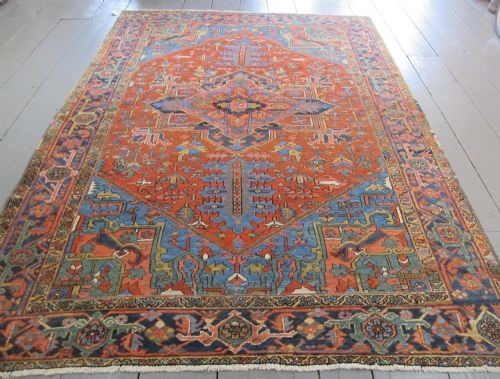
A large heriz rug represents a grand tradition of floor coverings originating from the mountainous region of north-west Persia. These pieces are principally encountered as room-sized carpets dating from the late nineteenth century through to the early decades of the twentieth century.
The aesthetic is characterised by robust, stylised medallions and firm rectilinear geometry rather than the flowing curves seen in urban Persian weaving. Buyers searching for a large heriz rug will find formats designed for substantial spaces, often displaying distinctive corner spandrels and a strong central motif.
Materials and construction
Weavers constructed these carpets using durable wool for the pile, chosen to withstand heavy domestic use while holding rich vegetable dyes. The foundation relies on strong cotton warps and wefts, which allow the dense, heavy structure to lie flat upon the floor.
The knotting technique is symmetrical, tied firmly onto cotton foundations to produce a resilient and rigid fabric. This specific method of construction accounts for the durability and the characteristic geometric crispness of the drawn patterns.
The listings span production dates from the mid-nineteenth century through to the 1930s, utilising durable wool pile on cotton foundations.
What separates the finer examples
Quality in these carpets rests upon the precision of the drawing and the clarity of the colour palette. Finer pieces demonstrate a sharper geometric articulation in the medallion and a more deliberate balance of secondary motifs across the field.
The handling of the wool and the vibrancy of the dye saturation further distinguish superior specimens from simpler village output. A well-preserved pile and intact original borders elevate a carpet within its category.
The Large Heriz Rug Glossary
- Medallion
- The large central ornamental design dominating the field of the carpet. It typically anchors the geometric symmetry of the composition.
- Spandrels
- The triangular corner patterns situated in the angles between the main border and the central field. They often repeat motifs found in the central medallion.
- Serapi
- A sub-type associated with the Heriz region, generally characterised by a more open design, finer knotting, and a softer palette. These pieces are often earlier in date.
- Bakshaish
- An adjacent weaving centre producing carpets with highly stylised, geometric interpretations of traditional floral designs. They display a primitive charm distinct from standard Heriz production.
- Warps
- The vertical threads running lengthwise through the loom that form the foundation of the rug. The fringe is typically a continuation of these structural threads.
Large Heriz Rug: Frequently Asked Questions
Where were these carpets made?
These carpets originate from the Heriz region and surrounding villages in north-west Persia. The local topography and access to specific mountain wools influenced the sturdy character of the weaving.
Production centred on domestic workshops and village looms, where traditional designs were passed down through generations.
How do I care for an old rug?
Place the carpet in a low-traffic area or use a quality underlay to prevent shifting and wear. Regular gentle vacuuming without a beater bar keeps dust from settling into the wool pile.
Rotate the piece periodically to ensure even exposure to foot traffic and sunlight. Professional cleaning should be undertaken sparingly by specialists experienced in antique textiles.
What is the difference between Heriz and Serapi?
Serapi carpets represent an earlier, finer group of regional weaving with a more spacious field design and subdued coloration. They often feature a less rigid geometric structure than standard later Heriz production.
Standard Heriz carpets tend to be slightly later in date, featuring denser patterns, bolder contrasts, and a heavier handle.
How do I date a large rug?
Dating relies on stylistic indicators such as the structure of the medallion, the breadth of the borders, and the complexity of the secondary ornaments. Natural dye variations and the overall handle of the wool provide further clues to the period.
Comparison with documented examples from the late nineteenth and early twentieth centuries helps narrow the decade of origin.