
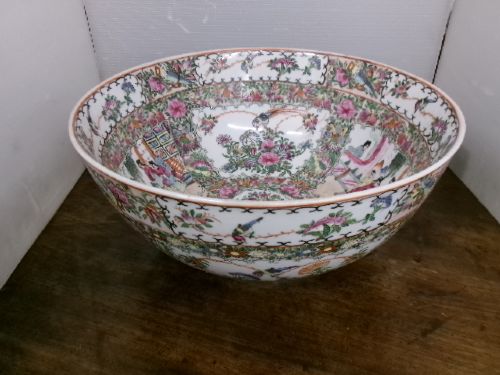

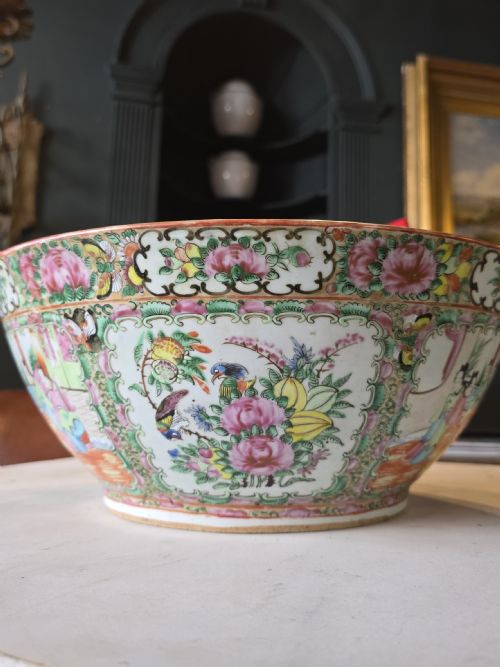


Large Famille Rose Bowl
A large famille rose bowl brings vibrant enamel decoration and generous proportions to a room, offering both decorative presence and historical utility.
Large Famille Rose Bowl
When you search for a large famille rose bowl, you are looking at substantial vessels designed for display or communal service. These objects typically manifest as decorative bowls, centre bowls, and punch bowls originating from Chinese export production.
The pieces appearing on this page span from the eighteenth century through to the nineteenth century, alongside mid-twentieth-century examples. You will frequently encounter forms described as Canton, Rose Medallion, and Chinese Export porcelain.
Vessels range from fifteen inches up to twenty inches in diameter, providing deep basins that showcase elaborate hand-painted motifs. Their primary function shifts between historical dining use and striking interior decoration.
How they were made
These bowls are constructed from hard-paste porcelain, formed into large circular basins and fired at high temperatures. The robust ceramic body provides a stable white canvas for subsequent decoration.
Artisans applied overglaze enamels in pink, green, and other vibrant colours, frequently incorporating gold leaf, gilt, and gilding to accentuate key elements of the design. Hand-painted brushwork defines the complex pictorial scenes and floral borders characteristic of the palette.
Some nineteenth-century bowls stretch up to twenty inches wide, demanding serious table space and considerable caution when carrying punch.
What varies in quality
Quality in these pieces is dictated by the precision and density of the hand-painted brushwork across the surface. Finer examples display meticulous detail in figures, foliage, and geometric borders without the crowding or stiffness seen in simpler commercial work.
The richness and preservation of the overglaze enamels and gilding also differentiate the grade of a bowl. Superior pieces retain bright, intact colouration and carefully applied gold leaf that enhances the overall composition.
Samson
The Large Famille Rose Bowl Glossary
- Famille rose
- A palette of opaque overglaze enamels dominated by pink or rose colours, introduced in Chinese porcelain production during the Qing Dynasty. This style allowed for nuanced shading and detailed pictorial representation.
- Canton
- A style of Chinese export porcelain decorated in the port of Guangzhou, typically featuring dense panels of figures, birds, and flowers. It is synonymous with nineteenth-century export wares.
- Rose medallion
- A specific pattern of Canton porcelain divided into alternating or adjoining panels containing figures and natural motifs, usually surrounding a central medallion. These designs cover the interior and exterior surfaces of large bowls.
- Punch bowl
- A large, deep vessel originally utilised for mixing and serving communal punch during social gatherings. Their generous capacity made them central pieces on dining tables.
- Overglaze enamel
- Pigments applied to a previously fired and glazed porcelain surface, which are then fixed in a secondary, lower-temperature kiln firing. This technique permits a wide spectrum of vibrant colours.
- Gilding
- The application of gold leaf or powdered gold to the surface of porcelain to highlight rims, handles, or decorative borders. It adds a layer of reflective contrast to the polychrome enamels.
Large Famille Rose Bowl: Frequently Asked Questions
What were large famille rose bowls used for?
These large bowls served primarily as punch bowls for communal drinking during banquets and social gatherings, holding mixed beverages for guests.
Over time, many transitioned into decorative centrepieces on large tables or sideboards, valued for their colourful visual impact.
How do I tell an eighteenth-century bowl from a nineteenth-century one?
Eighteenth-century pieces typically exhibit finer, more restrained enamel work and thinner porcelain bodies associated with earlier export periods.
Nineteenth-century examples, particularly Canton and Rose medallion wares, often feature denser, more colourful panel decoration and heavier porcelain construction.
Where were these bowls made?
They were produced in China, specifically for the export market, combining traditional Chinese ceramic manufacturing with decorative styles tailored for Western tastes.
Decoration often took place in workshops around Guangzhou, historically known to Europeans as Canton, before shipment abroad.
How should I care for a large antique porcelain bowl?
Keep the bowl away from direct sunlight and dramatic temperature fluctuations to protect the delicate overglaze enamels and gilding from degradation.
Clean only with a soft, dry cloth or gentle dusting, avoiding chemical cleaners or immersion in water to preserve the surface.